The radial interval is nonempty exactly when , or . Choose the representative angular range . The region of integration is thereforeIt is the right-hand cap inside the cardioid and outside the circle of radius , symmetric about the horizontal axis. Its boundary intersections have coordinates , and the cap reaches . The radial segment on the horizontal axis runs from to .
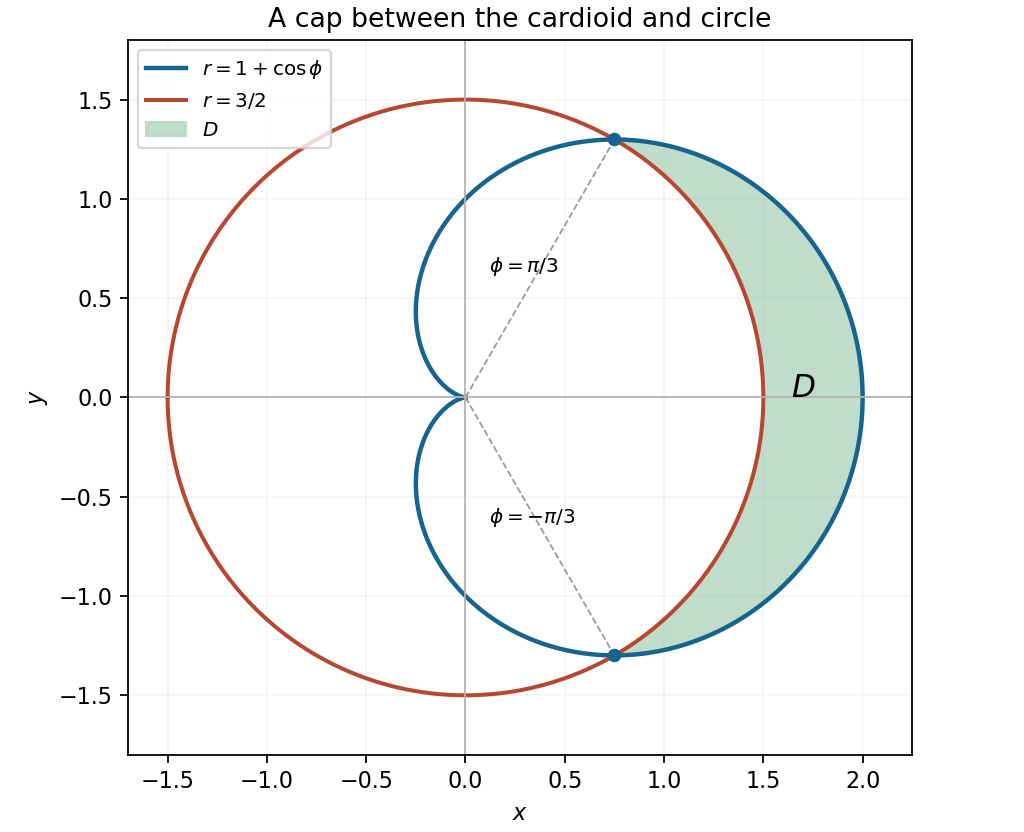

The polar area element is . Integrating first in radius and using symmetry givesThis is the specialization , of the polar cap between a cardioid and a circle area formula.
Substitute , and include the Jacobian determinant factor . The integrand times the area element becomesBoth terms containing one factor are odd in , while the radial bounds and angular interval are even. They therefore integrate to zero. The remaining double integral isThe domain stays away from , so the denominator of the original integrand causes no singularity in this region.
Translate the variables by , , . The numerator becomes . The part odd in integrates to zero, while the constant part factors into three Gaussian integrals. ThusThe absolute integrability of a polynomial times a Gaussian justifies this separation by Fubini's theorem. Neither nor affects the result; when , odd symmetry makes the integral zero.
Articles by others on the same topic
There are currently no matching articles.