Write . Squaring the nonnegative complex modulus on each side givesThe linear terms cancel, leaving . Therefore the locus isIts real and imaginary axis intersections are and .
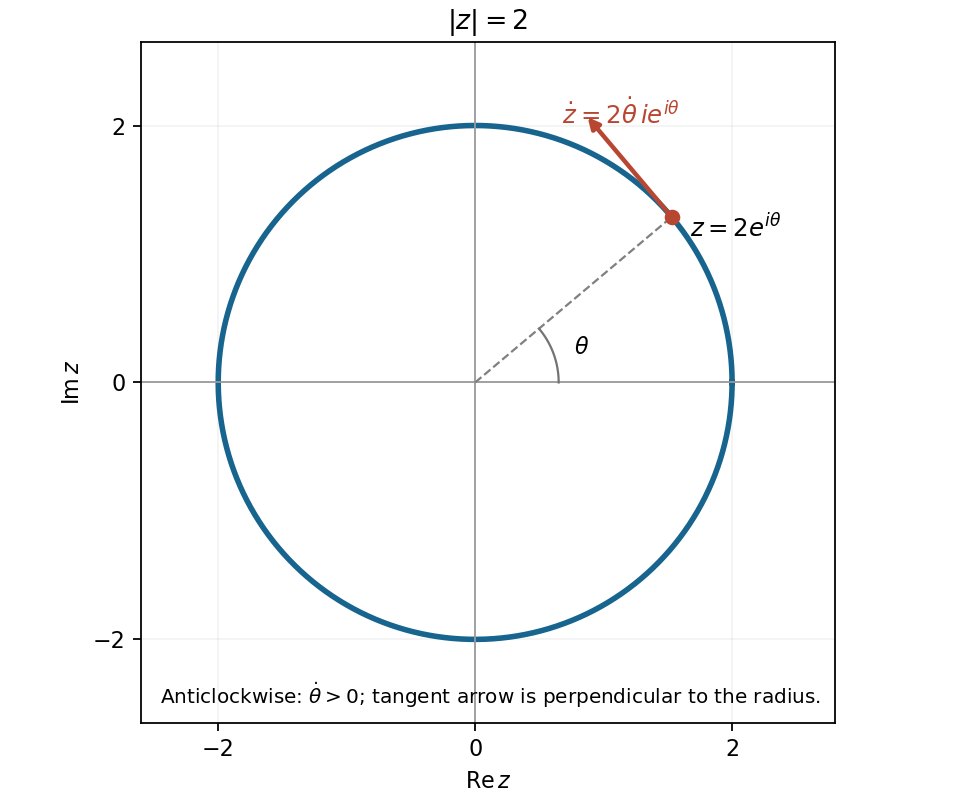

On this circle the radial coordinate is constant, , so . The velocity is a tangent vector to the circle in the anticlockwise direction, represented by when . Substituting into part (b),The inward component is the centripetal acceleration; the transverse component allows the speed to change. Anticlockwise motion does not imply uniform speed or . The preceding figure includes the required tangent arrow.
The perpendicular unit vectors represented by and point radially outwards and transversely in the increasing-angle direction. Reading off their real coefficients in part (b) gives the signed componentsThese are velocity in polar coordinates and acceleration in polar coordinates. In particular is a transverse speed component; alone is an angular velocity. The moving basis, rather than any extra force assumption, accounts for the additional acceleration terms. At the origin the polar directions themselves are undefined, although the Cartesian velocity and acceleration can remain well defined.
Articles by others on the same topic
There are currently no matching articles.