Condition throughout on the given arrival time of A, with . A departs at time . B also departs at exactly when it arrives before that release, so , or . Since is uniform on an interval of length ,The original timeline below shows the three disjoint ranges of . The same idealized simultaneous-release convention as in part (a) is used.
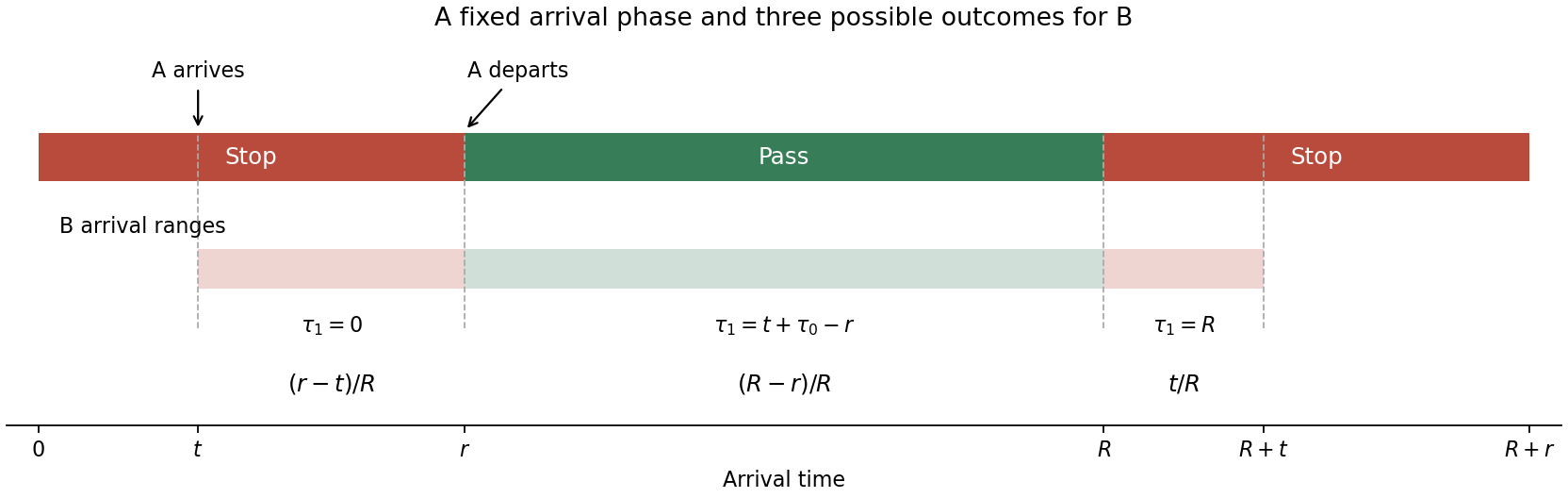
Conditional arrival ranges for the following vehicle at a fixed arrival phase of the leading vehicle
. Details. 
If B arrives during the remaining pass phase, then , or . It passes immediately, soBecause , this is strictly between zero and . The phase interval has length , giving
The remaining arrivals occur in the next stop phase: , or . B waits until , while A departed at , giving . This interval has length , henceEndpoint assignments do not affect probabilities. The three outcomes are exhaustive and satisfyThese are conditional probabilities for the stated fixed ; there is no additional averaging over A's arrival phase in the question.
Articles by others on the same topic
There are currently no matching articles.