The field is not a conservative vector field: either nonzero closed line integral computed below rules out a scalar potential. Equivalently, its planar curl is .
For , integrating gives . Matching then gives . ThusThis also explains why both closed line integrals of vanish.
Starting at , traverse the right, top, left and bottom sides in that order. For , the differential expression is . The four line integral contributions are respectively , so the total is two.
For , the expression is . The right side contributes , and the top side contributes ; the other sides contribute zero. Therefore
Parametrize the circle by , . Its tangent is , so the dot product is one. For the other field,Integrating around the full circle gives
Substituting the endpoint parameter values givesThe curve lies on the unit circular cylinder . Its azimuth increases from zero to while its height increases linearly, so it is one quarter-turn of a rising helix. The arrow in the sketch indicates increasing parameter.
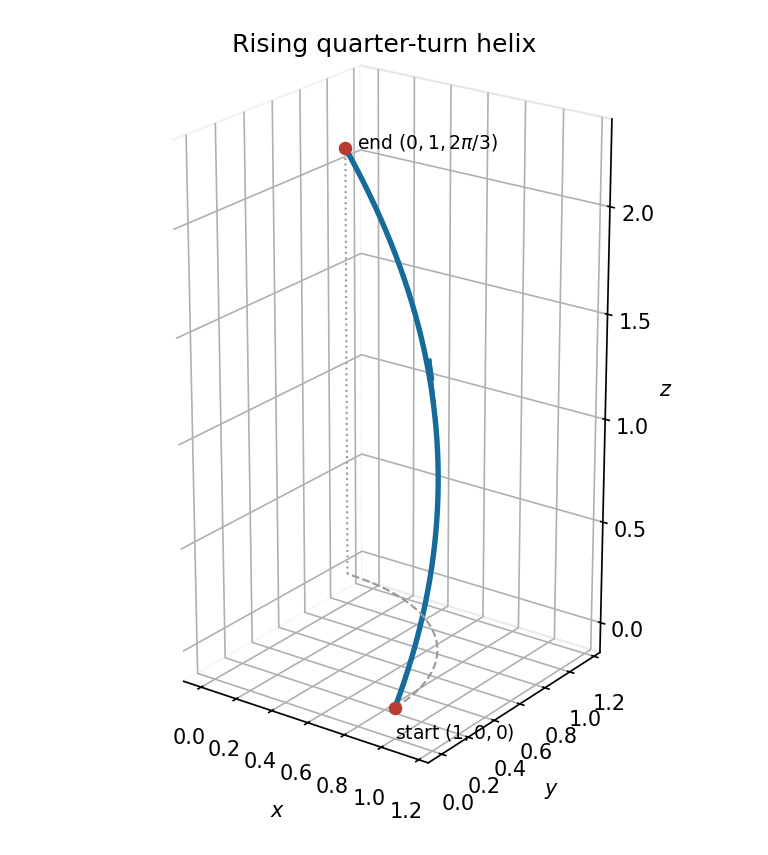

The arc length factor is the norm of the tangent:Hence and . The scalar line integral is thereforeThis uses scalar arc length, rather than the oriented displacement used in the vector line integrals of part (a).
Articles by others on the same topic
There are currently no matching articles.