For a continuous random variable, the probability density integrates to the probability of an interval:Individual endpoints have zero probability, so strict or non-strict inequalities give the same answer.
Subtracting the constant translates the event without changing its probability. ThereforeThis is a translation of the interval in the probability distribution of .
Apply the preceding interval formula on a short interval and use the change of variables :Comparison with the defining integral for a probability density givesAt continuity points, this can also be read as .
The independence of random variables means that fixing leaves the conditional probability density of equal to . Given that value of , is the translate . HenceAt a continuity point of , the expression is . Since , this conditioning uses a conditional probability density, rather than division by the probability of the single event .
Use the law of total probability to average the conditional interval probability over :The integrands are nonnegative, so Tonelli's theorem permits interchanging the integrals. ThusReading off the probability density gives the convolution of probability densities:
A uniform distribution has constant probability density on its interval, and the integral of that density must be one. The interval has length one, soChanging either endpoint value has no effect on the probability distribution.
Insert the two densities into the convolution of probability densities:Using the antiderivative with respect to givesThis is the convolution of a Cauchy distribution and a uniform distribution with half-width .
The probability density is an even function. Its derivative simplifies toIt increases for and decreases for , with maximum height . Thus the most probable value, or mode, is . The original sketch shows the symmetric, slightly flattened peak and long tails.
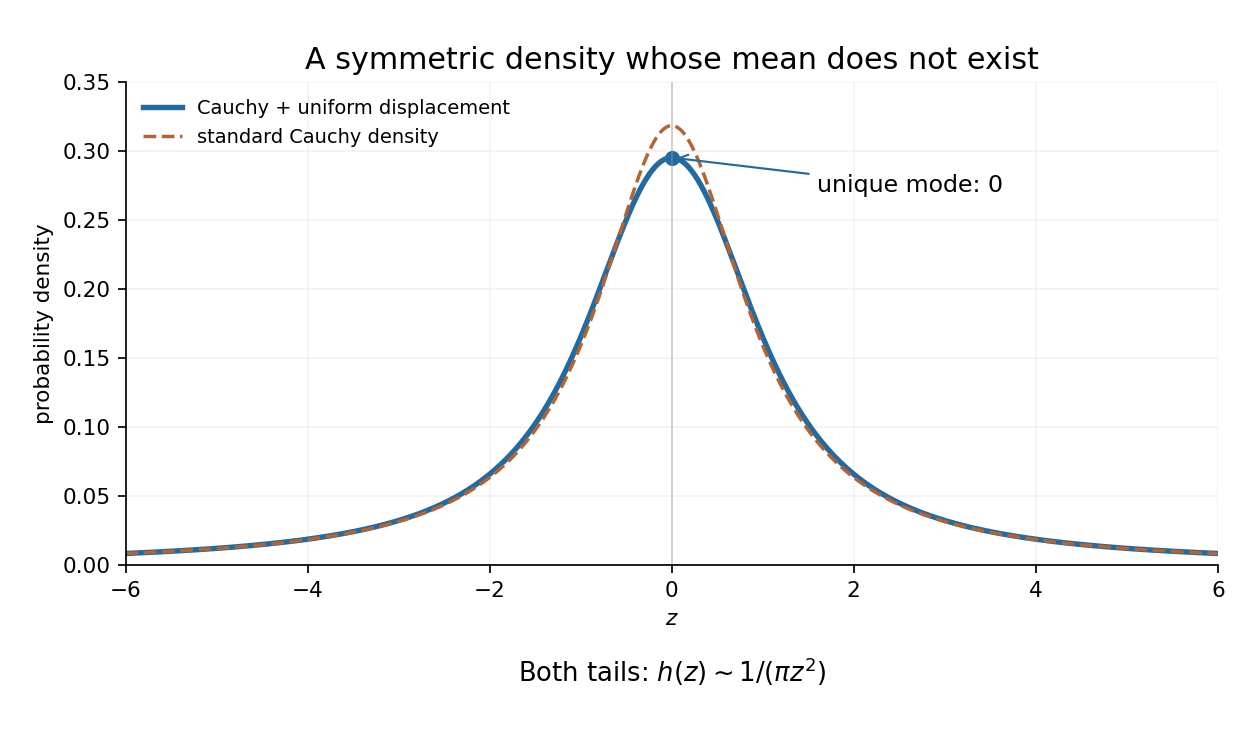

There is a genuine qualification to the request for a mean: the mean does not exist. The integral representation shows that as , soThe two divergent integrals cannot be subtracted to define an expected value. Symmetry does give the Cauchy principal value , but that is not the mean. Equivalently, adding the bounded variable cannot make the first absolute moment of a Cauchy distribution finite.
Articles by others on the same topic
There are currently no matching articles.