Multiply numerator and denominator by the complex conjugate :Thus the real part and imaginary part are
Powers of the imaginary unit repeat in blocks , each with sum zero. The first terms comprise eleven complete blocks; the last is . Applying Euler's formula to the resulting complex exponential gives . HenceThe angles here are in radians.
The exponential definitions of hyperbolic sine and hyperbolic cosine, together with Euler's formula, give and . The argument of the complex logarithm therefore reduces to .
Using the principal logarithm, , soIf no branch of the complex logarithm is selected, its complete set of values is , . The real part remains zero, while the imaginary part is . The original paper does not explicitly state a branch convention.
The literal expression in the original PDF is undefined. Indeed, hyperbolic tangent satisfies , andAlready the summand contains , a pole. The shifted term has the same issue when . Thus this is not a finite sum of defined complex numbers, and it has no literal real or imaginary part. Cancelling two undefined terms is not ordinary arithmetic.
There is nevertheless a natural interpretation by meromorphic telescoping cancellation. Insert the same small positive real shift into every hyperbolic tangent argument. Each term is then finite, and the telescoping sum isSince hyperbolic tangent has period , its first argument can be reduced to . Taking the limit givesThis is a common-shift continuation of the sum, plausibly the intended telescoping answer. It requires that additional convention; it is not the value of the expression as printed.
Write . Then and , so the condition fixes the sum of distances from and . It is an ellipse with centre , vertical semimajor axis , and focal distance . Its horizontal semiminor axis obeys . Thus the locus isThe vertices are and ; the horizontal extremities are . The complex conjugation places the second focus above the origin.
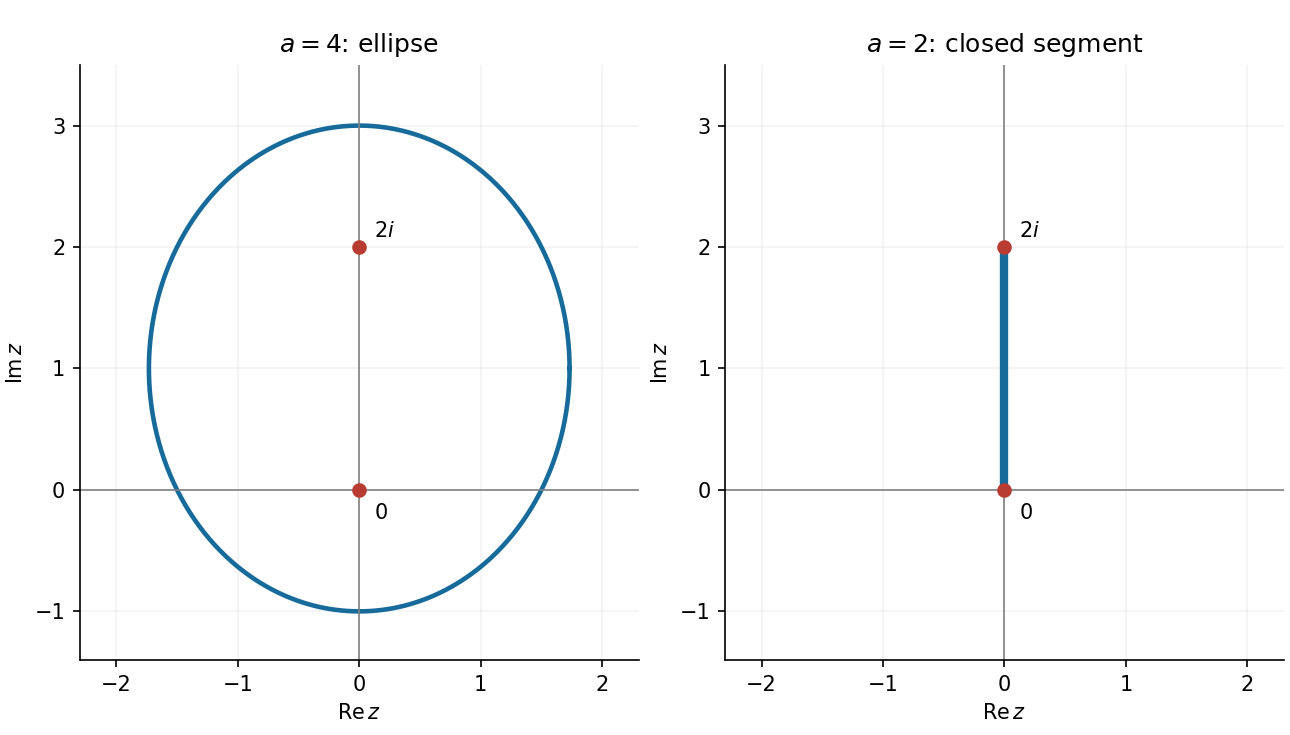

The triangle inequality bounds the distance sum below by the separation of the two foci, which is two. Equality holds exactly for points on the closed segment joining them. Hence the locus isBoth endpoints are included. It is the segment on the positive imaginary axis shown in the right-hand panel above.
Articles by others on the same topic
There are currently no matching articles.