Use Green's second identity in the source coordinate:Take and , the fundamental solution of the Laplace equation satisfying . With localized charge and the decaying potential, the boundary integral tends to zero on expanding spheres. The volume identity then gives , hence the Coulomb potentialConvergence of this integral and a condition fixing the potential at infinity are needed: mere pointwise decay of is not enough, and a harmonic function could otherwise be added. A bounded, compactly supported charge distribution is a sufficient setting for this derivation.
For the disk put . On its axis, every ring of radius is at distance , soFor subtract ; for add . This is the electrostatic potential of a uniformly charged disk with zero potential at infinity. The absolute value is essential for reflection symmetry and the correct behavior on the lower axis.
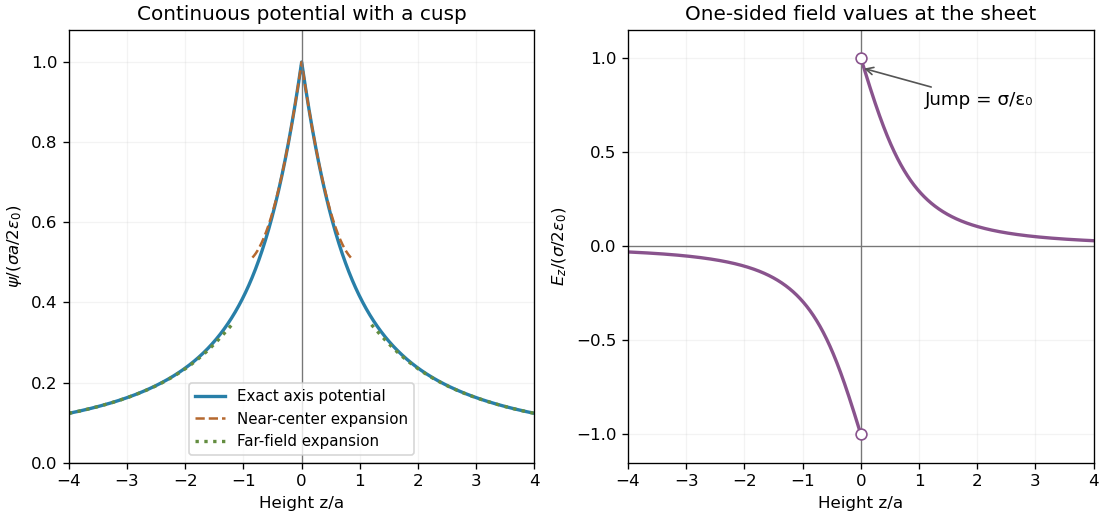

Write . The Taylor expansion gives the near-axis resultTo extend off the axis, work separately above and below the charged plane. In either source-free half-space the regular axisymmetric solid harmonics are . Matching the positive-axis coefficients, using , and then reflecting in the disk givesHere is a Legendre polynomial. The quadratic term is . The linear term is above and below; it represents the discontinuity of the normal electric field. A single regular spherical expansion across the entire charged sheet would incorrectly remove that jump.
For large , expand in to obtainThe axisymmetric exterior multipole expansion replaces each on the positive axis by . Reflection symmetry eliminates the odd multipoles, soThe leading term is the potential of total charge concentrated at the center; the next is its electric quadrupole correction. On either axis , recovering the same even axis potential.
Articles by others on the same topic
There are currently no matching articles.