For a separated harmonic function in polar coordinates, single-valuedness forces integer angular frequencies. The radial factors for frequency are , while frequency zero has a constant and . Finiteness at the origin excludes and .
The source's angular factor is in every term, as printed, rather than . The power-law angular mode for the planar Poisson equation givesHence, assuming the series permits termwise differentiation, the general finite, single-valued solution isThe arbitrary harmonic series must itself converge to a finite function on the prescribed disk. If , the source has a direction-dependent limit at the origin; the displayed potential still extends finitely there, but the equation at that point is understood weakly rather than as a smooth classical source.
For the special source, a particular potential is . Its boundary cosine term is canceled by , and the boundary sine term is supplied by . The resulting Dirichlet boundary conditions has solutionIt is finite at zero, has the required boundary values, and its Laplacian is .
The far radial derivative selects the growing frequency-one term . The matching decaying harmonic is . The no-penetration condition gives at , so . Thus the potential flow around a circular cylinder isThe remaining single-valued exterior harmonics are excluded by the zero radial derivative at the cylinder and the prescribed derivative at infinity, apart from the arbitrary additive constant. In particular the logarithmic radial term would have a nonzero radial derivative on the cylinder. A circulation term proportional to is excluded by single-valuedness of the potential.
Use Green's second identity in the source coordinate:Take and , the fundamental solution of the Laplace equation satisfying . With localized charge and the decaying potential, the boundary integral tends to zero on expanding spheres. The volume identity then gives , hence the Coulomb potentialConvergence of this integral and a condition fixing the potential at infinity are needed: mere pointwise decay of is not enough, and a harmonic function could otherwise be added. A bounded, compactly supported charge distribution is a sufficient setting for this derivation.
For the disk put . On its axis, every ring of radius is at distance , soFor subtract ; for add . This is the electrostatic potential of a uniformly charged disk with zero potential at infinity. The absolute value is essential for reflection symmetry and the correct behavior on the lower axis.
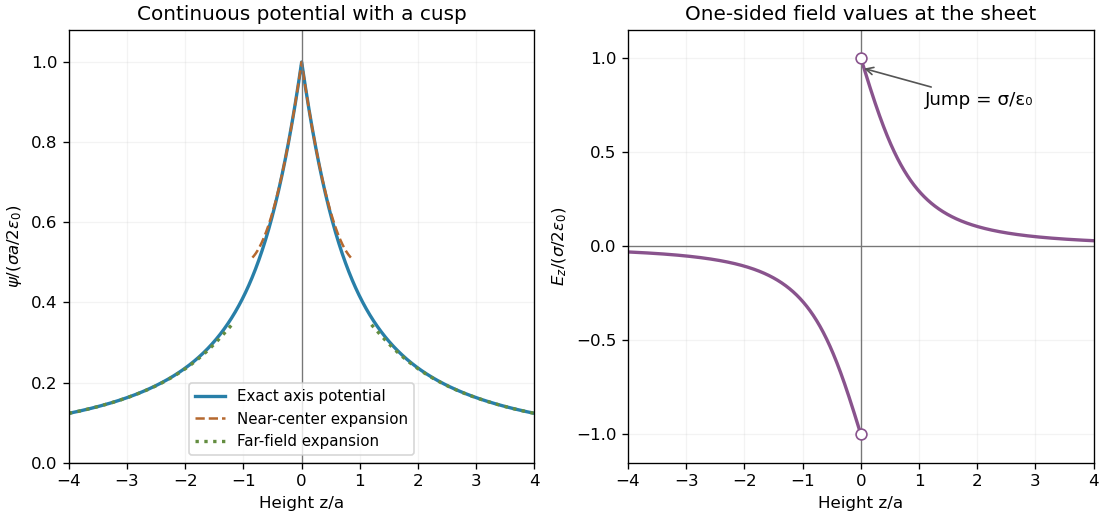

Write . The Taylor expansion gives the near-axis resultTo extend off the axis, work separately above and below the charged plane. In either source-free half-space the regular axisymmetric solid harmonics are . Matching the positive-axis coefficients, using , and then reflecting in the disk givesHere is a Legendre polynomial. The quadratic term is . The linear term is above and below; it represents the discontinuity of the normal electric field. A single regular spherical expansion across the entire charged sheet would incorrectly remove that jump.
For large , expand in to obtainThe axisymmetric exterior multipole expansion replaces each on the positive axis by . Reflection symmetry eliminates the odd multipoles, soThe leading term is the potential of total charge concentrated at the center; the next is its electric quadrupole correction. On either axis , recovering the same even axis potential.
For a complex derivative to exist, the difference quotient must agree along real and imaginary increments. These give and , respectively. Equating their real and imaginary parts gives the Cauchy-Riemann equationsFor , the components are and . The first equation requires , so ; the second requires , so . Thus zero is the only possible differentiability point. Directly,so . The function is differentiable at that isolated point but is not holomorphic on any neighborhood of it.
Use the chain rule with , . Then and . Substituting the Cartesian Cauchy-Riemann equations gives . Similarly . Thus, for , the polar equations areThe restriction is needed because the polar chart degenerates at the origin.
On the unit circle use with . The specified branch has there and . ThereforeThis is the circle integral of a logarithm with a radial branch cut, using the one-sided values at the cut crossing. The logarithm is discontinuous at that crossing, so the Cauchy integral theorem for a function holomorphic around a closed contour does not apply.
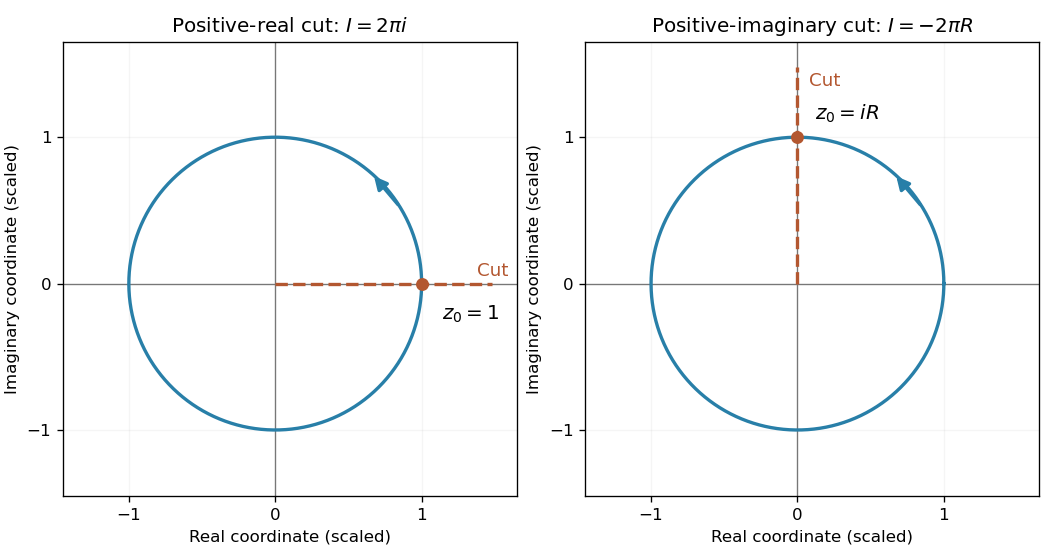

Choose the argument interval , which makes the logarithm real on the positive real axis and puts its cut on the positive imaginary axis. Parametrize . The constant term contributes , leavingEquivalently the cut-crossing point is , so the circle integral of a logarithm with a radial branch cut is . The different cut changes where the discontinuity lies on the circle; it is not merely an additive constant change of branch along the entire contour.
The residue theorem states that a positively oriented simple closed contour enclosing isolated poles and none on the contour has integral times the sum of their residues, provided the function is holomorphic elsewhere inside. Near a simple zero of , . HenceFor , this gives for every integer .
To evaluate the real integral, integrate around an upper semicircle, with a small upper semicircular indentation excluding zero. Use the branch real on the positive axis and with argument between zero and in the upper half-plane. The large arc tends to zero as and the small arc as . The only enclosed pole is , whose contribution isOn the negative real axis the upper boundary value is . The two real segments therefore contributeComparing real parts yieldsThe integral is absolutely convergent at both zero and infinity, so no principal-value interpretation is needed.
For causal functions the convolution is . In a half-plane of absolute convergence, changing variables in its Laplace transform and using Fubini's theorem givesThis proves the convolution theorem for Laplace transforms. Transforming the differential equation gives . The direct transform pairs and then giveFor a continuous forcing, call the last term . The Leibniz integral rule gives and . Also . Thus both the original equation and the initial values hold.
For an impulse at positive time , the Dirac delta evaluates the convolution, yieldingHere is the Heaviside step function. The displacement remains continuous at , while its derivative jumps upward by one, exactly as required by integrating the differential equation across the unit impulse.
An isotropic tensor has unchanged components under every rotation of the Cartesian axes. Under proper rotations in three dimensions, rank one has no nonzero isotropic tensor, rank two has , and rank three has . Here is the Kronecker delta and the Levi-Civita symbol. If invariance under reflections is also required for a true tensor, the rank-three case vanishes; is then a pseudotensor.
The velocity gradient tensor for the given field isIts symmetric part, the strain-rate tensor if is interpreted as a velocity, isThe antisymmetric part has the specified ordering , withThe index ordering matters for this sign; it agrees with a local rotation velocity . This is the axial part of the scalar, symmetric-traceless and axial tensor decomposition, retaining the trace inside the symmetric part here.
At the specified point, . The upper block has characteristic polynomial . Thus the principal values and unit eigenvectors areThese mutually orthogonal directions are the principal strain rates' axes for this local field; reversing an eigenvector does not change its axis.
A normal mode has all coordinates following one fixed displacement pattern with a common time factor. Its normal frequency is that factor's oscillation frequency; normal mode coordinates are amplitudes in a basis of such patterns, making the linear equations independent. A zero-frequency mode can instead have constant velocity along a symmetry direction.
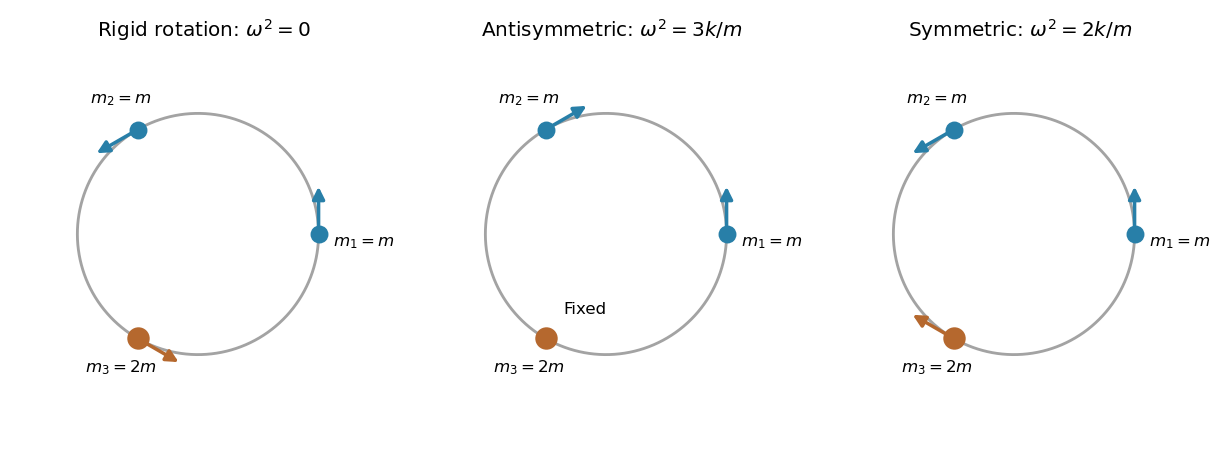
For the unit circle, each angular displacement equals its corresponding arc displacement. The kinetic energy and change in potential energy areAny common spring prestress changes only the constant , because the sum of the three arc lengths is fixed. The Euler-Lagrange equations giveThese are the normal modes of three beads connected by springs on a circular hoop, with third mass . For , their three mode vectors and squared angular frequencies areThe zero mode rotates the entire configuration without stretching a spring. The antisymmetric mode moves the equal masses oppositely while leaving the third fixed. In the symmetric mode the equal masses move together against the third, with zero total angular momentum. These vectors are orthogonal in the mass inner product with matrix .
Writing gives independent equations , , . In particular , retaining possible slow common rotation. For , the two positive frequencies coincide at ; their two-dimensional space is all patterns with .

A right coset of in is . Right multiplication by is a bijection , with inverse , so every right coset has elements. The analogous map proves the same assertion for left cosets.
Write the displayed matrices as . Direct multiplication givesAll new coordinates are integers, so the set is closed. Matrix multiplication is associative, the identity is , andwhich also has integer coordinates. Thus it is the Integer Heisenberg group.
The subset contains the identity, and multiplication and inversion add or negate , so it is a subgroup. Its right cosets areThey are exactly the sets with fixed integer coordinates , as described by cosets of a coordinate subgroup of the integer Heisenberg group. The factor order is essential; multiplying by on the other side would also change the upper-right coordinate by .
Let be a quarter-turn and a reflection of the square. The dihedral group is generated by with and , and its elements are . Two generators are minimal because this group is not cyclic. Its subgroups of order two are and for . Its subgroups of order four are , and .
A group homomorphism obeys for all elements; a group isomorphism is a bijective group homomorphism. Take the rotation subgroup and defineThe quaternion element has order four, so the map is well defined modulo four, preserves products and is injective onto . Surjectivity onto all eight quaternion elements is not required of a homomorphism.
A cyclic group is generated by the powers of one element. The final claim needs the usual qualification no nontrivial proper subgroup, and : the trivial subgroup is proper in every nontrivial group, even one of prime order. With that interpretation, if has prime order , Lagrange's theorem permits only subgroup orders one and . Conversely, if its order is composite, choose a divisor with . The subgroup has order , strictly between one and . This proves the assertion described by groups with no proper nontrivial subgroups.
A group representation is a homomorphism into invertible linear maps. It is a faithful representation when it is injective, equivalently when its kernel contains only the identity. A faithful real two-dimensional representation of the cyclic group of order four isThese are rotations of the plane through . Since and , their multiplication agrees with the group, and all four matrices are distinct.
For any invertible , set . Thenso this also is a group representation. The character of a representation is . For the displayed quarter-turn representation, its values on are .
The trace is invariant under a similarity transformation, by cyclicity of the trace:Hence equivalent representations have the same character of a representation.
If , the representation law gives . Trace invariance under this similarity transformation givesThus the character of a representation is constant on every conjugacy class.
Articles by others on the same topic
There are currently no matching articles.