For a complex derivative to exist, the difference quotient must agree along real and imaginary increments. These give and , respectively. Equating their real and imaginary parts gives the Cauchy-Riemann equationsFor , the components are and . The first equation requires , so ; the second requires , so . Thus zero is the only possible differentiability point. Directly,so . The function is differentiable at that isolated point but is not holomorphic on any neighborhood of it.
Use the chain rule with , . Then and . Substituting the Cartesian Cauchy-Riemann equations gives . Similarly . Thus, for , the polar equations areThe restriction is needed because the polar chart degenerates at the origin.
On the unit circle use with . The specified branch has there and . ThereforeThis is the circle integral of a logarithm with a radial branch cut, using the one-sided values at the cut crossing. The logarithm is discontinuous at that crossing, so the Cauchy integral theorem for a function holomorphic around a closed contour does not apply.
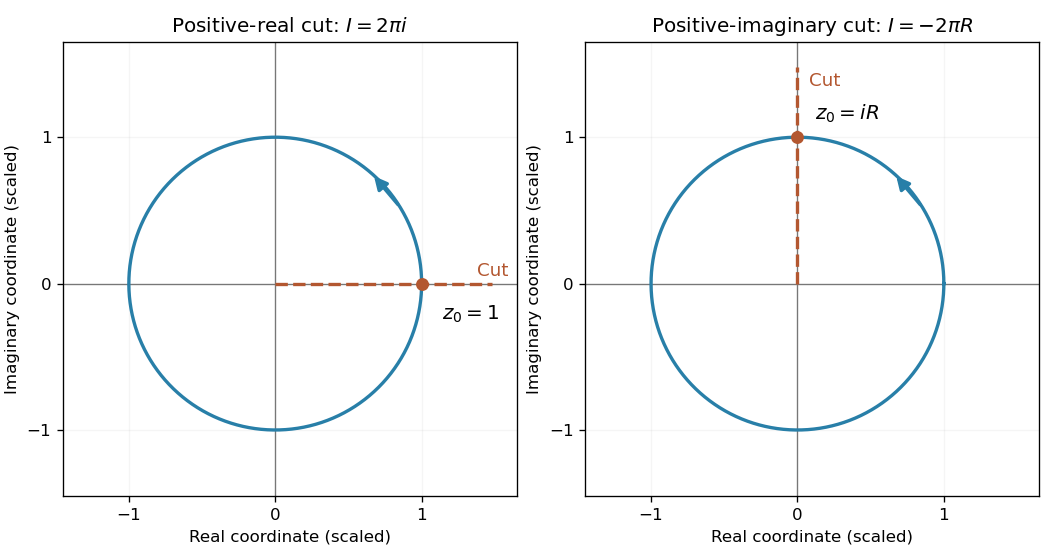

Choose the argument interval , which makes the logarithm real on the positive real axis and puts its cut on the positive imaginary axis. Parametrize . The constant term contributes , leavingEquivalently the cut-crossing point is , so the circle integral of a logarithm with a radial branch cut is . The different cut changes where the discontinuity lies on the circle; it is not merely an additive constant change of branch along the entire contour.
Articles by others on the same topic
There are currently no matching articles.