On the sphere, constant gives a latitude circle of radius and height . Constant gives a meridian semicircle in a vertical plane through the axis. The orthonormal basis of spherical coordinates isHere points outward, along increasing polar angle, and along increasing azimuth. At either pole the radial unit vector is unambiguous, but the two tangential coordinate vectors depend on the undefined longitude. The figure shows their directions away from the poles.
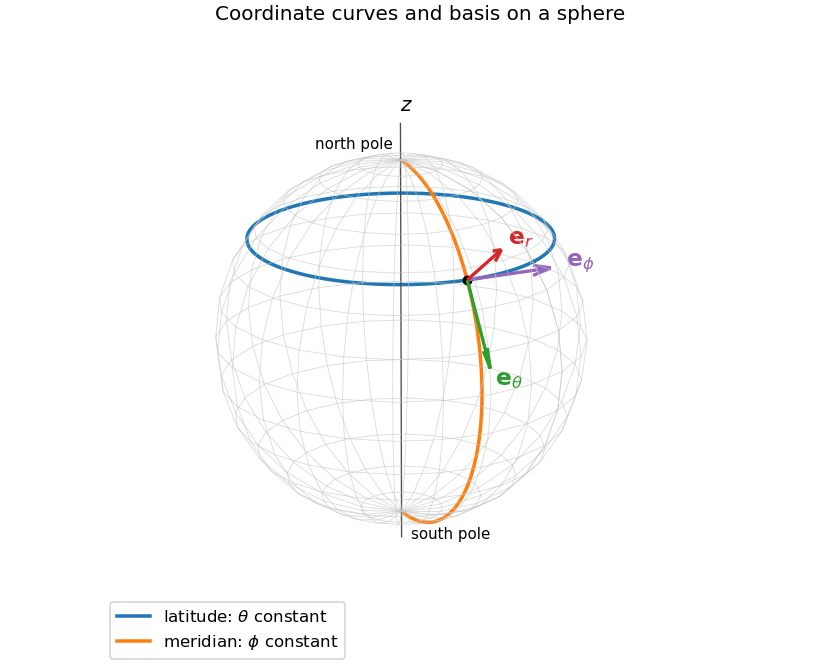

This coordinate ambiguity does not make a vector field singular if its tangential coefficient vanishes suitably. In Cartesian coordinates,The first is smooth at the north pole and zero there; the second is smooth and zero at the south pole. Their actual singular axes are the opposite ones. These are the regular patches of a two-patch vector potential for a radial monopole.
Along the circle with increasing , the line element is . Thus the two circulations areThe half-angle identities simplify them toHere so both potentials are defined on the whole curve.
For an axisymmetric azimuthal vector field, the curl in spherical coordinates has componentsThe angular expressions are and , each with derivative . Also is independent of , so the second component vanishes. Consequently, on each potential's regular patch,
The outward area element is . ThereforeSplit the sphere into the northern cap and the southern cap . Their induced boundary orientations are and , respectively. The Stokes theorem applies to on the north and on the south. Adding their fluxes gives , agreeing with direct integration.
There is no contradiction with the flux of a globally smooth curl through a closed surface: neither potential is regular on the entire sphere. On their overlap they differ by , a local gauge transformation. The longitude is not a globally single-valued scalar, so that difference can have nonzero circulation around .
Articles by others on the same topic
There are currently no matching articles.