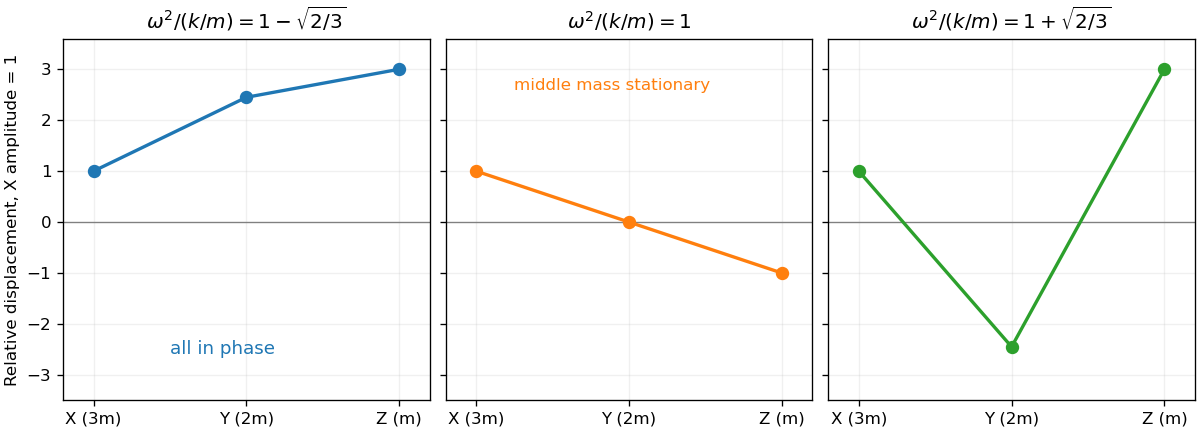
With downward position as the vertical coordinate, the full potential energy isThe equilibrium tensions are , and . On expanding, these relations cancel every term linear in the displacements, leaving . Newton's second law therefore givesFor a normal mode , set . The generalized eigenvalue problem isIts determinant is , so the angular frequencies and mode directions areThe square roots of these positive values give the requested frequencies. Only the lowest mode has all components of the same sign, so all three particles oscillate in phase at the lowest frequency. The mode shapes are shown below.

Articles by others on the same topic
There are currently no matching articles.