Use the weighted inner product with positive weight . For a self-adjoint operator and nonzero eigenfunction , self-adjointness gives . The positive norm therefore forces to be real. For two eigenfunctions of distinct eigenvalues, the same calculation gives , proving their orthogonality.
The Chebyshev differential equation takes the Sturm-Liouville formIts operator is , so as required. For , direct substitution gives . Comparing coefficients yieldsExplicitly, using ,The endpoints are singular because vanishes and diverges there. The polynomial solutions use the natural condition at each end; under these are the Neumann eigenfunctions of the Chebyshev differential operator, proportional to . They differ from the zero-value endpoint realization of the same differential expression.
Let be the -periodic ramp represented by on . The Fourier series of a periodic sawtooth givesBoth boundary data are multiples of this odd function, so their angular means and cosine coefficients vanish. Consequently . Put . Matching the sine coefficients at the two radii gives and . Solving this two-by-two linear system yieldsEquivalently, two-boundary annular harmonic interpolation expresses the same solution asEvery term is a harmonic function, and the radial factors enforce the specified boundary values. For a radius strictly between and , their geometric decay makes the series smooth. At the boundary discontinuity , the limiting Fourier value is the mean of the two one-sided values, zero. The boundary data are imposed away from that exceptional point, as stated.
Away from its source, a radial two-dimensional Green's function satisfies , so . The divergence theorem on a disk of radius around the source requires , hence and . Choosing the additive constant givesThe equality with the Dirac delta is distributional; away from the source the Laplacian vanishes.
For the wedge, use the finite image construction for a planar wedge. In complex coordinates , place three positive sources at and three negative sources at , . The positive source at is the actual charge. The five images are thereforeOn either grounded ray, reflection pairs each positive source with an equally distant negative source, so their logarithmic potentials cancel. All images lie outside the open physical wedge. Summing their contributions with coefficient gives the required potential. The figure shows the bisecting-source configuration.
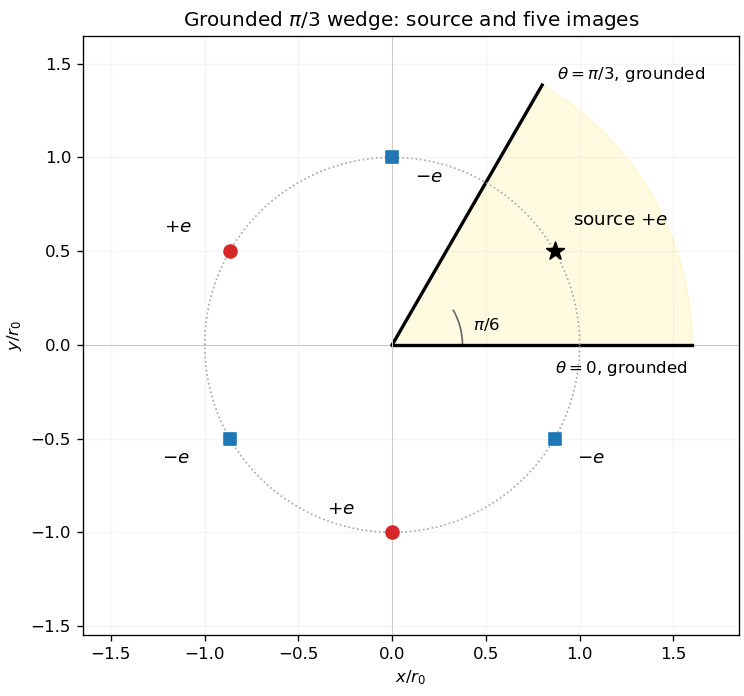

For , , the positive points are the three roots of and the negative points are the roots of . Thus the logarithmic sum isBoth boundaries have , verifying the zero potential directly. An arbitrary reference length inside the individual logarithms cancels because the six signed charges sum to zero.
For a simple pole, the residue is , the coefficient of its Laurent series. On an anticlockwise circle , integration of each Laurent term is zero except , whose integral is . This proves the stated single-pole residue theorem.
For , the only pole inside the rectangle of height is , with residue . The residue theorem therefore gives . The upper edge is traversed from right to left and satisfies , so the two horizontal contributions sum to .
On the right edge the modulus is bounded by , and on the left by . Multiplying by the fixed edge length shows that both contributions tend to zero because . ThusUsing yieldsThis rectangular contour for an exponential beta integral also gives the ordinary beta integral after the substitution .
Use . Jordan's lemma says that for , if a function has maximum modulus on upper semicircles, then ; a bound is . For use lower semicircles instead. The rational factors here meet this decay condition, so the residue theorem evaluates their inverse transforms.
For , only the upper half-plane contains a pole, at . Its residue after multiplication by is . The lower contour encloses no pole. ThereforeHere is the Heaviside step function, with midpoint value for symmetric Fourier inversion.
For , the upper-pole residue is when , while the clockwise lower contour gives the matching expression for . ThusThe final rational factor has double poles at . At the upper pole,The upper inverse integral is times that residue. The lower contour for negative supplies , and the value at zero is zero. Consequently
Under an orthogonal change of Cartesian coordinates with , a rank- Cartesian tensor transforms as , summing repeated indices. An isotropic tensor is invariant under every rotation. For an isotropic fourth-rank tensor, half-turns about the coordinate axes eliminate components unless each coordinate label occurs an even number of times. Coordinate rotations make the remaining two-pair patterns depend on three constants , , . Invariance after rotating the first axis to gives . HenceThis is a direct proof of the rank-four isotropic decomposition, without assuming any prior interchange symmetry of the four indices. Each displayed delta pairing is itself rotation invariant.
For symmetric strain, contraction gives . Comparing with the Lamé parameters yieldsWrite and , so . Since , the strain energy density becomesThe two terms describe volumetric and shear deformation, respectively. Thus nonnegative isotropic elastic strain energy is equivalent toNecessity also follows by taking a nonzero traceless strain and a pure dilation separately. The combination is the bulk modulus; strict inequalities give positive energy for every nonzero strain.
With downward position as the vertical coordinate, the full potential energy isThe equilibrium tensions are , and . On expanding, these relations cancel every term linear in the displacements, leaving . Newton's second law therefore givesFor a normal mode , set . The generalized eigenvalue problem isIts determinant is , so the angular frequencies and mode directions areThe square roots of these positive values give the requested frequencies. Only the lowest mode has all components of the same sign, so all three particles oscillate in phase at the lowest frequency. The mode shapes are shown below.
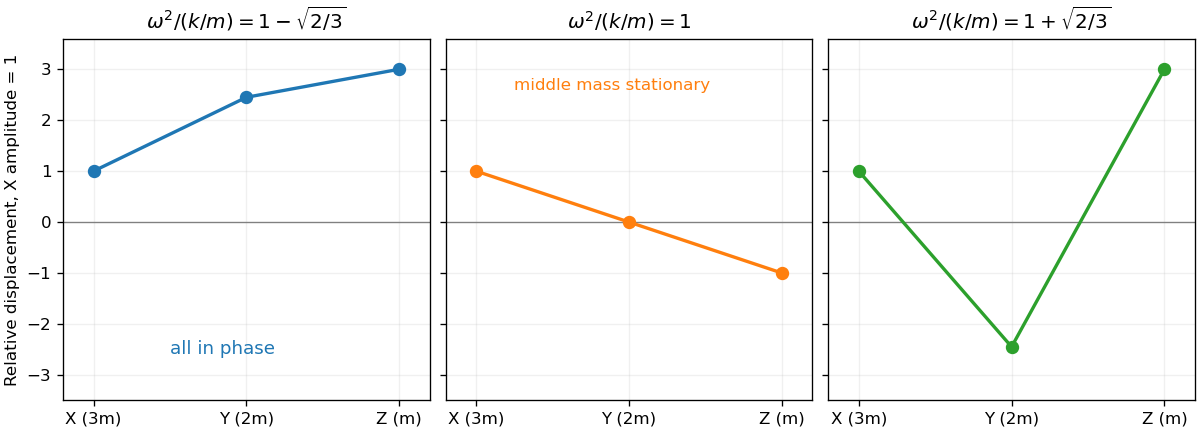
The three relative displacement patterns of the unequal-mass chain, from lowest to highest frequency
. Details. 
For release from rest with remaining at equilibrium, chooseThis excites only the middle-frequency mode, so for all time. It is a stationary middle mass in a three-mass spring chain: the equal and opposite adjacent spring forces cancel on .
If , then for both cosets equal . For , neither coset intersects : an intersection would imply . Both have elements, because multiplication by is a bijection. They therefore both equal , proving in this case too. This establishes that an index-two subgroup is normal.
For Lagrange's theorem, left cosets partition . Indeed if , then by multiplying by elements of ; otherwise the cosets are disjoint. Every coset has elements, so if there are cosets,The group order of thus divides the group order of . Normality is not needed for this divisibility statement.
The kernel of a group homomorphism is . It is a subgroup, since the identity maps to the identity and for . Alsoso . Applying the same inclusion with gives equality, proving that is a normal subgroup.
The map is well defined, multiplicative and injective, with image . Thus the first isomorphism theorem givesThe quotient is isomorphic to all of precisely when the original homomorphism is surjective.
For the general linear group, the determinant gives a homomorphism , since . Its kernel is the special linear group , so that subgroup is normal. Every nonzero real is the determinant of for , making the map surjective. Thereforewhere the operation on the right is multiplication.
Let . Since and , its powers define the representation of the cyclic group of order four:For the quaternion group, denote the three displayed complex matrices by . Direct multiplication gives , , , and . Together with the images of , these are exactly the quaternion multiplication relations, proving that the assignment defines a group homomorphism into .
Use the realification of a complex representation: for , define . It acts on grouped real and imaginary coordinates and satisfies . The explicit generators areSet and to specify all eight elements.
For an invertible real , the equivalent representation obeys . The trace is invariant under similarity, so their characters agree. Explicitly,
Articles by others on the same topic
There are currently no matching articles.