For a twice continuously differentiable vector field in Cartesian coordinates, the curl and divergence arePut . Using the Levi-Civita symbol, the Kronecker delta contraction and the product rule,The last term vanishes because the divergence of a curl is zero: the symmetric mixed derivatives contract against an antisymmetric symbol. Thus the curl of a cross product identity becomes
For orthogonal coordinates with position vector , the scale factors of orthogonal coordinates and local unit vectors areOrthogonality gives , and right-handedness fixes . In cylindrical coordinates, , soThe radial vector points away from the axis; the azimuthal vector is tangent in the direction of increasing ; is the Cartesian positive direction. The azimuthal basis is undefined on the coordinate axis itself.
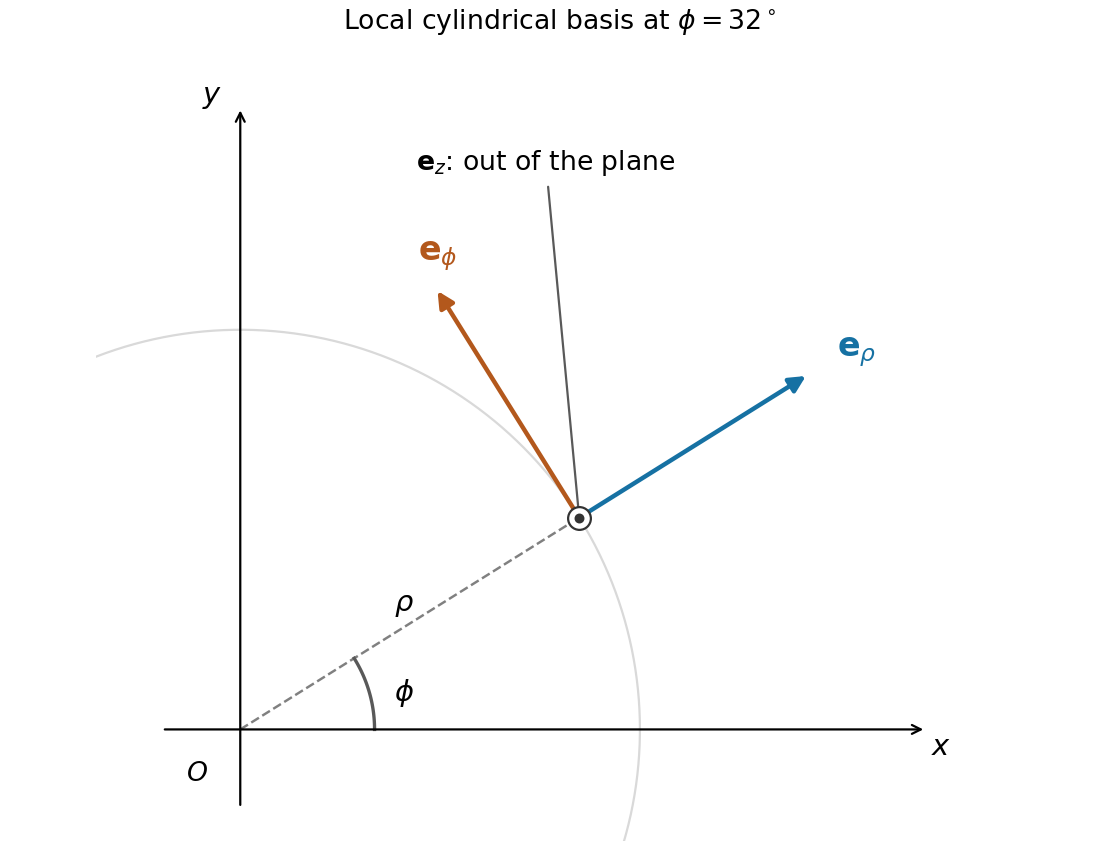
Cylindrical unit vectors relative to Cartesian axes, viewed from positive z
. Details. 
For the axial velocity profile, the cylindrical coordinates formula givesThe associated cross product isThis field has only a radial component depending on , so its curl is zero. Also . The identity above therefore yieldsIn fact both directional derivatives vanish: the first differentiates only in the azimuthal direction, and the second differentiates only in the direction. All physical vector fields extend smoothly through , despite the coordinate-basis singularity.
Articles by others on the same topic
There are currently no matching articles.