The kinetic energy is . Differentiating the quadratic potential energy gives the equations for small oscillations,Put and . The eigenvalue problem is . Its characteristic polynomial isThus a convenient set of normal modes isEach shape can be multiplied by an arbitrary sinusoidal time amplitude. In the lowest mode all beads move in phase. In the middle mode the central bead is fixed and the outer beads move oppositely. In the highest mode the two outer beads move together against the centre. These vectors are mutually orthogonal and span the three displacement coordinates.
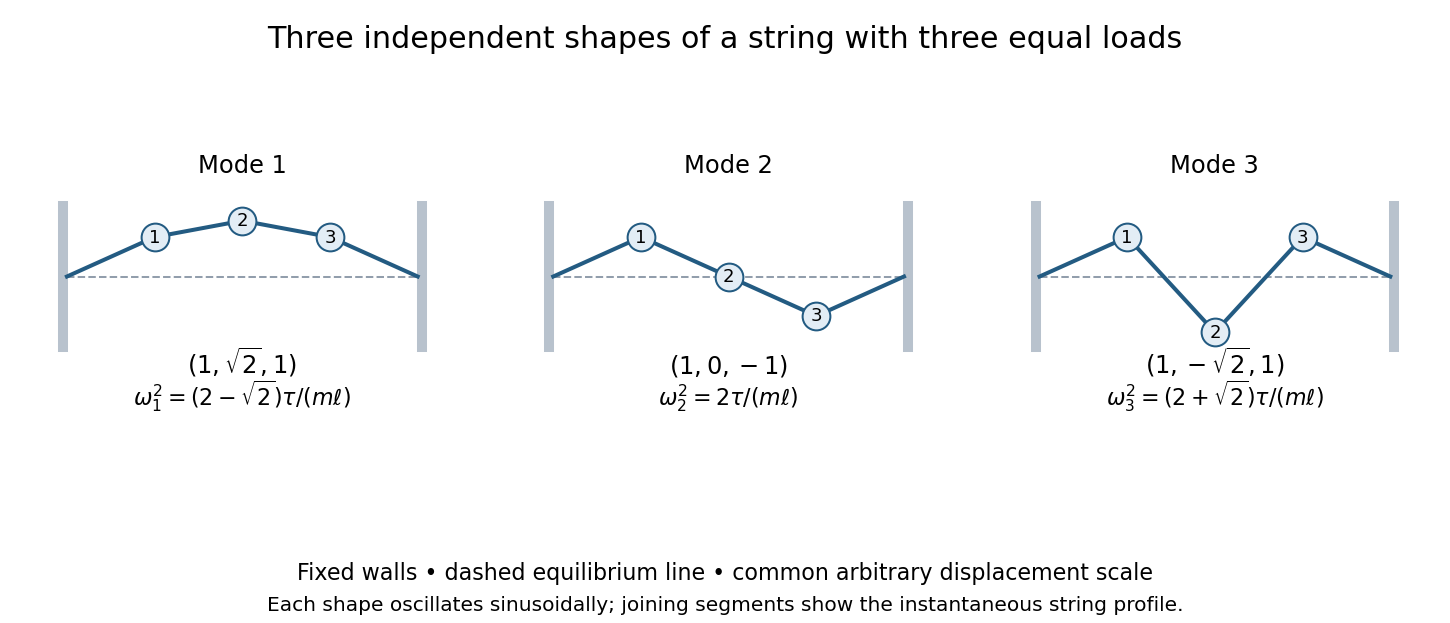
The three transverse string modes; the dashed line is equilibrium and bead displacements share one arbitrary scale
. Details. 
These are the three-mass case of the normal modes of a uniformly loaded finite string, with discrete sine shapes . The sketches use straight string segments between masses and fixed zero displacements at the walls. The small-slope and constant-tension assumptions justify the quadratic energy and linear equations.
Resolve the initial displacement into the mode shapes from part (i):There is no component along : the initial displacement is invariant under exchanging beads 1 and 3, whereas that mode is antisymmetric. Zero initial velocities select cosine time dependence. ThereforeHere and . At zero time these expressions give and all three velocities vanish.
The motion is a superposition of the two symmetric normal modes, with opposite signed modal amplitudes. The outer beads always move together. Equivalently, , displaying the modulation from the two frequencies. The result describes the linearized string while the initial amplitude and subsequent slopes remain small compared with the bead spacing.
Articles by others on the same topic
There are currently no matching articles.