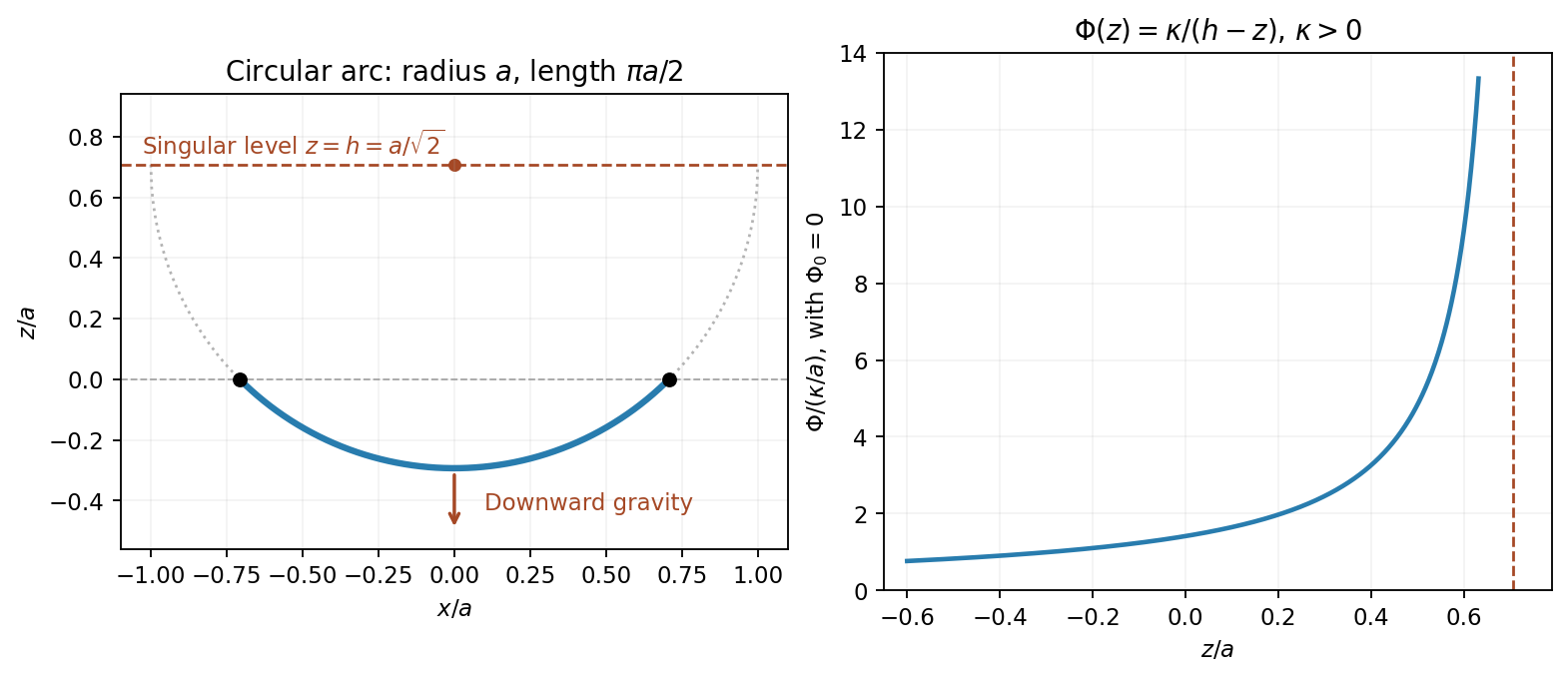
A curve element has arc length and mass . Adding its gravitational energies givesFor the fixed-length constraint, use the augmented integrand . It has no explicit dependence, so the Beltrami identity givesThe desired lower circular arc isIt joins the required endpoints, subtends angle , and has length . Its slope gives . Therefore a gravitational potential producing a circular hanging chain isChoosing makes the first integral constant, . Its gravitational acceleration is , which points downward. An arbitrary additive potential constant changes no force.
This construction really gives a minimum. With , the variable part of is ; the term is fixed by the length. The calibration for semicircular hyperbolic geodesics uses , whose gradient has norm . The Cauchy-Schwarz inequality gives , with equality on traversed left to right. Thus the circular arc minimizes the energy among competitors of the same length and endpoints in the stated potential domain, rather than merely satisfying a necessary stationarity condition.

Articles by others on the same topic
There are currently no matching articles.