Let . Averaging each pair of transposed entries gives the symmetric tensorFor , the upper block is the outer product of with itself. It sends that vector to times itself and annihilates its perpendicular. Thus its orthonormal principal axes and corresponding eigenvalues areTaking these vectors as the rows of the change-of-components matrix givesThis matrix is orthogonal with determinant one. These are the principal axes of a planar rank-one tensor block.
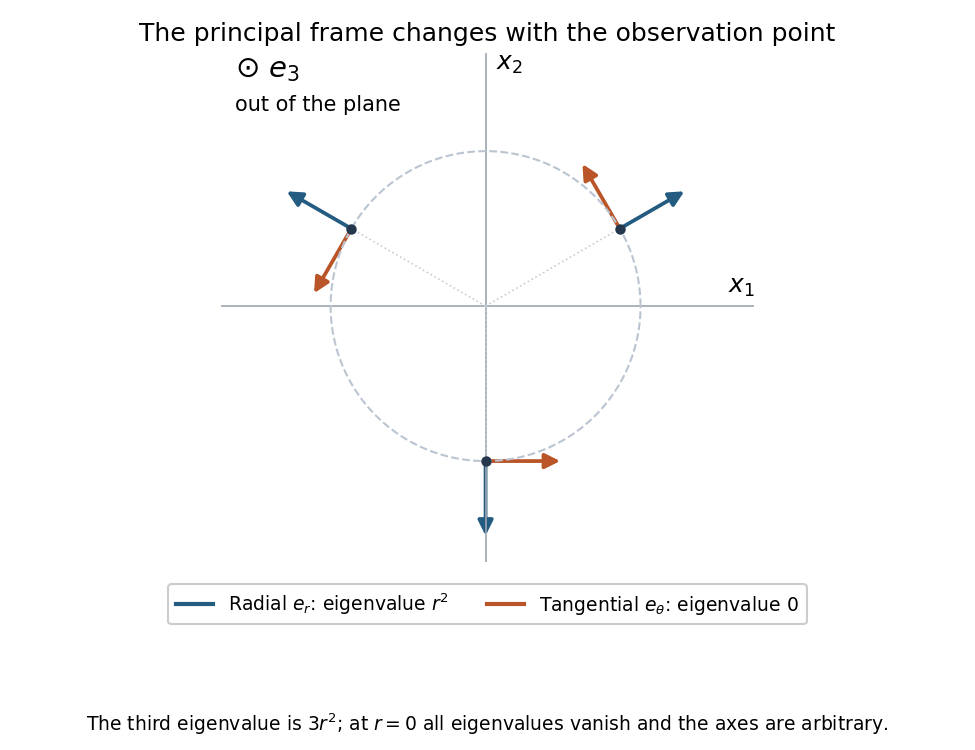
The radial and tangential principal directions rotate with position; the third principal axis is perpendicular to this plane
. Details. 
The matrix is a pointwise frame transformation: because its angle varies with position, it does not represent one fixed Cartesian rotation diagonalizing the entire field everywhere. On the axis , the symmetric tensor is zero; all principal values coincide and any orthonormal axes may be chosen. The displayed formula for is therefore used only off that axis.
Articles by others on the same topic
There are currently no matching articles.