Preserving Cartesian lengths and Euclidean inner products requires an orthogonal matrix:Its determinant is . Relative to an originally right-handed frame, gives a right-handed frame and a left-handed frame. More generally, this sign determines whether the two frames have the same or opposite orientation.
The tensor component transformation law isFor a tensor field, the components are compared at the same physical point, whose coordinates satisfy .
Define the symmetric tensor and antisymmetric tensor parts by and . The transformed transpose satisfies . Thereforeand similarlyBoth obey the tensor component transformation law. Thus the symmetric and antisymmetric parts are themselves second-order tensors. Taking a transpose and forming linear combinations commute with this orthogonal change of frame.
Let . Averaging each pair of transposed entries gives the symmetric tensorFor , the upper block is the outer product of with itself. It sends that vector to times itself and annihilates its perpendicular. Thus its orthonormal principal axes and corresponding eigenvalues areTaking these vectors as the rows of the change-of-components matrix givesThis matrix is orthogonal with determinant one. These are the principal axes of a planar rank-one tensor block.
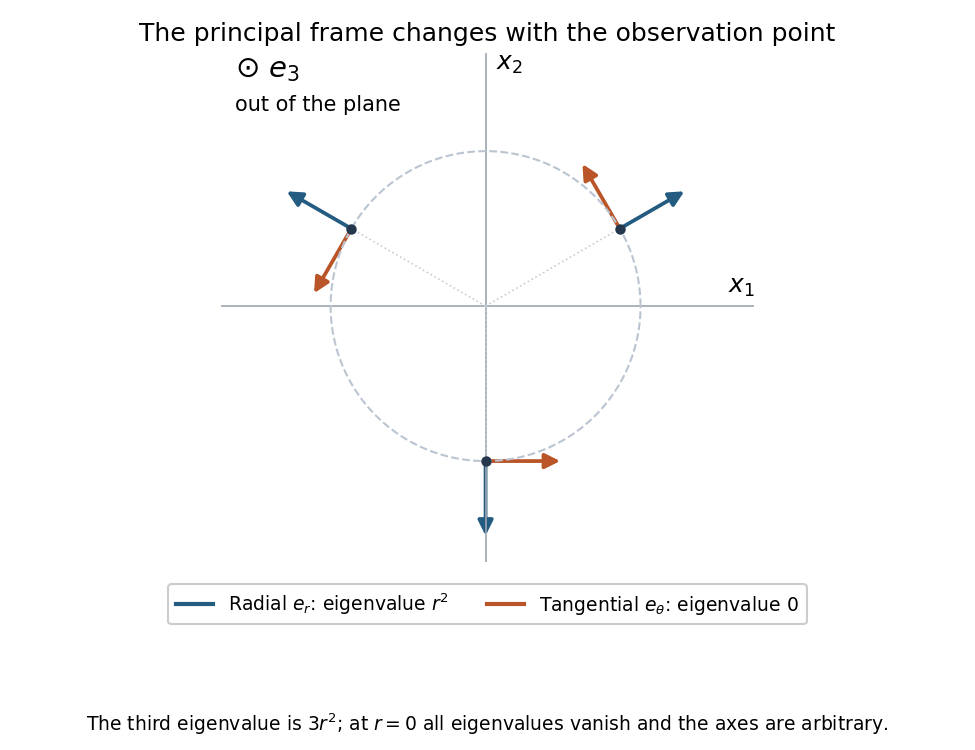
The radial and tangential principal directions rotate with position; the third principal axis is perpendicular to this plane
. Details. 
The matrix is a pointwise frame transformation: because its angle varies with position, it does not represent one fixed Cartesian rotation diagonalizing the entire field everywhere. On the axis , the symmetric tensor is zero; all principal values coincide and any orthonormal axes may be chosen. The displayed formula for is therefore used only off that axis.
The scalar, symmetric-traceless and axial tensor decomposition fixes the scalar part by the trace:Subtracting this isotropic part from the symmetric tensor in part (c) givesIts trace is zero. The antisymmetric tensor part isAdding reconstructs every entry of .
Subtracting a scalar multiple of the identity preserves every eigenvector: if , then . Thus the principal axes are the same as in part (c), with shifted principal valuesThe two tensors are coaxial symmetric tensors. At both vanish, so neither specifies unique axes.
Articles by others on the same topic
There are currently no matching articles.