For a bounded volume with piecewise smooth closed boundary , and a continuously differentiable vector field on a neighbourhood of , the divergence theorem statesHere is the outward unit normal vector. The left side is the outward flux; the right side integrates the divergence over the enclosed volume.
The upper piece is a downward-opening circular elliptic paraboloid cap, running from the circle to the apex . The middle piece is the side of a circular cylinder of radius one and height one. The lower piece is the unit disk in the horizontal plane. Their union is the closed boundary ofThe four panels show the three separate pieces and their union; there is no additional fourth component. In a meridional section, the boundary consists of the base segment, two vertical sides, and the parabolic cap. The outward normals point downward on the base, radially outward on the cylindrical side, and upward/outward on the cap.
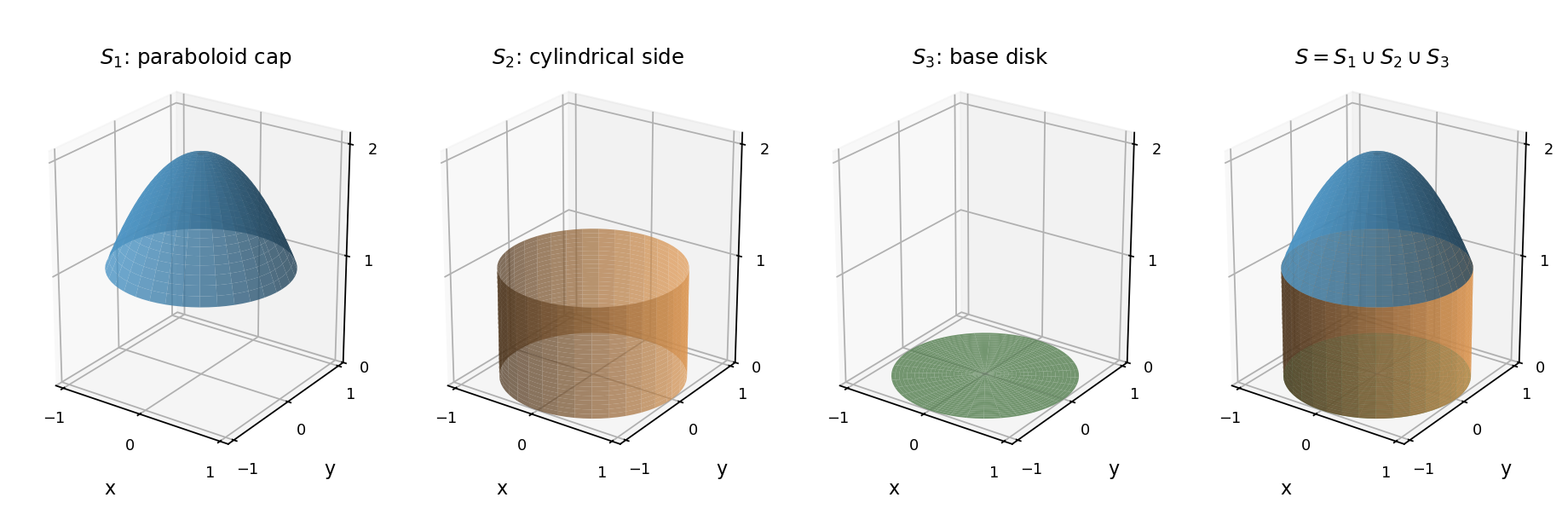

The polynomial vector field is smooth throughout the solid, so the divergence theorem applies. Differentiation givesThe volume is invariant under both and . Hence the integrals of the two odd terms vanish, and the flux is simply the volume. Using the circular cross-sections,The seams between the surface pieces have zero surface measure and contribute no extra term.
Articles by others on the same topic
There are currently no matching articles.