Use the Fourier transform conventionSince in distribution theory, the carrier has transformThe modulation property of the Fourier transform translates the message spectrum to the two carrier frequencies. ThereforeThe first term represents the unmodulated carrier wave; the other terms are the amplitude modulation sidebands.
A direct way to avoid the singular transform of is to invert a triangular function. Evenness givesAt the limit is , so there is no singularity in the original signal. ThusAlternatively, the hint uses the Hadamard finite-part reciprocal-power distribution, whose distributional Fourier transform is ; combining its three translates gives , the same triangle. Treating as an ordinary integrable function would be invalid.
The message spectrum has height at zero, vanishing at . For , the modulated continuous spectrum consists of disjoint triangles of height , centred at , each with half-width one. In addition there is a Dirac delta carrier line of weight at each centre. These lines have specified area, not a finite height; arrows mark them schematically.
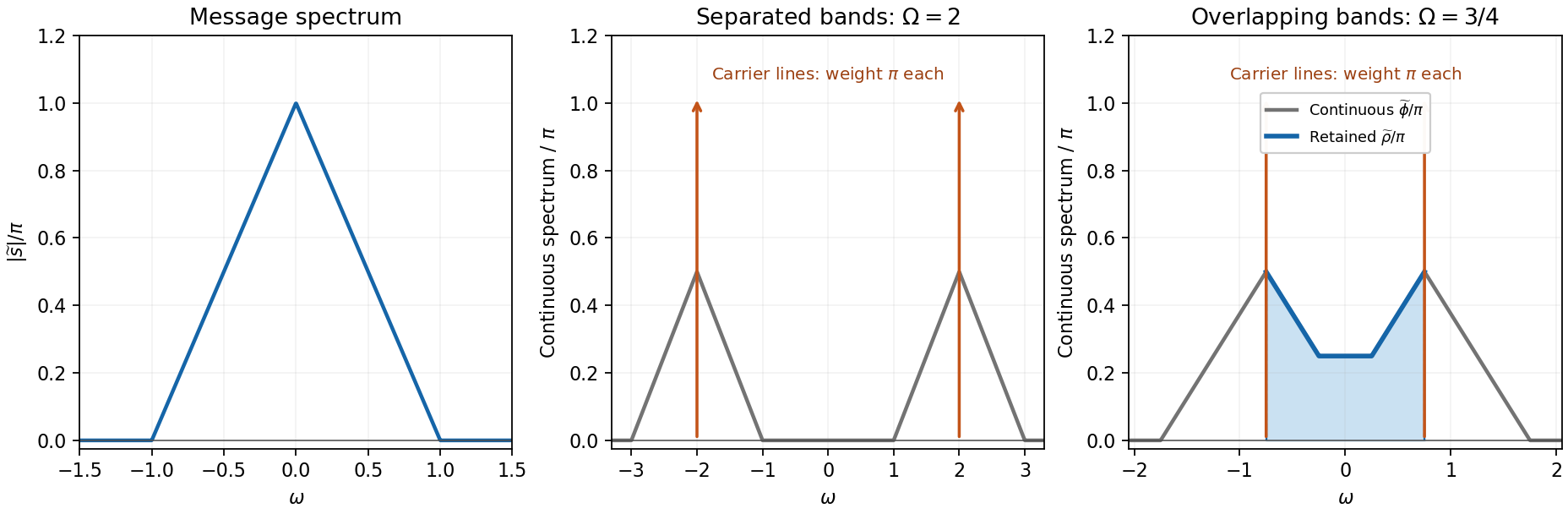
Triangular message spectrum, separated sidebands, and overlapping sidebands with the prescribed carrier-rejecting filter
. Details. 
At , the two continuous triangles overlap near zero. Their amplitudes add, giving a central plateau. Explicitly, write for the continuous part of :There are also the two carrier Dirac delta lines . The last panel of the preceding figure shows this spectrum and the retained central portion. The prescribed strict cutoff removes the carriers and keepsThe values of the ordinary function at individual endpoints do not affect its inverse transform. To handle the carrier lines, one must additionally assign zero filter gain to those lines, as the carrier-rejecting prescription indicates. A discontinuous mask has no canonical product with a Dirac delta at its discontinuity; a different physical boundary gain would leave a corresponding multiple of .
The retained spectrum is real and even. Its inverse Fourier transform isIntegrating the linear factors yieldsThe removable value is , obtained either by expansion or by integrating . Because the carrier frequency is below the message bandwidth, this is Fourier filtering of overlapping amplitude-modulation sidebands; the usual picture of two isolated bands in single-sideband modulation does not apply without that qualification.
Articles by others on the same topic
There are currently no matching articles.