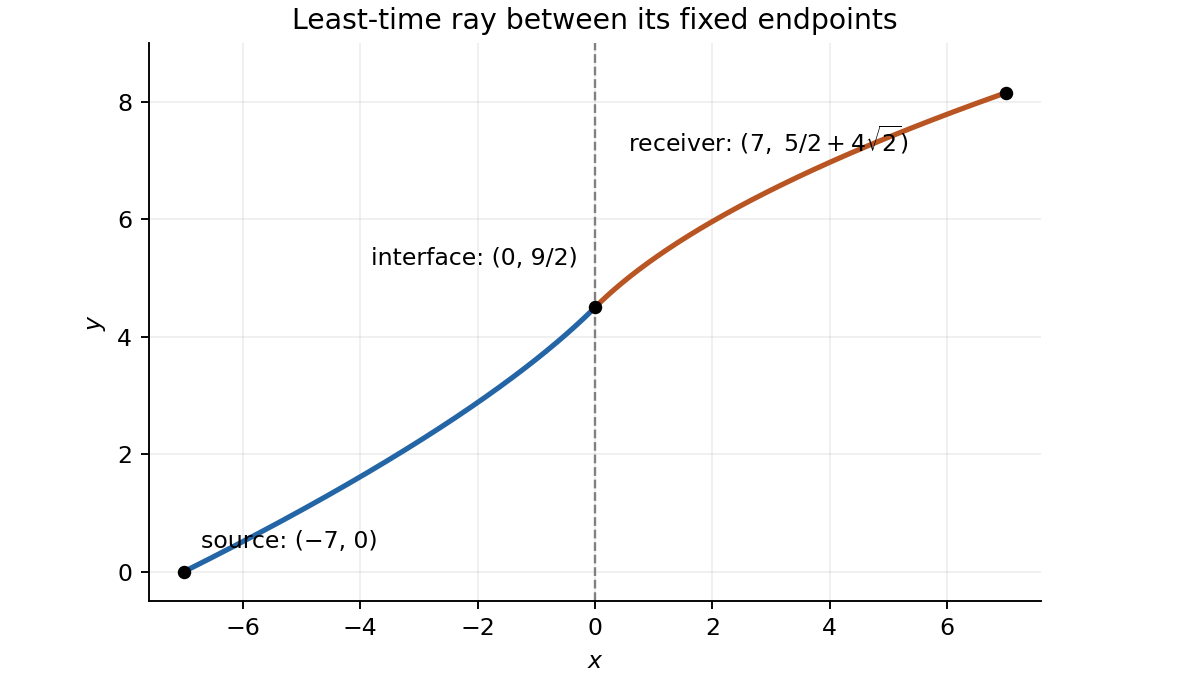
Retain the question's common crossing condition , and replace the slope-ratio condition of part (iii) by the specified initial slope. Then part (i) givesso . Substitution in part (ii) gives the rayIt starts at with slope , passes through with slope one, and reaches the receiver with slope . The final height isThe left-hand curvature is ; the right-hand curvature is . Thus the graph is increasing throughout, with a change from upward to downward curvature at the interface.

Articles by others on the same topic
There are currently no matching articles.