The integrand has no explicit dependence. Thus the Euler-Lagrange equation gives the conserved transverse optical momentumAt , and the crossing slope is one, so . Solving for the positive slope gives , henceThe slopes agree at zero. The same conserved momentum holds across the interface because the refractive index is continuous and there is no point source in the variational equation.
Here a least-time ray means the minimum between the source and the receiver point selected by this ray. For those fixed endpoints, proves strict convexity in the slope, so the stationary ray is the unique minimum among graph paths. If the receiver could instead be freely placed anywhere on the line and its height were also minimized over, the horizontal ray would be faster; that different problem is incompatible with the prescribed crossing slope.
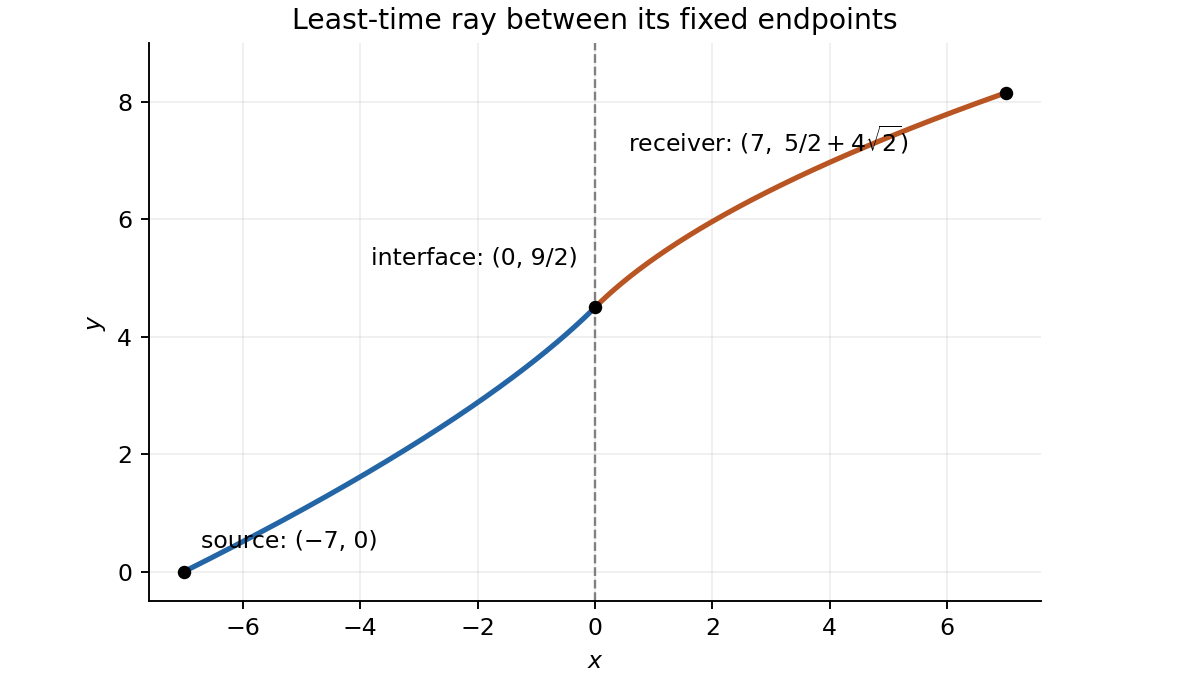
Integrate the slope in part (i), using . On the left,Its value at the interface is . On the right, integrate from the interface and enforce continuity. ThereforeBoth and are continuous at zero. The ray steepens as it approaches the interface from the left and flattens as it leaves to the right.
Retain the question's common crossing condition , and replace the slope-ratio condition of part (iii) by the specified initial slope. Then part (i) givesso . Substitution in part (ii) gives the rayIt starts at with slope , passes through with slope one, and reaches the receiver with slope . The final height isThe left-hand curvature is ; the right-hand curvature is . Thus the graph is increasing throughout, with a change from upward to downward curvature at the interface.

Articles by others on the same topic
There are currently no matching articles.