The cornea supplies much of the eye's converging optical power; the crystalline lens supplies additional, adjustable power through ocular accommodation. The transparent aqueous and vitreous media transmit the light. The iris controls the pupil, acting as an aperture rather than as the focusing element, and the retina is the receiving surface. The posterior optic nerve conveys the resulting neural signals; it does not carry an optical picture out of the eye.
Each sufficiently small object patch sends a pencil of rays through the pupil. Refraction at the corneal and lenticular surfaces brings that pencil towards a retinal image point. Pencils from different object heights meet at different retinal positions, producing a real inverted image. In a paraxial equivalent model,The several physical refracting surfaces have been replaced here by an equivalent thin lens; this is a model, not a claim that all bending occurs at the crystalline lens. For a distant object, approximately parallel incoming pencils focus near the back focal surface. Ocular accommodation increases power for nearer objects while the retinal position remains nearly fixed.
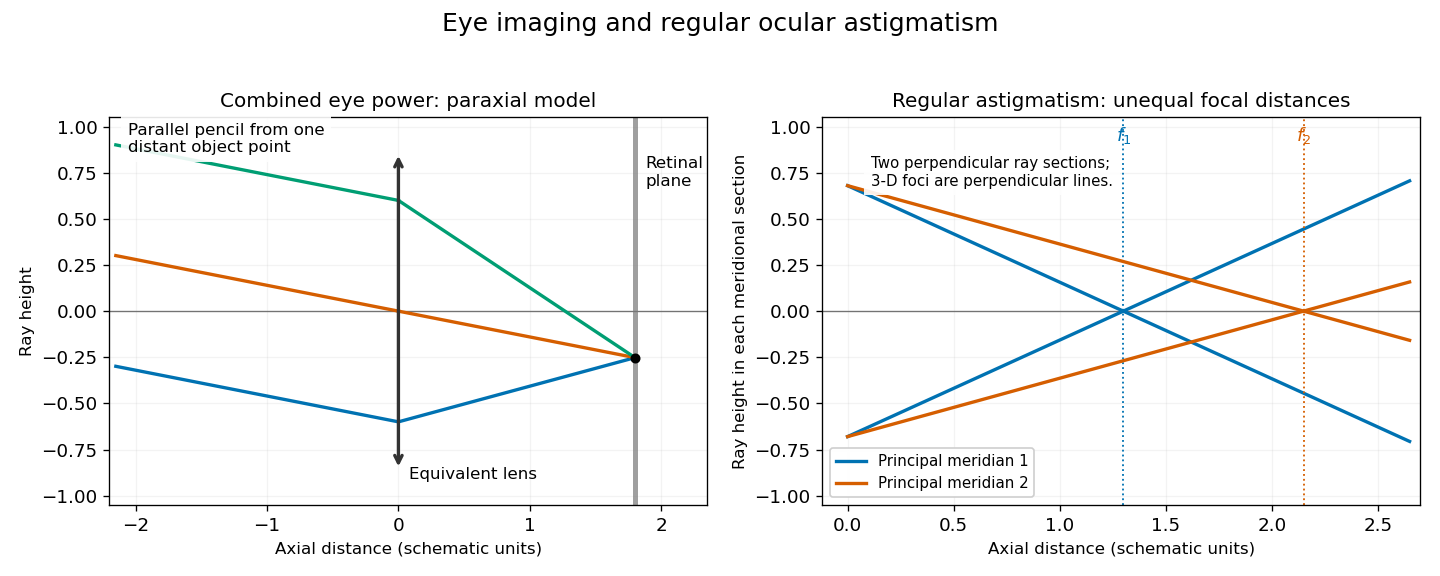

In regular ocular astigmatism, the two principal meridians are perpendicular but have different refractive powers, commonly because the cornea has different curvatures in those meridians. A point object then gives two line foci at different depths rather than a single sharp point. The difference is not merely an overall spherical focusing error. Refraction with differently oriented cylindrical trial lenses can locate the power and axis; keratometry or corneal topography measures corneal shape. Cylindrical lens or toric lens correction supplies the missing meridional power with the proper orientation. Spectacles and appropriately fitted toric contact lenses can provide such correction. A method for measuring corneal curvature should not be confused with a complete measurement of the eye's total refractive error.[ref]
Physiology of Astigmatism by the American Academy of Ophthalmology. Regular astigmatism and principal meridians
[ref] Articles by others on the same topic
There are currently no matching articles.