Original volume: Examination papers for the Degree of Bachelor of Medicine by the University of Oxford (1864–1867). Open the original paper in the scanned volume, PDF pages 59–60.
Original questions are transcribed from the public-domain edition. Credit: Wellcome Collection; original supplied by Royal College of Physicians, London. Source and public-domain rights statement.
Historical terms are interpreted in their nineteenth-century setting. Modern explanations and measurements are identified where they extend beyond the knowledge available in December 1866.
Original question.
Give an account of the different ways in which the Nervous system may influence the functions of organic or vegetative life.
The nervous system regulates visceral movement, glandular secretion, blood flow and coordinated bodily responses, while also influencing nutrition indirectly through those functions. Organic or vegetative life here means activities maintaining the body, such as blood circulation, digestion, pulmonary ventilation, secretion and excretion. It does not designate an independent form of living substance.
One influence is directly motor. Autonomic nerves alter the rate and force of the heart, contract or relax smooth muscle in the intestine, urinary bladder, airways and blood vessels, and coordinate movement with the opening and closure of sphincters. Their effect need not be excitatory: an active vagus nerve can slow the heart, while other pathways accelerate it. In the modern account, sympathetic and parasympathetic effects depend on the target and its receptors; they are not respectively universal accelerator and brake systems. Some organs receive both divisions, while others do not have a simple balanced double supply.[ref]
15.1 Divisions of the Autonomic Nervous System. Opening comparison; Sympathetic Division; Parasympathetic Division; target-specific actions
A second influence is secretomotor. Activity in appropriate nerves can increase salivary secretion, alter gastric acid secretion and promote sweating. This is distinguishable from moving a duct or changing its calibre. A convincing experiment collects a secretion from a cannulated duct while a nerve is stimulated, rather than inferring secretion from a change of colour or organ size. For example, stimulation of the chorda tympani can evoke fluid from the submandibular gland. The response depends on functioning secretory biological cells; the nerve communicates a command rather than supplying the material constituents of saliva.
A third influence is vasomotor. Changing the calibre of arterioles changes local vascular resistance and perfusion. The classic comparison of an ear before and after interruption of its cervical sympathetic supply illustrates loss of vasoconstrictor tone: the vessels dilate and the ear becomes warmer because more warm blood reaches it. Stimulation of the peripheral cut pathway can produce the converse vascular effect. Warmth therefore need not mean that the local nerves themselves generate more heat. Vascular control also changes the delivery of oxygen and nutrients to a gland or tissue, so it can modify function indirectly.
These outputs are organized by sensory feedback and reflexes. Distension of the intestine can evoke coordinated movement; changes in blood pressure or blood-gas composition influence heart rate and breathing. Local circuits in the enteric nervous system permit some digestive activity without an intact connection to the brain, while longer reflexes involve the spinal cord or brainstem. Central states also matter: the sight or expectation of food can initiate preparatory digestive responses, and fear can alter heart rate, sweating and visceral movement.[ref]
15.2 Autonomic Reflexes and Homeostasis. Long and Short Reflexes; control of cardiovascular and digestive functions
Somatic motor activity also supports vegetative functions. Breathing uses the respiratory diaphragm and other skeletal muscles; swallowing and continence use coordinated skeletal muscle as well as smooth muscle. Thus organic function cannot be identified solely with the anatomical distribution of the sympathetic nervous system.
The historical idea of a direct trophic influence requires discrimination. A denervation region may change through loss of movement, altered perfusion, loss of protective sensation or changed secretion. Those observations alone do not establish a special nutritive fluid flowing down the nerve. Modern biology recognizes molecular signalling between nerves and their targets, as well as neuroendocrine signalling pathways: the hypothalamus can influence hormone release, and sympathetic input can evoke adrenal medulla secretion. These are mechanisms added to, rather than evidence for an undefined historical nutritive force. A useful experimental design measures the motor, vascular and secretory consequences separately before assigning a residual effect to direct trophic action.
Original question.
What do you know of the development, relations, and functions of the Eustachian Tube ?
The Eustachian tube, or auditory tube, connects the middle ear with the nasopharynx. Its principal functions are ventilation and pressure equalization, clearance of middle-ear secretions, and protection against inappropriate entry of nasopharyngeal material.
Developmentally, its lumen and epithelial lining arise chiefly from the proximal part of the tubotympanic recess, an extension of the first pharyngeal pouch. The expanded distal part contributes to the tympanic cavity. The neighbouring first pharyngeal cleft is associated with the external ear passage and must not be substituted for the pouch as the origin of the auditory tube. Supporting cartilage and connective tissue develop from surrounding mesenchyme. At birth the tube is shorter and more nearly horizontal; craniofacial growth lengthens it and changes its orientation. The developmental account distinguishes formation of the channel from later growth of its surrounding structures.[ref]
Embryology, Ear (StatPearls). Middle Ear: tubotympanic recess, proximal auditory tube, distal tympanic cavity and postnatal orientation
In an adult the auditory tube is roughly 3.5–4 cm long. From its tympanic opening in the anterior wall of the middle ear, it runs forwards, downwards and medially towards its pharyngeal opening in the lateral wall of the nasopharynx, behind the nasal cavity. Its lateral third is bony, lying in the temporal bone; the medial two thirds are chiefly cartilaginous with a membranous part. The narrow junction is the tubal isthmus. The cartilaginous portion is normally collapsed, so an open passage for sound or reflux does not continuously connect pharynx and middle ear.
The bony part is closely related medially to the canal of the internal carotid artery; the canal for the tensor tympani muscle lies above it. The medial cartilaginous part rests towards the skull base. Its pharyngeal end makes the tubal prominence, or torus tubarius, near the soft palate. The tensor veli palatini muscle acts on the cartilaginous and membranous tube and is the main active dilator. The levator veli palatini muscle passes beneath it and participates in the palatal and tubal functional arrangement. Swallowing and yawning intermittently open the tube.[ref]
Middle Ear Anatomy and Physiology (StatPearls). Eustachian Tube; Muscles: bony/cartilaginous portions, opening muscles and three principal functions
Opening permits gas transfer to compensate for a difference between middle-ear and ambient pressure. If the tube remains obstructed, absorption of gas from the cavity can make middle-ear pressure fall; movement of the tympanic membrane and sound transmission then change. Clearance is helped by the mucociliary lining, which carries material towards the nasopharynx. Closure between openings limits reflux and transmission of nasopharyngeal pressure disturbances. A tube that remains persistently open therefore also functions abnormally; more openness is not invariably better.
The physiological point can be demonstrated by observing the tympanic membrane while swallowing during a change of external pressure, or by recording the membrane's mechanical response over a controlled range of ear-canal pressures using tympanometry. These observations examine pressure communication and membrane mobility, not merely whether air can be forcibly driven through a passage. The relatively immature geometry and opening mechanism in young children helps explain their vulnerability to middle-ear fluid retention, but geometry alone is not an exhaustive account of infection risk. The anatomical structures were recognizable in 1866; the modern measurement method should not be mistaken for apparatus supplied by the examination.
Original question.
Write an account of the origin, course, and functions of the chorda tympani, the buccal, the musculospiral, and the obturator nerves.
The four names identify distinct pathways: chorda tympani, the sensory buccal nerve, the radial nerve formerly called musculospiral, and the obturator nerve. Origin must include the parent nerve or nerve plexus, while the function must follow the actual fibre supply rather than the name of a structure crossed.
Chorda tympani. This branch leaves the facial nerve in its descending facial canal before the stylomastoid foramen. It enters the tympanic cavity from behind, passes forwards between the malleus and incus close to the inner surface of the tympanic membrane, and leaves through the petrotympanic fissure. In the infratemporal fossa it joins the lingual nerve, a branch of the mandibular division of the trigeminal nerve. It then travels with that carrier towards the tongue and submandibular ganglion.
The chorda tympani carries taste from the anterior two thirds of the tongue, with sensory cell bodies in the geniculate ganglion and central connections to the nucleus of the solitary tract. It also carries preganglionic parasympathetic fibres from the superior salivatory nucleus towards the submandibular ganglion; postganglionic fibres supply the submandibular gland and sublingual gland. It does not provide the general touch supply of that part of the tongue; that travels through the lingual nerve's trigeminal nerve pathway. Taste and tactile testing can consequently distinguish two functions that briefly share one peripheral trunk.[ref]
Anatomy, Head and Neck, Chorda Tympani (StatPearls). Introduction; Structure and Function: facial origin, middle-ear passage, lingual connection and gustatory/secretomotor fibres
Buccal nerve. In the usual anatomical meaning intended by this list, this is the long buccal nerve from the anterior division of the mandibular trigeminal nerve. It commonly emerges between the heads of the lateral pterygoid muscle, descends near the anterior border of the mandibular ramus and the temporalis muscle insertion, and passes towards the cheek. Its branches reach cheek skin, the buccal mucosa, and the buccal gingiva beside the lower molars. It is principally sensory. The motor supply of the buccinator muscle comes from the facial nerve, whose buccal branches are a different set of nerves. Thus the ability to hold the cheek against the teeth and sensation in the cheek are not tests of the same efferent pathway.[ref]
Anatomy, Head and Neck: Buccal Nerve (StatPearls). Introduction; Structure and Function: mandibular origin, relations to lateral pterygoid and sensory distribution
Radial nerve, historically musculospiral. This is the major continuation of the posterior cord of the brachial plexus, usually containing fibres from C5–T1. It passes from the axilla into the posterior arm, accompanying the profunda brachii artery in the radial groove of the humerus. It pierces the lateral intermuscular septum and reaches the anterior compartment between brachialis and brachioradialis. Near the lateral elbow it divides into a superficial sensory branch and a deep motor branch. The latter passes through the supinator muscle and continues as the posterior interosseous nerve.
The radial nerve supplies triceps brachii and anconeus, then brachioradialis, the radial wrist extensors and, through its deep continuation, the principal finger and thumb extensors and associated posterior forearm muscles. Its sensory branches supply posterior arm and forearm regions and part of the dorsolateral hand. A lesion's level matters: an arm lesion can impair wrist and finger extension, while an isolated superficial branch lesion is sensory and does not itself cause a wrist drop. Conversely, a posterior interosseous nerve lesion chiefly affects motor function. The fingertip pads are not the characteristic autonomous sensory territory of the superficial radial nerve.[ref]
Anatomy, Shoulder and Upper Limb, Radial Nerve (StatPearls). Structure and Function; Sensory; Motor; Muscles; Physiologic Variants
Obturator nerve. It arises from the anterior divisions of the anterior rami of L2–L4 in the lumbar plexus. It emerges from the medial border of psoas major, crosses the pelvic side wall and leaves through the obturator canal with the obturator vessels. Its anterior and posterior divisions characteristically run on opposite sides of adductor brevis, although the level of division varies. The anterior division supplies adductor longus, gracilis and commonly adductor brevis; the posterior division supplies obturator externus and the adductor portion of adductor magnus, with variable additional contributions. The hamstring portion of adductor magnus has a different supply. Cutaneous supply to a variable medial-thigh patch and articular branches to the hip and knee supplement its principal motor role in thigh adduction. Obturator internus is supplied by its own sacral-plexus nerve, not by the obturator nerve merely because the names resemble one another.[ref]
Anatomy, Abdomen and Pelvis, Obturator Muscles (StatPearls). Nerves: L2–L4 supply of obturator externus versus separate supply of obturator internus
[ref]Obturator Nerve by the National Library of Medicine. MeSH definition: lumbar origin, thigh adductors and medial-thigh sensation
Original question.
What are the physiological limits within which the size of the liver may vary, and what are the conditions which produce such variations ?
The liver has a substantial normal range of size, determined by age, body dimensions, nutritional state and its variable contents; there is no universal absolute minimum and maximum valid for every healthy person. One must also distinguish true organ volume from the position of its lower border, which moves with the respiratory diaphragm during breathing.
An ordinary adult liver is on the order of 1.5 kg and roughly a few percent of body mass, but neither figure is a diagnostic boundary. As an explicitly modern example, an autopsy study of adult men reported a mean hepatic mass of 1561 g and observed values from 838 to 2584 g in its selected population. Those are sample observations, not a declaration that every liver inside those limits is healthy or that every one outside is diseased. A newer large-sample study similarly found an association of liver mass with body mass; much of an apparent sex difference disappears when body size is taken into account.[ref]
Normal organ weights in men: part II—the brain, lungs, liver, spleen, and kidneys. Abstract and reported organ-mass data; selected male autopsy population, 2012
[ref]Updating Normal Organ Weights Using a Large Current Sample Database. Results and Conclusions: liver mass, body size and sex after adjustment
Age changes the proportion as well as the absolute size. The fetal and infant liver is relatively large; the adult organ is smaller in proportion to the whole body. Its fetal role in haematopoiesis and subsequent changes of growth and function make an adult mass standard inappropriate for an infant. Constitutional body size and normal anatomical shape also vary: a long lower projection is not necessarily the same thing as an enlarged total organ.
- Glycogen is accumulated after suitable feeding and mobilized during fasting and exercise. Its storage is associated with water, so changing glycogen stores changes more than the dry mass of the stored glucose units.
- Hepatic lipids and their turnover also contribute to variation. This does not make substantial hepatic steatosis a normal consequence of every meal or justify treating pathological fatty enlargement as physiological.
- The amount of blood contained in the hepatic sinusoids and larger vessels can change with circulation and posture. Physiological vascular filling must be distinguished from persistent congestion caused by heart failure.
- Hydration and longer-term nutritional state influence the organ and its stores. Severe wasting or a persistent progressive enlargement requires a different explanation from a reversible difference between standardized fed and fasted observations.
A meal therefore changes hepatic activity and splanchnic blood flow without requiring a large immediate increase in total liver volume. In a modern paired study of 20 healthy volunteers, single-photon emission computed tomography before and after a standardized meal showed a nonsignificant 1.5% decrease in estimated liver volume. The authors judged the change to be within methodological error. This is a useful check against assuming that greater digestive activity proves gross swelling.[ref]
Effect of food intake on liver and spleen volume: assessment with single photon emission computed tomography. Abstract: standardized meal, paired measurements and liver-volume result, 1997
The experimental approach is to compare like with like: specify age and body mass, use a fixed interval after food, standardize hydration, posture and respiratory phase, and distinguish a volume measurement from a palpable edge or a single linear dimension. Magnetic resonance imaging can measure volume while magnetic resonance spectroscopy measures glycogen or lipid signals; the two observations answer different questions. The size of an excised organ additionally depends on how much blood remains in it. The physiological point appropriate to the 1866 question is reversible variation with growth, alimentation and vascular filling. Modern imaging results refine that point; they are not numerical standards that the historical exam could have expected.
Original question.
Trace the course taken by the chyle from its formation up to the spot where it is poured into the blood-vascular system.
Chyle is intestinal lymph enriched with absorbed dietary lipids; its usual route ends in the venous circulation at the left jugulosubclavian junction. The milky appearance after a fat-containing meal is chiefly due to suspended lipid-rich particles, now called chylomicrons.
Formation begins with lipid digestion in the small intestine. Pancreatic lipase helps hydrolyse dietary triglycerides; bile salts help the digestion products reach the intestinal absorptive surface in mixed micelles. Enterocytes take up the products, reconstruct much of the long-chain triglyceride, and package it with other lipids and apolipoproteins into chylomicrons. These leave the basolateral side of the enterocytes and enter the central lacteals of the intestinal villi. Thus the particles carried in chyle are not simply intact globules of a meal passing through an open hole from the intestinal lumen.[ref]
From the lacteals, chyle enters lymphatic channels in the intestinal wall and then collecting vessels in the mesentery. These vessels pass through mesenteric lymph nodes, with afferent vessels entering and efferent vessels leaving the nodes. Successive collectors join the intestinal lymphatic trunk or trunks. They usually communicate with the cisterna chyli, an expanded origin of the thoracic duct in the upper lumbar region, near the bodies of L1–L2 and to the right of the aorta. The cisterna chyli also receives lymph from lumbar trunks; the stream beyond it therefore contains material from more than the intestine. A conspicuous sac is not present in every individual.
The thoracic duct passes through the aortic hiatus of the respiratory diaphragm and ascends in the posterior mediastinum, typically between the aorta and azygos vein, behind the oesophagus. It crosses towards the left in the middle or upper thorax, continues to the root of the neck and arches to its terminal venous opening. The usual endpoint is the left venous angle, where the left internal jugular vein joins the left subclavian vein; terminal branches and the precise opening show anatomical variation. It is not normally the right venous angle or a direct entrance into the portal vein.[ref]
Anatomy, Thorax, Thoracic Duct (StatPearls). Structure and Course: cisterna chyli, thoracic course, left cervical arch and variable venous termination
The flow is promoted by intrinsic contraction of collecting lymphatic vessels, movements of surrounding muscles and respiratory changes of pressure. Lymphatic valves limit backward movement. Lymph nodes are interposed biological structures, not pumps that propel every particle independently.[ref]
21.1 Anatomy of the Lymphatic and Immune Systems. Lymphatic Capillaries; Larger Lymphatic Vessels, Trunks, and Ducts; lymph transport
This route applies particularly to the long-chain dietary lipids carried by chylomicrons. Most absorbed glucose and amino acids, and much shorter-chain fatty acid material, follow portal vascular routes instead. Confusing these pathways would obscure the reason for asking separately about chyle. In a classical anatomical demonstration, the mesenteric channels of an appropriately fed animal appear white, and an injected or dissected preparation can trace their continuity towards the thoracic duct. The timing after a fatty meal matters: an empty-looking channel in a fasted preparation does not prove absence of a lymphatic vessel. The molecular account of chylomicrons is a modern explanation of the older gross observation.
Original question.
Enumerate the different muscles, membranes, and vessels which you would meet with in dissecting from the external integument down to the level of Cowper's glands.
Cowper's glands are the paired bulbourethral glands, deep to the perineal membrane on either side of the membranous urethra. The relevant dissection is of the male anterior perineum, or urogenital triangle. A broad exposure reveals structures at different lateral positions; they are not all piled one above another along a single central line.
From superficial to deep, the principal layers and contents are:
- Skin and superficial fascia. The superficial fascia includes a fatty layer and a deeper membranous layer, Colles' fascia. The latter attaches laterally to the ischiopubic rami and posteriorly towards the posterior border of the perineal membrane and perineal body; anteriorly it is continuous with fascia of the scrotum and lower abdominal wall. Superficial vessels and nerves accompany these layers. Cutaneous arterial supply includes branches of the perineal artery and, more anteriorly, contributions associated with the external pudendal circulation.
- The superficial perineal compartment. Removing the membranous fascia exposes the superficial pouch and the investing fascia over its muscles. Centrally, bulbospongiosus covers the bulb of the penis and proximal corpus spongiosum. On either side, ischiocavernosus covers a crus of the penis. Posteriorly, the superficial transverse perineal muscle runs towards the perineal body. Older descriptions call these the accelerator urinae, erector penis and transversus perinei respectively. The names should be matched to the structures rather than counted as additional muscles.
- Superficial perineal vessels. The perineal artery, a branch of the internal pudendal artery, supplies this region and gives posterior scrotal and muscular branches; accompanying veins drain it. These vessels lie in relation to the pouch and its muscles, rather than constituting a complete vascular sheet. The bulb and crura are the associated erectile tissues, not additional membranes.
- The perineal membrane. This dense fibrous sheet spans the anterior pelvic outlet between the ischiopubic rami. It is the structure traditionally described as the triangular ligament's inferior layer. It is pierced by the urethra and by the ducts of the bulbourethral glands, as well as related vascular passages. The artery of the bulb of the penis passes to the bulb in close relation to the membrane. The deep and dorsal penile arterial routes lie more anteriorly; they should be identified where the exposure reaches them rather than imagined to cross every central dissection plane.
- The deep perineal structures. Beyond the perineal membrane are the external urethral sphincter complex, traditionally described deep transverse perineal fibres, the membranous urethra and the bulbourethral glands. The glands lie in close relation to sphincteric skeletal muscle. Their ducts run forwards through the perineal membrane and open into the bulbar urethra, so the position of a duct's opening is not the position of its gland.
The superficial muscles, erectile bodies and pudendal branches identify the shallow compartment; the perineal membrane separates it from the gland-bearing deeper region.[ref]
Anatomy, Abdomen and Pelvis: Superficial Perineal Space (StatPearls). Structure and Function; Blood Supply and Lymphatics; Muscles
The deep space contains the sphincter complex and male bulbourethral glands, with their ducts traversing the membrane.[ref]Anatomy, Abdomen and Pelvis: Deep Perineal Space (StatPearls). Introduction; Structure and Function; Blood Supply and Lymphatics
The main internal pudendal vessels themselves run laterally in the pudendal canal, in relation to the fascia over obturator internus, before their terminal distribution. A median approach to a gland does not necessarily expose their whole trunks. The deep dorsal vein of the penis has a distinct anterior route beneath the pubic arch and should not be confused with the small accompanying perineal veins. These positional qualifications are necessary for an accurate enumeration of the vessels one may meet.
Nineteenth-century descriptions often arranged the deep structures as a urogenital diaphragm enclosed between two neat fascial layers, the superior and inferior layers of the triangular ligament. Modern dissection finds a more complex sphincteric and connective-tissue arrangement. The historically named layers explain the older vocabulary, but the perineal membrane and surrounding muscles should not be made into a fictitious uniform sandwich. Nor does reaching the bulbourethral glands require dissecting through the whole pelvic diaphragm above them.
Original question.
Give some account of the organisms known as “Infusoria,” “Vibriones,” and “Bacteria.” What relations have they been supposed by different authorities to hold to the production and to the products of Fermentation and Putrefaction ?
The names are historical microscopic groupings, and the central dispute is whether the organisms cause the chemical changes, arise as their products, or merely grow in the altered liquid. Those are different causal propositions. Seeing small moving bodies in a fermenting infusion does not by itself choose among them.
Infusoria were organisms encountered in infusions of organic material. Many recognizable examples are now classified as ciliates or other unicellular eukaryotes, with a cell nucleus, organized feeding structures and locomotory cilia or flagella. Historical usage could extend much more widely than a modern taxonomic group. Some organisms found in an infusion feed on the bacteria already growing there; their later appearance can thus reflect ecological succession rather than production of the first chemical change.
Vibriones commonly denoted minute actively moving, often elongated, curved or sinuous forms. It does not follow that every historical vibrion belongs to the modern genus Vibrio. Bacteria, in some nineteenth-century classifications, meant a narrower set of minute rod-like bodies than the present bacterial domain. In modern terms bacteria are prokaryotes, lacking a membrane-bound cell nucleus; they generally multiply by binary fission. Shape and apparent movement alone do not establish their species. Brownian motion of nonliving particles also must not be mistaken for independent locomotion.
Three positions illustrate the debate available in 1866:
- Chemical decomposition transmitted by contact. Justus von Liebig treated a ferment as unstable nitrogenous material whose own alteration communicates decomposition to fermentable substances. On such an account, multiplication of a definite living organism is not the necessary primary explanation; organisms found in the altered material can be secondary accompaniments or consequences. This is a claim about the initiating cause, rather than merely the true observation that fermentation has chemical reactants and products.[ref]Organic Chemistry in its Applications to Agriculture and Physiology by Justus von Liebig. Part II, chemical processes of fermentation, decay and putrefaction; contact with decomposing nitrogenous matter, 1840
- A specific living ferment. Louis Pasteur's work connected particular transformations with the growth of particular microscopic agents. His lactic-fermentation account describes inoculating a suitable medium with a small amount of ferment, observing its multiplication and the associated chemical change. For alcoholic fermentation the familiar agent is yeast, now classified among fungi, not an infusorian animal or a bacterium. Different products can indicate different microbial processes rather than interchangeable effects of any decomposing material.[ref]Mémoire sur la fermentation appelée lactique by Louis Pasteur. §II, Fermentation lactique; inoculation, growth and the concluding contrast with the chemical-contact interpretation, communicated 1857
- Spontaneous generation or heterogenesis. Félix Archimède Pouchet defended the production of microscopic life from suitable organic materials without the introduction of pre-existing organisms of the same kind, a position developed in his 1859 Hétérogénie by Félix Archimède Pouchet. That interpretation makes some apparent organisms products of the putrefying preparation. It must be separated from the question whether, once present, they can accelerate further decomposition. Louis Pasteur opposed this explanation of ordinary laboratory infusions through controlled exclusion of contaminating particles.[ref]Sur les corpuscules organisés qui existent dans l'atmosphère by Louis Pasteur. Historical discussion of heterogenesis and experiments excluding atmospheric dust, 1861
The decisive experimental question is not whether fresh air is present, but what accompanies it. In a curved-neck flask, a boiled nutrient liquid remains in communication with air while much airborne dust settles in the neck. An otherwise comparable preparation can be exposed by breaking the neck or bringing trapped material into contact with the liquid. The comparison tests whether access of contaminating material, rather than air as such, permits growth and putrefaction. Heat treatment, the preparation's composition, possible surviving resistant forms and accidental contamination all affect interpretation. A negative culture under one condition is not a universal proof about the origin of life.[ref]
Sur les corpuscules organisés qui existent dans l'atmosphère by Louis Pasteur. Curved-neck experiments: unaltered liquid with air access; alteration following removal of the neck or disturbance admitting particles
Modern fermentation is an enzyme-mediated metabolic process; putrefaction commonly involves microbial degradation of nitrogenous organic matter, with mixed and sometimes foul-smelling products. Organisms can be causal agents, and their products can subsequently feed other organisms. Thus the two directions of influence need not be mutually exclusive in a mixed infusion. The mere coexistence of bacteria, ciliates, gas and odour supplies much weaker evidence than controlled inoculation, time-resolved microscopy and chemical measurement.
A later qualification is essential. Eduard Buchner's cell-free fermentation experiments, first reported in 1897 and described in his 1907 lecture, showed that an extract of yeast could carry out alcoholic fermentation without intact living yeast cells. This supports chemical machinery made by organisms; it does not restore the earlier indiscriminate decomposition-by-contact hypothesis. These later findings must not be put into an 1866 candidate's mouth.[ref]
Cell-free fermentation by Eduard Buchner. 1907 lecture, preparation of pressed yeast juice and demonstration of fermentation; historical account of the 1897 discovery
Original question.
Explain what is meant by the Botanical Terms “Stomata,” “Primordial Utricle,” “Cambium Layer;” and give a short history of the physiology of the sap.
Stomata are regulated pores of the plant epidermis; the primordial utricle is an older name for living peripheral cell contents; the vascular cambium is a tissue that produces secondary conducting tissues. These are respectively an opening apparatus, part of a cell's living contents, and a region of dividing cells.
A stoma is an aperture bounded by two guard cells, commonly with associated subsidiary cells. Changes of guard cell turgor pressure alter the aperture. Stomata permit entry of carbon dioxide for photosynthesis and loss of water vapour through transpiration, while also allowing other gas exchange. Most leaves have many on their lower surface, but distribution varies, so absence from the upper surface is not a definition. A pore is not itself a minute leaf blood vessel.
The primordial utricle was distinguished in nineteenth-century microscopy as the protoplasmic layer inside the cell wall, especially conspicuous around the large central vacuole of a mature plant cell. In modern vocabulary this includes peripheral cytoplasm bounded externally by the cell membrane; the vacuolar boundary is the tonoplast. The old term should not be reduced to a synonym of the rigid cell wall or assumed to designate an independently living bag. In plasmolysis, an appropriate external hypertonic solution draws water from the cell and the living contents withdraw from the wall, making the distinction visible.[ref]
The vascular cambium is a lateral meristem, characteristically situated between the xylem and phloem of a woody stem. Its divisions produce secondary xylem towards the inside and secondary phloem towards the outside; radial derivatives also contribute to vascular rays. Activity connects the growth of the conducting system with thickening of the axis. It is not simply a film of nutritious liquid that spontaneously turns into wood. The cork cambium is a different lateral meristem, concerned with the protective outer covering.[ref]
The course of sap can now be followed from soil to growing tissue. Root cells acquire mineral ions, and water enters along a water potential gradient. Water and dissolved minerals move into the xylem and upwards through the root and stem to the leaves. In a transpiring plant, evaporation from moist internal leaf surfaces and diffusion out through stomata maintain a pull on the continuous water columns. Cohesion between water molecules and the mechanical support of xylem walls allow tension to be transmitted. Root pressure can drive exudation or guttation under some conditions, but it is not a sufficient universal explanation for supply to the tops of tall trees.
In leaves, photosynthesis incorporates carbon dioxide into organic compounds. Soluble products, especially sucrose, enter the phloem and move from sources to sinks, such as growing roots, buds, fruits or storage organs. Thus elaborated sap is not invariably a single downward stream: the direction depends on where a source and a sink lie. The modern pressure-flow hypothesis explains bulk movement through differences of hydrostatic pressure associated with loading and unloading solutes. Neither the ascending nor the assimilate stream forms an exact analogue of an animal's closed blood circulation.[ref]
30.5 Transport of Water and Solutes in Plants. Water Potential; Transpiration; Movement of Photosynthates: the cohesion-tension and pressure-flow accounts
A short experimental history makes these distinctions concrete. In Vegetable Staticks by Stephen Hales (1727), Stephen Hales measured water use and perspiration by plants and attached tubes and pressure gauges to cut vines. Exudation into a sealed vertical tube demonstrates a positive pushing pressure generated below the cut. The corresponding observation after the bleeding season differed, showing that root pushing and the supply to a leafy, transpiring shoot need not have the same explanation. Weighing a potted plant while limiting evaporation from the soil provides another balance: water lost from the system must be compared with its supply and changes of storage.[ref]
Vegetable Staticks by Stephen Hales. Experiments on perspiration; Chapter III, Experiments XXXIV–XXXV, pp. 100–103, vine-stump tubes and seasonal contrast
A cut shoot taking up water is informative, but its uptake alone does not establish all the forces acting in an intact rooted plant.For the phloem, removal of a ring of bark can interrupt assimilate transport while leaving a substantial wood pathway intact; accumulation above the interruption distinguishes the two transport systems, although injury complicates any inference about a natural circulation. In an 1866 account, terms such as crude and elaborated sap could summarize these routes. The modern quantitative water potential and pressure-flow hypothesis accounts extend beyond that historical vocabulary.
Original question.
What are the distinctive characters of the classes Vermes and Arachnida ? Specify parasitic members from each of these classes.
The historical Vermes is a broad assemblage of worm-like animals; Arachnida is an arthropod group with a fundamentally different appendage-bearing plan. Vermes has no single set of characters defining an equivalent modern natural clade, so it is necessary to state the scope of the comparison.
Animals called Vermes typically have elongated or flattened bodies and lack paired jointed walking legs of the arthropod type. Many show bilateral symmetry. Their internal organization is highly variable: some possess a complete alimentary canal, some a blind-ending one, and Cestoda lack an alimentary canal entirely. Body cavities, body coverings and segmentation also vary. Modern Annelida, Nematoda and flatworms are consequently distinct groups; the segmented body of an annelid and the chain of reproductive proglottids in a tapeworm should not be identified as the same organization. It would be inaccurate to characterize all Vermes as either segmented or unsegmented, or all as having no digestive tract.
Parasitic examples within that historical assemblage include Ascaris lumbricoides, Enterobius vermicularis, Trichuris trichiura and Trichinella spiralis among Nematoda; Taenia solium and Taenia saginata among Cestoda; and Fasciola hepatica or Schistosoma haematobium among Trematoda. These illustrate intestinal adults, tissue larvae and blood- or bile-duct inhabitants rather than one obligatory habitat. Leeches provide annelid examples, including blood-feeding temporary external parasites. A parasitic mode of life alone cannot unite these forms into a natural zoological class.[ref]
Entozoa, an Introduction to the Study of Helminthology by Thomas Spencer Cobbold. 1864 classification and separate accounts of Trematoda, Nematoda and Cestoda
[ref]DPDx: Ascariasis. Causal Agents; Life Cycle
An adult typical arachnid has a chitinous exoskeleton, jointed appendages, and a body organized into a prosoma and opisthosoma, though their boundaries may be inconspicuous or fused in some groups. The prosoma bears chelicerae, pedipalps and four pairs of walking legs. There are no antennae and no wings. These features distinguish the usual arachnid plan from the three pairs of adult insect walking legs and the antenna-bearing insect head. Respiration may use book lungs, arthropod tracheae, body-surface exchange or combinations according to the group; book lungs are not a universal requirement.[ref]
28.6 Superphylum Ecdysozoa: Arthropods. Chelicerata: Arachnida, body regions, chelicerae, pedipalps and four walking-leg pairs
The strongest parasitic examples are mites and ticks. Sarcoptes scabiei, the itch mite, burrows in the superficial skin and has eight legs in its nymphal and adult stages; its larva has six. The Demodex mites occupy hair follicles and associated glandular sites, with elongated bodies that should not make them nematode worms. Ixodes and Argas include blood-feeding ticks. Their compact or fused body regions do not abolish their arachnid appendage plan. The six-legged larva of a tick or mite is a developmental exception to the adult eight-leg character, not evidence that it becomes an insect.[ref]
DPDx: Scabies. Causal Agents; Life Cycle: superficial burrows, three larval leg pairs and four nymphal/adult pairs
[ref]A final useful negative example is the louse: although a familiar ectoparasite, it is an insect, not an arachnid. Conversely, a free-living spider is an arachnid without being a parasite. The comparison therefore requires structural characters as well as a separate specification of which members are parasitic.
Original question.
What are the main points of difference and what the main points of interdependence existing between the Animal and Vegetable Kingdoms ?
The main differences concern cellular construction and the usual modes of obtaining food, movement and development; the main interdependence concerns transfers of matter and energy through ecosystems. The nineteenth-century animal–vegetable division is useful as a comparison of familiar forms, but it is not a complete modern classification of life.
A typical plant cell has a cell wall, a large central vacuole and, in photosynthetic tissue, chloroplasts. An animal cell lacks a cellulose wall and chloroplasts and has a different extracellular and tissue organization. Both possess a cell membrane, cytoplasm, a cell nucleus and, in their usual aerobic cells, mitochondria. Roots and other non-green parts of a plant need not contain functional chloroplasts; an erythrocyte's loss of its cell nucleus is likewise not a definition of all animal cells.[ref]
Most green plants acquire carbon through photosynthesis, taking carbon dioxide from their surroundings and mineral nutrients and water chiefly through roots. Familiar animals obtain preformed organic material by feeding and digesting it or absorbing material derived from a host. Animals generally have conspicuous coordinated movement, and many have nervous systems and muscles; higher plants regulate growth and movement without such organs. These are useful generalizations with exceptions. Some plants depend on other organisms for carbon; some animals are permanently attached; and neither lack of locomotion nor a green appearance alone settles every microscopic classification. Fungi and bacteria should not be forced into one of these two kingdoms in a modern account.
One major interdependence is nutritional. Photosynthesis converts light input into chemical energy stored in organic material. Plant material feeds herbivores and, through them, carnivores; it also enters detrital food webs. An animal that eats an animal can therefore remain indirectly dependent on primary production by plants, algae or other photosynthetic organisms. Chemical elements pass between organisms, but energy is progressively dissipated as heat; it is not recycled in the same closed manner as an element.[ref]
8.1 Overview of Photosynthesis. Overview and food-chain examples: light capture, organic products and heterotrophic dependence
A second relation is gas exchange. In its simplest overall form, oxygenic photosynthesis may be represented byAerobic utilization of the resulting glucose has the complementary overall balanceThese balanced equations show complementary material transfers without making the underlying pathways literal reversals of one another. Plants also perform cellular respiration, by day as well as by night. They can therefore release carbon dioxide while consuming oxygen; a sufficiently illuminated leaf may simultaneously show net uptake of carbon dioxide because photosynthesis exceeds respiration. Stating that plants only purify air and animals only spoil it would erase this essential distinction between gross processes and net exchange.
Other relations close material cycles. Animals return organic matter through excretion and death; microbial decomposition and mineral transformations return nutrients in forms available for plant uptake. Most atmospheric nitrogen is not directly available to ordinary plants merely because animals have breathed or excreted near them: nitrogen fixation, ammonification and often nitrification involve particular microorganisms. Plants and animals also interact through pollination, seed dispersal, grazing, parasitism and shelter. Such relations may benefit both partners, one partner at the other's expense, or different partners under different conditions; interdependence is not universal mutual benevolence.
A closed illuminated aquarium containing plants and animals gives an instructive experiment, provided gas exchange with air, illumination, nutrient supply and organismal amounts are specified. Dissolved oxygen and carbon dioxide should be followed over light and dark periods. Survival alone is an ambiguous readout: microorganisms, stored food and air exchange may support it temporarily. A more controlled comparison includes illuminated and dark plant vessels and animal-only vessels. The expected alternation of net gas exchange makes the physiological distinction visible while exposing why no simple rule guarantees indefinite balance in any arbitrarily stocked closed jar.
Original volume: Examination papers for the Degree of Bachelor of Medicine by the University of Oxford (1864–1867). Open the original paper in the scanned volume.
Original questions are transcribed from the public-domain edition. Credit: Wellcome Collection; original supplied by Royal College of Physicians, London. Source and public-domain rights statement.
Original question.
Make such a dissection of the organ put before you as will enable you to demonstrate and describe the greatest number of its internal cavities and structures which are visible in one view.
TODO: The supplied organ is not identified or illustrated; its dissection and visible internal structures cannot be specified from the paper alone.
Original question.
Place under the Microscope some of the tissue of which the greater part of the organ you have dissected is made up ; and state the points in which it differs from tissue bearing the same name in other parts of the body.
TODO: The tissue sample from the unidentified organ in question 1 and its microscopic appearance are absent; the organ or tissue type must not be guessed.
Original question.
What does the Microscope enable you to predicate of the organisms contained in the jar labelled No. 1 ?
Original question.
Write a description of the plants labelled 2, 3, and 4, and give a short history of the Natural Orders to which they belong.
TODO: Plants labelled 2, 3 and 4 are absent; their identities and Natural Orders cannot be assigned from the paper alone.
Original question.
Describe at length the preparation labelled No. 5, specifying the functions which its several component parts perform in life.
TODO: Preparation No. 5 is absent; its identity, structures and functions cannot be attached to a known specimen.
Original question.
Write a short description of the Museum-Preparations, Nos. ⟦specimen numbers left blank in the source⟧
TODO: The museum preparations are absent and even their numbers are left blank after the printed Nos.; preserve that original blank.
Original volume: Examination papers for the Degree of Bachelor of Medicine by the University of Oxford (1864–1867). Scanned volume, PDF page 57. Source range: PDF pages 57–57. Oxford, December 1866.
Original questions are transcribed from the public-domain edition. Credit: Wellcome Collection; original supplied by Royal College of Physicians, London. Source and public-domain rights statement.
Original question.
In what relation do the chemical elements stand to the other kinds of matter on the earth's surface ? Why are air and water, respectively, no longer regarded as elements ?
Chemical elements are the constituents from which ordinary chemical compounds are built; many familiar materials are mixtures of those chemical compounds and sometimes free chemical elements. In the historical operational definition, a chemical element could not be resolved into simpler substances by chemical means. In the modern definition, its chemical atoms all have the same atomic number. Ordinary chemical reactions rearrange those chemical atoms rather than creating a new chemical element.
Air is a mixture, chiefly of nitrogen and oxygen, whose components can be separated or selectively consumed. For example, burning phosphorus in a suitable enclosed sample removes most of the oxygen and leaves chiefly nitrogen; the residual gas has different properties from the original air. Air also contains carbon dioxide, variable water vapour and smaller amounts of other gases. Its variable composition is incompatible with treating it as one elementary substance.
Water is a chemical compound: electrolysis produces molecular hydrogen and molecular oxygen, approximately in the volume ratio at the same temperature and pressure. Their recombination produces water again:Thus water has fixed composition but is chemically decomposable, whereas air has no fixed single chemical formula. Neither belongs with the chemical elements merely because it is common and widespread on the Earth's surface.
Original question.
By what methods may oxygen be prepared ?
Oxygen can be obtained by decomposing an oxygen-rich chemical compound, or by separating it from air. For the historical laboratory, heating potassium chlorate, heating certain metal oxides, and electrolysis of water are useful examples. The substance collected is molecular oxygen, .
A common preparation heats potassium chlorate, often with manganese dioxide as a catalyst:A heat-resistant vessel and delivery tube conduct the evolved gas to an inverted collecting vessel over water, after the initial displaced air has been excluded. Oxygen is only slightly soluble in water, making this collection principle useful. The manganese dioxide changes the reaction rate and required heating conditions; it is not the net source of the oxygen in this catalysed balance. Without the catalyst, potassium perchlorate can occur as an intermediate.
Two older preparations use heated metal oxides:The first explains the historical decomposition of mercury(II) oxide, with metallic Mercury deposited on cooler parts of the apparatus. It is historical chemistry, not a preferred present-day teaching preparation. The second is one stage in the reduction of manganese dioxide; at still higher temperature further oxygen loss can give , so the oxide residue depends on the conditions. Strong heating of potassium nitrate provides another net balance:In electrolysis, suitable separated electrodes collect oxygen at the anode and hydrogen at the cathode. With a suitable electrolyte and electrodes, the net chemical equation isThe gases must be kept in separate collecting spaces if the experiment is to demonstrate their separate identities and the approximately volume ratio. Choice of electrolyte matters: a chloride-containing electrolyte can give chlorine instead of clean oxygen evolution.
For a modern small-scale comparison, catalytic decomposition of hydrogen peroxide givesThis is a different feedstock from potassium chlorate. Large-scale separation of oxygen from air by cryogenic fractionation belongs to later industrial practice and should not be substituted for an 1866 laboratory answer. A collected sample can be tested by its vigorous support of combustion, conventionally the relighting of a glowing splint; this observation identifies a property, while the preparation and exclusion of interfering gases establish the sample's provenance.
Original question.
What are the sources and properties of ammonia ?
Ammonia is the volatile nitrogen–hydrogen chemical compound , obtained historically from ammoniacal salts and from the decomposition of nitrogen-containing organic matter. Sources include the decay of animal and vegetable material, the conversion of urea in stale urine, and the destructive distillation of coal, bones or horn. In gasworks, much of the Ammonia was captured in the aqueous ammoniacal liquor during cooling and washing of crude coal gas. These sources do not mean that nitrogen-free constituents of coal spontaneously produce nitrogen.
An ammonium salt releases Ammonia when heated with a suitable chemical base. For ammonium chloride and slaked lime,The ionic principle is . A generating vessel supplies a drying stage and then an inverted dry collecting vessel in which the lighter Ammonia displaces air. It is unsuitable for ordinary collection over water because it dissolves so readily. Quicklime can serve as a drying agent; a strongly acidic drying material would instead consume the Ammonia.
Ammonia is a colourless gas with a penetrating, irritating odour. Its approximate relative density against air is . It is readily liquefied under suitable cooling or pressure, and its dissolution in water releases heat. It is toxic and corrosive at sufficient exposure; direct smelling is not an analytical requirement.[ref]
The aqueous chemical equilibriumexplains the alkaline reaction and the change of moist red litmus to blue. The historical name “ammonium hydroxide” for the solution should not imply that every dissolved molecule has become a discrete molecule of . With hydrochloric acid, Ammonia forms ammonium chloride:The familiar white cloud where the gases meet consists of fine solid salt particles, rather than liquid water alone. In solution, Ammonia also acts as a ligand; an excess can produce a deep-blue copper–ammine coordination complex from suitable copper(II) solutions. Although Ammonia does not readily sustain an ordinary flame in air, it is not intrinsically incapable of combustion; sufficiently favourable mixtures burn.
Original question.
In what metallic solutions does sulphuretted hydrogen produce precipitates in presence of an acid ? How is this gas prepared ?
In a suitably dilute, nonoxidizing chemical acid, hydrogen sulfide precipitates the sufficiently insoluble sulfides, including those of copper, lead, Mercury, bismuth, cadmium, arsenic, antimony and tin. “Sulphuretted hydrogen” is the historical name for hydrogen sulfide, . Oxidation state and acidity must be specified: the statement is not independent of every possible chemical solution condition.
| Representative dissolved species | Principal precipitate | Usual appearance |
|---|---|---|
| Copper(II) | Black | |
| Lead(II) | Black | |
| Mercury(II) | Black when freshly precipitated | |
| Bismuth(III) | Brown-black | |
| Cadmium(II) | Yellow | |
| Arsenic(III) | Yellow | |
| Antimony(III) | Orange | |
| Tin(II) | Brown or brown-black | |
| Tin(IV) | Yellow |
Arsenic is now classed as a metalloid; the historical analytical grouping was not a rigorous modern division into metals and nonmetals. Dissolved silver also gives black in acidic conditions. It is often absent from the conventional second analytical group because a preceding hydrochloric acid treatment has already removed it as silver chloride. Suitable gold and platinum solutions can likewise yield dark sulfide precipitates, although their speciation and reduction chemistry make a simple universal colour rule inappropriate. Thus an analytical group is a separation convention, not a list of every ion that can possibly react.
For a divalent metal ion, a useful net balance isThe selectivity follows from two coupled chemical equilibrium conditions. Hydrogen sulfide is a weak acid; increasing suppresses its ionization. Approximately,Even this small sulfide activity can exceed the solubility product of very insoluble sulfides. More soluble sulfides, such as those of zinc and manganese, generally require less acidic or alkaline conditions. Consequently an excessively strong chemical acid, complex formation or an oxidizing medium can change the result. Colours alone are preliminary indications, not final identification.[ref]
Qualitative Analysis of Metal Ions in Solution by Williams College. Experiment 2–3, Introduction and Group II discussion, printed II & III-1–3 and II & III-9–10
The traditional preparation treats iron(II) sulfide with a dilute nonoxidizing chemical acid:A gas-generating flask with controlled acid entry and a delivery outlet conducts the product to the test solution. The apparatus must permit gas flow and contain the effluent rather than accumulating pressure in a sealed vessel. Sulfuric acid in dilute form can replace hydrochloric acid; concentrated oxidizing acids are unsuitable for this simple preparation. Hydrogen sulfide is acutely toxic, and loss of odour perception makes smell an unreliable warning: the historical apparatus describes a laboratory principle, not a household test.[ref]
Hydrogen sulfide by the National Institute for Occupational Safety and Health. Physical Description, odour fatigue, Symptoms and Target Organs
Original question.
What are the principal constituents of coal gas ?
Purified coal gas is mainly molecular hydrogen, methane and carbon monoxide, with smaller quantities of other hydrocarbons and diluent gases. It is made by heating coal in retorts with little or no admitted air, not by completely burning the coal.
The hot products include permanent gases, condensable organic vapours and water vapour, leaving coke in the retort. Cooling removes much of the coal tar and condenses water, which captures Ammonia as ammoniacal liquor. Further washing and purification remove much of the remaining Ammonia, hydrogen sulfide and other objectionable constituents before the gas is distributed. A crude retort product and purified household coal gas therefore have different compositions.
Molecular hydrogen is commonly the largest component by volume. Methane is another major combustible constituent, while carbon monoxide contributes fuel value and serious toxicity. Ethylene and other unsaturated hydrocarbons, together with vapours such as benzene, contribute strongly to the luminous flame. Their thermal breakdown can produce incandescent soot, explaining why a small fraction of heavier hydrocarbons can disproportionately affect lighting quality. Smaller or variable quantities of carbon dioxide and molecular nitrogen dilute the combustible mixture. Molecular oxygen is not an intended major constituent; air ingress can change the mixture.
There is no single balanced chemical equation for making coal gas: coal is a complex feed and produces many products simultaneously. Nor is one exact percentage composition universal; it depends on the coal, retort temperature, operating conditions and purification. The main distinction is between the light combustible gases, the smaller illuminating hydrocarbon fraction, and contaminants or diluents. Modern natural gas, usually rich in methane, should not be used as a synonym for historical coal gas.
Original question.
Potassium iodide is prepared by converting iodine into iodide, then obtaining a pure crystalline potassium salt. One chemical route uses potassium hydroxide; an alternative first forms iron(II) iodide. The account here describes the chemical operations and their balances, without assigning a later pharmacopoeial formula to 1866.
In the alkaline route, iodine reacts with hot potassium hydroxide to give a mixture of potassium iodide and potassium iodate:This is disproportionation: iodine goes from oxidation state to both and . Merely evaporating the solution would leave the unwanted iodate with the iodide. Heating the dried salts with charcoal reduces the iodate to iodide. A limiting balance with carbon monoxide as the carbon oxide product isThe carbon oxides can depend on the reaction conditions; the indispensable chemical point is removal of the iodate's oxygen without losing its iodine. Extraction with water, filtration of insoluble residue, concentration and crystallization then recover potassium iodide. A modern USDA technical evaluation explicitly describes this same reaction sequence; it is corroboration of the chemistry, not evidence that its modern document was the 1866 official recipe.[ref]
Potassium Iodide technical evaluation by United States Department of Agriculture. 2011 report, printed pp. 5–6, Evaluation Question 1, method (a)
In the alternative iron route,followed byThe insoluble iron-containing material is separated and the potassium iodide recovered from the liquid. Oxidation of the ferrous precipitate during working can alter its final form, so the displayed chemical equation is the ideal metathesis balance rather than a guarantee that every collected particle remains pure iron(II) carbonate.
Pure potassium iodide is a colourless or white crystalline ionic solid, commonly in cubic crystals, readily soluble in water and less soluble in ethanol. It has no intrinsic brown iodine colour. Its aqueous solution contains potassium ions and iodide ions. Free iodine dissolves in the presence of iodide through triiodide formation,With silver nitrate, iodide gives yellow silver iodide, sparingly soluble in water and resistant to ordinary aqueous Ammonia:A little chlorine liberates iodine, which gives the characteristic colour with starch:By contrast, iodate contamination can liberate iodine simply on acidification in the presence of iodide:That distinction explains why removal of the iodate is part of preparing a well-defined product, rather than an optional cosmetic step. These are chemical properties and recognition principles, not advice to administer the salt.
Original question.
How is phosphorus obtained ?
The relevant historical route starts with phosphate-rich bone ash, converts it into a reducible phosphate preparation, and heats that preparation with carbon to obtain elemental phosphorus. Bone contains phosphorus in phosphate, not as free pieces of phosphorus awaiting extraction.
Burning cleaned bones removes most organic matter and leaves bone ash, rich in calcium phosphates. Although natural bone mineral is not pure , that formula is a useful historical reaction model. Treatment with sulfuric acid forms sparingly soluble calcium sulfate and a soluble acid phosphate fraction. With partial removal of calcium, an idealized balance isSeparate the sulfate-rich residue, concentrate the phosphate-bearing liquor, and heat the resulting material with charcoal in a retort. Dehydration and high-temperature reduction produce phosphorus vapour together with carbon oxides, while a calcium phosphate residue remains. One overall balance for the acid-phosphate route isThis is a summed process balance; it does not imply that the hydrated phosphate survives unchanged until one elementary reaction suddenly occurs. It also makes clear that the partial-acid route leaves some of the original phosphorus in the calcium phosphate residue. Contemporary descriptions distinguish this route from treating the ash with enough sulfuric acid to give a more fully acidified phosphorus-bearing liquid.[ref]
Lessons in Elementary Chemistry by Henry Enfield Roscoe. 1868 printing, Lesson XV, printed pp. 131–133: bone ash, acid phosphate and charcoal reduction; later printing used as historical description, not a pharmacopoeia
The retort outlet leads to a water-covered receiver: phosphorus vapour condenses and is protected from air. The collected product is principally white phosphorus, with molecular form . Its readiness to oxidize and ignite is why collection under water belongs to the explanation of the apparatus. This historical product must be distinguished from red phosphorus, obtained by a subsequent controlled transformation rather than directly identified with the freshly condensed product.
For comparison, the well-known silica-assisted phosphate-reduction balance isHere silica binds calcium into a silicate-rich residue. Modern electric-furnace manufacture uses this principle; describing an electric furnace as the ordinary 1866 apparatus would be anachronistic. The historical answer is the sequence bone ash → acid phosphate preparation → carbon reduction in a retort → condensation of phosphorus under water.
Original question.
Explain briefly the method of spectrum analysis, and state some of the discoveries which have resulted from its application.
Spectrum analysis identifies substances by the positions and patterns of characteristic spectral lines, rather than by the overall colour of a flame alone. A small amount of a suitable salt is introduced into a hot, weakly luminous flame. In the historical prism spectroscope, light enters a narrow slit, a collimator makes the emerging rays nearly parallel, a prism separates them by wavelength, and an observing telescope shows images of the slit at different spectral positions. A reference scale or comparison spectrum makes positions reproducible.
A clean platinum wire and reagent blank help distinguish the sample's signal from contamination. A reference sample establishes the expected positions, while repeated cleaning and testing check whether an unfamiliar line belongs to the sample. Several substances can be recognized in one mixture because their characteristic line patterns can coexist, although overlapping lines and changing excitation conditions complicate identification. Robert Bunsen and Gustav Kirchhoff's original account explicitly emphasizes the faint background of the flame, the prism instrument and the characteristic patterns of alkali and alkaline-earth salts.[ref]
Chemical Analysis by Observation of Spectra by Gustav Kirchhoff and Robert Bunsen. 1860 paper, apparatus and comparison of salt spectra
In modern terms, emission lines arise when excited chemical atoms or ions release photons at energies corresponding to allowed differences between energy levels:The quantum mechanics behind this equation is a later explanation, not the theory available to an 1866 candidate. Similarly, absorption lines appear when a cooler foreground gas removes particular wavelengths from a brighter background. Agreement between laboratory line positions and dark lines in the solar spectrum permits identification of constituents of the solar atmosphere without bringing a solar sample into the laboratory. It does not establish the detailed chemical constitution of every layer of the Sun.
By December 1866, striking examples included caesium (1860), rubidium (1861), thallium (1861) and indium (1863). The first two were recognized in the work of Robert Bunsen and Gustav Kirchhoff, using conspicuous blue and deep-red spectral features respectively. William Crookes recognized the characteristic green line associated with thallium, while Ferdinand Reich and Hieronymus Theodor Richter identified indium through its indigo-blue spectral signature. These observations motivated chemical separation and further characterization; an unexpected line by itself is a clue to a new chemical element, not a complete proof.[ref]
Caesium — Element information, properties and uses. History, discovery in 1860
[ref]Rubidium — Element information, properties and uses. History, discovery in 1861
[ref]Thallium — Element information, properties and uses. History, green spectral line and 1861 announcement
[ref]Indium — Element information, properties and uses. History, 1863 discovery
The corresponding recognition of familiar chemical elements in the solar spectrum opened stellar chemical analysis. Later discoveries such as solar helium should not be credited to the 1866 state of the subject.
Original question.
Use a qualitative separation into aqueous extract, lipid-soluble material, protein-rich residue and mineral matter, and test each fraction independently. A tubercle is a lesion containing several kinds of material, not a pure chemical compound with one diagnostic formula. The question asks how to investigate its composition; no observations or numerical composition are supplied.
First record the lesion's physical appearance and take a portion for microscopy before destructive treatment. Separate the lesion from surrounding tissue as far as practicable, while recording that contamination by blood, connective tissue or adherent salts can affect the analysis. Different stages of a lesion need not have the same proportions of organic material and calcified matter. A small portion gently dried in suitable apparatus shows whether much water is lost; collecting condensation supports identification of the volatile fraction as containing water, although mass loss alone is not a chemically specific water test.
- The water extract contains soluble salts and some soluble organic material. Test its reaction with litmus; heating a suitable clear portion can disclose coagulable protein. Acidification and heating must be controlled because changes of pH and high salt content can alter coagulation. The absence of a heat coagulum does not prove the absence of every protein.
- An ethanol or diethyl ether extraction can remove lipids and other solvent-soluble material. Evaporating a separated solvent extract leaves material whose solubility, oily or crystalline appearance, and behaviour on heating help characterize it. Hydrolysable fats can undergo saponification; cholesterol belongs to the unsaponifiable fraction. A greasy residue alone does not establish one particular lipid.
- Examine the largely insoluble organic residue for protein. A controlled alkaline copper reaction gives the violet biuret test with sufficient peptide bonds; the yellow xanthoproteic reaction with nitric acid supplies corroborating evidence for suitable aromatic residues. Neither colour establishes that all the material is specifically albumin, casein or a hypothetical unique “tuberculin” substance. Record the reaction conditions and use a reagent blank and known positive material.
- Ignite a separate portion carefully to remove combustible organic material, then examine the ash. Dissolve suitable portions in a noninterfering chemical acid. Calcium can be recognized by oxalate precipitation under appropriate conditions; phosphate by an established phosphate test such as the yellow ammonium phosphomolybdate reaction. Carbonate can be recognized by acid-induced carbon dioxide evolution and a separate limewater test. These are separate aliquots: acid treatment used to dissolve the ash can destroy evidence for the original carbonate.
Test soluble salts using a fresh portion or a suitable water extract: for example, silver nitrate can detect chloride, while barium under controlled acidic conditions can detect sulfate. A chloride test should not be performed on material already contaminated with hydrochloric acid. The results identify constituents or operational fractions, not necessarily the precise salts originally present in intact tissue; ashing can also change their chemical forms.
If the intended composition is elemental rather than proximate, investigate an isolated organic fraction separately: oxidation with heated copper(II) oxide can convert its carbon into carbon dioxide and its hydrogen into water, which are trapped and identified independently. A suitable nitrogen determination can convert organic nitrogen into Ammonia for identification in a separate receiver. Mineral carbonate and pre-existing moisture must be controlled before attributing these products to the organic material. Such tests answer a different question from identifying the particular proteins or lipids.
This approach has a historical basis. Original analyses by Robert Mortimer Glover, reproduced in an 1847 review, separately extracted material with ethanol, diethyl ether and water, then examined protein-rich residues and mineral salts. They reported variation between lesions and did not consistently find casein. This evidence supports fractionation and caution about specificity, not one universal numerical recipe for all tubercles.[ref]
A modern conclusion must separate composition from cause. A protein-, lipid- and phosphate-containing lesion is not thereby proved to be tuberculosis. Histological interpretation and appropriate microbiological examination are different investigations. Current confirmation of Mycobacterium tuberculosis involves validated tests such as nucleic acid amplification and culture, rather than the extraction reactions above; these are modern qualifications and are not attributed to the 1866 examination.[ref]
Clinical and Laboratory Diagnosis for Tuberculosis by CDC. Bacteriologic examination, nucleic acid amplification and culture sections
Original question.
Write a short account of the principal chemical changes to which the name ‘fermentation’ has been given.
The historical name fermentation covered several transformations of organic matter: alcoholic, lactic, butyric and acetous changes, as well as some processes now classified separately. In modern biochemistry, fermentation more narrowly means energy-yielding metabolism that regenerates oxidized cofactors without requiring an external respiratory electron acceptor. The older use of the word should not be forced into that modern definition.
In alcoholic fermentation, suitable yeast converts a fermentable sugar into ethanol and carbon dioxide. For glucose, the principal net balance isA vessel with an outlet for the evolved gas and a separate receiver illustrates the change: test the carbon dioxide with limewater and identify the volatile alcohol in a separated distillate. Gas evolution alone does not prove that the liquid contains ethanol. Actual yeast cultures also make biomass and minor products; the chemical equation describes the principal conversion. In modern terms, glycolysis supplies ATP, and the reduction leading to ethanol regenerates NAD+ from NADH.
In lactic acid fermentation, an ideal homolactic balance isThe souring of suitable carbohydrate-containing materials, including milk, supplied a familiar historical example. Hydrolysis of lactose supplies monosaccharides, while acid production lowers the pH and can precipitate casein. Casein coagulation is a consequence of the changed conditions, not evidence that the protein has itself been converted into lactic acid. Some organisms instead make additional products, so not every lactic fermentation obeys only this homolactic balance.
In butyric acid fermentation, carbohydrates or lactate can give butyric acid, carbon dioxide and molecular hydrogen. An idealized balance from lactic acid isIt contrasts with the simple homolactic balance because both gaseous products and a different organic acid appear. Mixed cultures and alternative pathways can alter the product distribution; odour is neither a sufficiently specific nor a necessary laboratory test.
Acetous fermentation denotes the conversion of ethanol into acetic acid, as in vinegar production:It depends on oxygen and is now understood as an aerobic microbial oxidation, rather than a fermentation in the narrow biochemical sense. This explains why access to air matters differently here than in the main alcohol-producing stage.
Other older extensions of the word include saccharification or diastatic changes, such as the hydrolysis of starch into smaller sugars by malt enzymes, and sugar inversion, in which sucrose takes up water to form glucose and fructose:The two hexose products have the same elemental formula but different structures. Such hydrolyses prepare substrates for later metabolism; they do not by themselves constitute the alcohol-producing conversion. Viscous fermentation or mucilaginous fermentation described transformations yielding gum-like material and sometimes mannitol; it is an operational historical category without one universal balanced chemical equation. Putrefactive fermentation referred to the decomposition of nitrogen-containing organic matter, including proteolysis and subsequent reactions producing Ammonia, amines and sometimes hydrogen sulfide. It likewise has no single formula covering every mixed substrate and product.
The unifying historical interest is that small amounts of a “ferment” bring about major changes in a large amount of organic substrate. Modern explanation distinguishes organisms, enzymes and metabolic pathways. The later demonstration of fermentation in cell-free yeast juice showed that alcoholic conversion need not require intact living yeast cells in the reacting liquid; that result belongs to 1897, not to knowledge to demand of an 1866 candidate.[ref]
Cell-free fermentation by Eduard Buchner. 1897 primary report, preparation of yeast juice and fermentation without intact yeast cells
Original volume: Examination papers for the Degree of Bachelor of Medicine by the University of Oxford (1864–1867). Open the original paper in the scanned volume.
Original questions are transcribed from the public-domain edition. Credit: Wellcome Collection; original supplied by Royal College of Physicians, London. Source and public-domain rights statement.
Original question.
Define a lever, and state its mechanical advantage. Into what classes have straight levers been divided ? Describe the mechanism by which the human arm is bent and extended.
A lever is a body free to rotate about a fulcrum. Its usefulness comes from a balance of torques, not from producing energy. For a stationary ideal lever, let and be the perpendicular lever arms of the effort and load . ThenThe mechanical advantage uses perpendicular distances to the lines of action, which need not equal distances measured along a bent or obliquely loaded arm. In an ideal slow motion, the effort moves through the larger distance when its force is the smaller: work is conserved.
For the three familiar straight arrangements, the fulcrum lies between effort and load in a first-class lever, the load lies between fulcrum and effort in a second-class lever, and the effort lies between fulcrum and load in a third-class lever. The second class has ideal mechanical advantage greater than one; the third has it less than one. The first can have either, depending on the lever arms.
The forearm bends by elbow flexion. The biceps brachii and brachialis pull through short tendons close to the elbow, while a load in the hand acts farther away. This is predominantly a third-class arrangement: a large muscle force buys a comparatively large and rapid hand displacement. The biceps brachii also contributes to forearm supination. Elbow extension is produced chiefly by the triceps brachii, whose tendon acts on the olecranon behind the elbow. The extensor insertion and forearm load lie on opposite sides of the effective pivot, giving the corresponding first-class analogy. Actual anatomical joint motion has changing muscle moment arms, and the joint reaction force also enters the full force balance; the body is not a set of frictionless pins. [ref]
Original question.
Describe the variations which the effective force of gravity undergoes in sustaining the motion of a simple pendulum.
The magnitude of the gravitational force remains approximately during a laboratory swing. Its tangential component changes with position, however. For simple pendulum length and angle measured from the downward vertical,This restoring component is zero at the lowest point and largest in magnitude at the turning points. It always accelerates the bob towards the lowest point. The radial gravitational component is ; the string tension must additionally supply the centripetal acceleration, so . Thus it is the radial resultant, not gravity alone, that bends the trajectory. The bob has maximum speed at the bottom even though its tangential acceleration is then zero.
For a small angular amplitude, the small-angle approximation gives simple harmonic motion with oscillation period . Measure from pivot to the bob's centre of mass, time many complete swings, divide the elapsed time by their number, and calculateRepeat with several lengths and plot against ; the ideal slope is . The first-order relative uncertainty obeys , with absolute uncertainty contributions combined according to their dependence. Keep the amplitude small: the finite-amplitude period is , with in radians. Using the longer finite-amplitude period in the small-amplitude formula would underestimate . Pivot friction, a finite bob and support motion are further experimental corrections.[ref]
University Physics Volume 1 by William Moebs and others. §15.4, simple pendulum and small-angle period
Original question.
Describe the common Hydrometer, and the method of using it.
A hydrometer is a sealed floating instrument with a weighted bulb and a narrow graduated stem. The ballast keeps the stem upright. By Archimedes' principle, its gravitational weight equals the buoyancy:It therefore sinks farther into a less dense liquid, displacing more volume, and floats higher in a denser one. The stem makes a small volume change readily visible as a change in immersion. If its cross-sectional area is , then over a uniform part of the stem. A density scale is consequently not generally uniform in .
Float the clean instrument freely in a sufficiently deep sample, without its touching the wall or bottom. Remove adhering bubbles, allow the temperature and motion to settle, and read the liquid surface at eye level using the meniscus convention specified for that instrument. A calibration for a particular temperature or reference density cannot be transferred without correction: both the sample and the instrument expand. An ordinary hydrometer measures density or specific gravity; a special scale for a particular chemical solution does not make it chemically selective. In particular, dissolved substances other than glucose can affect the density of urine.
Original question.
When a fine tube open at both ends is dipped in a liquid, describe the principal phenomena observed, and state the laws which they are found to obey.
A clean narrow tube dipped in a wetting liquid displays a curved meniscus and a rise above the external free surface. With a nonwetting liquid, such as Mercury against clean glass under the usual conditions, there is a convex meniscus and a depression. The material pair and surface cleanliness matter; small diameter alone does not determine the sign.
For a circular tube of radius , surface tension , and equilibrium contact angle measured through the liquid, the vertical force at the contact line is . Neglecting the small meniscus-volume correction, its balance with the excess column's gravitational weight gives Jurin's law:Thus the signed height is inversely proportional to radius for a fixed liquid, wall, temperature and contact angle. Increasing the tube length beyond the required column does not increase the equilibrium height. A short tube that cannot contain that column is a different boundary problem.
The same result follows from the Young–Laplace equation: a curved interface supports a capillary pressure difference, balanced by the hydrostatic head. Molecular interactions establish the surface tension and the preference for wetting the solid, encoded in the contact angle. The force balance does not require molecules to attract across the whole height of the column. To test the inverse-radius law, use tubes of several measured radii with the same surface preparation, and compare after equilibrium; different cleaning or contact-angle hysteresis can otherwise imitate a failure of the radius law.
Original question.
A free reed is a thin elastic tongue fixed at one end over a closely fitting opening in a rigid frame. A pressure difference drives an airflow; displacement of the tongue alters the available opening, and the changing aerodynamic force can sustain its vibration against elastic restoring force and damping. Unlike a beating reed, the tongue passes through the opening without regularly striking its rim. The air supply provides the energy; the reed's dimensions and stiffness largely set the pitch, while its enclosure and any attached pipe modify the response and radiated sound waves.
The useful analogy with phonation is an airflow-driven valve coupled to an elastic oscillator. Air from the lungs passes between the vocal folds in the larynx. Their motion periodically modulates the flow, generating a rich sound spectrum; the pharynx, mouth and nasal passages filter it, while the tongue and lips help form speech sounds. The vocal folds are paired living tissues with adjustable tension and geometry, rather than a single metal tongue. Their oscillation should not be explained as a passive string struck repeatedly by air, nor does the free-reed analogy establish every detail of tissue motion. [ref]
Taking Care of Your Voice by the National Institute on Deafness and Other Communication Disorders. “What is voice?” and the labelled structures of voice production
Changing vocal-fold tension and effective vibrating mass changes the source pitch. Changing the resonating passages changes its spectral envelope and the vowel quality. Those are different controls: a singer can change pitch while retaining a recognisable vowel, or change vowel while sustaining approximately the same pitch.
Original question.
Describe the structure of the eye, considered as an optical instrument, and trace the course of the pencils of light which produce the image on the retina, illustrating by a figure.
What is the nature of the defect known as regular astigmatism, what is its cause, how is it detected, and how remedied ?
The cornea supplies much of the eye's converging optical power; the crystalline lens supplies additional, adjustable power through ocular accommodation. The transparent aqueous and vitreous media transmit the light. The iris controls the pupil, acting as an aperture rather than as the focusing element, and the retina is the receiving surface. The posterior optic nerve conveys the resulting neural signals; it does not carry an optical picture out of the eye.
Each sufficiently small object patch sends a pencil of rays through the pupil. Refraction at the corneal and lenticular surfaces brings that pencil towards a retinal image point. Pencils from different object heights meet at different retinal positions, producing a real inverted image. In a paraxial equivalent model,The several physical refracting surfaces have been replaced here by an equivalent thin lens; this is a model, not a claim that all bending occurs at the crystalline lens. For a distant object, approximately parallel incoming pencils focus near the back focal surface. Ocular accommodation increases power for nearer objects while the retinal position remains nearly fixed.
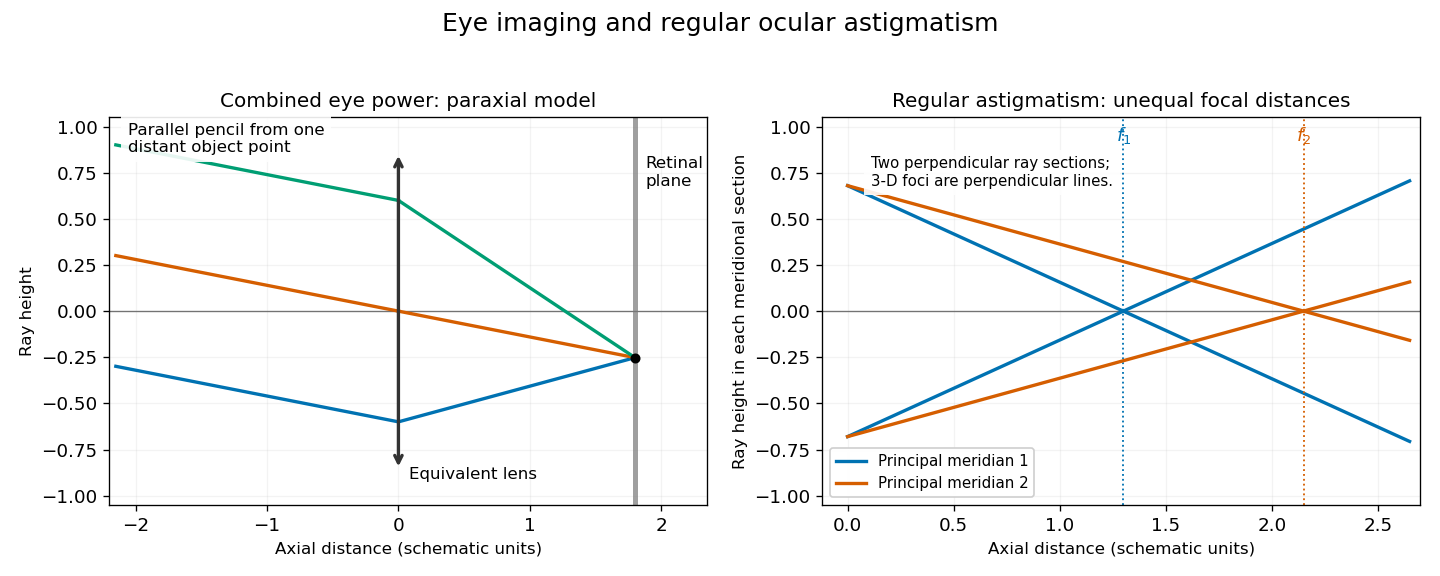

In regular ocular astigmatism, the two principal meridians are perpendicular but have different refractive powers, commonly because the cornea has different curvatures in those meridians. A point object then gives two line foci at different depths rather than a single sharp point. The difference is not merely an overall spherical focusing error. Refraction with differently oriented cylindrical trial lenses can locate the power and axis; keratometry or corneal topography measures corneal shape. Cylindrical lens or toric lens correction supplies the missing meridional power with the proper orientation. Spectacles and appropriately fitted toric contact lenses can provide such correction. A method for measuring corneal curvature should not be confused with a complete measurement of the eye's total refractive error.[ref]
Physiology of Astigmatism by the American Academy of Ophthalmology. Regular astigmatism and principal meridians
[ref]Original question.
When plane polarised light, after passing through a tube filled with an aqueous solution of sugar, is plane analysed, what phenomena are observed ?
Describe Biot's Saccharometer, and the method of using it for determining the amount of sugar present in diabetic urine.
An optically active glucose solution rotates the direction of linear polarization. With monochromatic illumination, rotating the polarimeter analyzer again produces a maximum and an extinction, but at angles shifted from the water-filled reference tube. In an ideal transparent sample, Malus's law givesThe specific rotation is defined for a stated temperature, wavelength, solvent and concentration convention. With in decimetres and in grams per millilitre, the conventional numerical value of must use the matching units. A broadband source generally gives coloured appearances because the rotation varies with wavelength; one analyser angle need not extinguish every colour.
Biot's saccharimeter is an angular polarimeter: a polarizing element, a tube of accurately known optical path length holding the sample between plane end windows, and a rotatable analysing element with an angular scale. The original arrangement used a black-glass polarizing mirror and a calcite analyser; later two-prism designs implement the same angular measurement. It should be distinguished from a later quartz-wedge compensating saccharimeter, which cancels the sample's rotation instead of directly reading the analyser rotation.[ref]
A Handbook of Sugar Analysis by Charles Albert Browne Jr.. pp.84–85, original Biot polariscope and simple angular polariscope; chapter VI, quartz-wedge compensation
For a historical urine estimate, clarify a sample without changing its sugar inventory, fill the tube without bubbles, make a solvent blank at the same settings, and measure the signed rotation relative to that blank. With a known dilution factor and an appropriate equilibrium glucose calibration,Repeat the reading and check a known glucose solution. Mutarotation makes the time since preparation relevant. The inference is selective only to the extent that other optically active solutes have been excluded or accounted for; a net rotation is not proof that every contribution is glucose. This is a historical analytical application, not a replacement for present clinical assessment of diabetes.
Original question.
Describe experiments shewing the conversion of work into heat (1) directly, (2) indirectly through electricity.
How much work must be done upon half a kilogram of copper (specific heat 0·095) in order to raise its temperature from C to C ?
For direct conversion, descending masses can drive paddles in an insulated vessel of water. Measure the lost gravitational potential energy and the temperature rise, including the vessel's heat capacity and corrections for unwanted heat transfer. Repeated reversal of the paddles and fixed baffles inhibit simple bulk co-rotation, directing more of the input towards dissipative fluid motion. Joule's paddle-wheel experiment tests a quantitative mechanical-to-thermal balance, rather than merely observing that stirring can warm water.[ref]
On the Mechanical Equivalent of Heat by James Prescott Joule. 1850, friction experiments and calorimetric corrections
For conversion through electricity, mechanical work drives a generator, whose electric current passes through a resistor in a calorimeter. The measured electrical input is , or for constant electric current and electrical resistance. Joule heating increases the internal energy of the resistor and surrounding water. Compare the generator's mechanical input with the total thermal gains, including generator and circuit losses if the system boundary contains them. A battery alone demonstrates electrical-to-thermal conversion; without accounting for a mechanically driven source it does not establish the requested mechanical intermediate chain.
Using the given value relative to water, the copper requiresWith the modern thermochemical calorie, , so the ideal required work isEquivalently it is about using standard gravity. A nineteenth-century numerical equivalent of heat could give a slightly different rounded result. The stipulated constant specific heat capacity is used here; an unprovided vessel heat capacity and environmental losses would add to the required input.
Original question.
How is the latent heat of a vapour estimated ? How has it been proposed to employ the absorption of heat attending the change from the liquid to the gaseous state as a means of destroying sensation in any part of the body, on which an operation is to be performed ?
Evaporation cools the remaining material when the escaping vapour takes energy from it faster than the surroundings supply heat. For an observable demonstration, compare two similar thermometer bulbs at the same initial temperature, one dry and the other wetted with a volatile liquid. Expose both to the same controlled airflow. The wetted bulb falls in temperature; the effect depends on vapour removal and environmental conditions. Another demonstration is continued heating during boiling at constant pressure: vapour is produced while the boiling liquid's temperature remains nearly constant. The supplied energy has not vanished; it contributes to the latent heat and expansion associated with the phase transition.
One calorimetry method estimates the specific latent heat of vaporization by condensing a known mass of dry saturated steam at into a known mass of cooler water. Let be the vessel's heat capacity, and the initial and final water temperatures. Assuming complete condensation without escaped steam or thermal losses,soThe last term removes the sensible cooling of the condensed steam. Weighing the receiving vessel before and after gives only if splashing, evaporation and liquid carried in with the steam are controlled. A steam trap and an insulated transfer path address two distinct errors: droplets falsely counted as condensing steam, and cooling before the calorimeter.
The historical local application was Richardson's ether spray. A bellows atomizer dispersed diethyl ether into fine droplets, promoting rapid vaporization and withdrawal of heat from the surface; the cooling could produce local loss of sensation. Benjamin Ward Richardson's 1866 account describes this evaporative method and its apparatus. Its historical physiological language is not adopted as a modern description of nerve signalling, and the account does not establish that the method is appropriate for every operation.[ref]
On a New and Ready Mode of Producing Local Anæsthesia by Benjamin Ward Richardson. 1866, description of the spray apparatus and cooling mechanism
Original question.
When a closed vessel containing a gas is heated at the bottom, explain how the gas becomes heated throughout.
In ventilating a room, at what places should the cold air be admitted ? Give your reasons for your answer.
At the heated bottom, thermal conduction first transfers energy into the adjacent gas. A warmer parcel ordinarily has lower density than its cooler surroundings at approximately the same local pressure, so buoyancy drives it upward. Cooler gas replaces it below, creating natural convection. Motion and mixing transport warm gas through the vessel, with conduction continuing across smaller temperature differences. In a sealed rigid vessel the mean pressure can rise as heating continues; “less dense at the same local pressure” is the buoyancy comparison, not a claim that the vessel's overall pressure stays fixed.
A useful control heats an otherwise similar vessel at the top: the resulting warm-over-cold arrangement is stably stratified, suppressing the overturning seen with bottom heating. Heat still spreads by thermal conduction; absence of bulk overturning does not mean absence of heat transfer.
For unwarmed cold outside air, use distributed high-level inlets or upper window openings that let the incoming stream mix with warmer room air before descending into the occupied region. A concentrated low-level cold stream can pass directly across people's feet without first mixing. Provide a separate route for outgoing air and avoid an inlet-to-outlet shortcut that leaves the occupied region poorly ventilated. The UK Health Security Agency's guidance specifically notes that a top window opening allows incoming air to warm as it mixes, reducing cold draughts.[ref]
Ventilation to Reduce the Spread of Respiratory Infections by the UK Health Security Agency. Natural ventilation in the home, top window openings and mixing
This is not a universal rule that every inlet belongs at the ceiling. A low inlet beside a heat source can warm the air before it rises, and deliberately designed displacement systems use other arrangements. Wind, opening heights, available pressure differences and the exhaust path determine the actual flow. The relevant principles are controlled air replacement, buoyancy and mixing, not height in isolation.
Original question.
When a plate of copper, and a plate of amalgamated zinc are placed in a vessel containing dilute sulphuric acid, state what takes place (1) when the plates are not connected, (2) when they are connected by a wire.
With the electrodes disconnected, the copper has no sustained external route through which to receive electrons from the zinc. It is not appreciably attacked by a clean, dilute nonoxidizing sulfuric acid solution. Zinc can in principle reduce acid while dissolving, but amalgamation suppresses much of the local action associated with impurities and promotes a high kinetic barrier for hydrogen evolution on the amalgamated surface. Thus the intended historical observation is little visible action with the circuit open, not a thermodynamic assertion that zinc cannot react with acid.
Closing the external wire supplies an electron path. At the zinc anode,at the copper cathode,The net redox is thereforeThe zinc dissolves, and bubbles of hydrogen appear chiefly at the copper. Electrons flow through the wire from zinc to copper; conventional electric current flows oppositely there. Ionic transport through the electrolyte completes the circuit and prevents indefinite charge accumulation in the solution. The copper primarily provides a conducting surface: there is no stipulated copper-ion solution from which metallic copper must be deposited, so this is not the Daniell cell reaction.
The chemical energy supplies the electrical work. Accumulation of hydrogen and changing interfacial conditions can polarize the cell, reducing the current. A complete description therefore distinguishes the initial closed-circuit response from an indefinitely constant-current idealization. Electrochemical overpotential explains why a favorable reaction and its observable rate are different questions.
Original question.
Explain the construction of Nobili's astatic Multiplier.
In physiological research should the Multiplier be constructed with a long or a short coil ? Give your reasons for your answer.
For Ørsted's experiment, place a long straight conducting wire close to and parallel with a freely moving horizontal compass needle. With no electric current, the needle follows the horizontal terrestrial magnetic field. Closing the circuit deflects it; reversing the electric current reverses the deflection, and moving the wire from above to below the needle also reverses the effect. For a long straight wire, the modern idealization iswith the circular direction given by the right-hand rule. These controls distinguish a magnetic action of the current from a fixed magnetized piece of wire or a mechanical disturbance.
Nobili's astatic galvanometer increases sensitivity in two ways. A coil with many turns multiplies the magnetic action of a given electric current. Two nearly equal magnetized needles are rigidly connected with opposite magnetic dipole moments and suspended by a fine thread. Their torques in the approximately uniform terrestrial field nearly cancel. In a common arrangement one needle lies inside the coil and the other above it, outside its strongest field, so the coil retains a substantial torque while the terrestrial restoring torque is reduced. A weak residual magnetic or suspension torque still provides a reproducible equilibrium; “astatic” means nearly cancelled terrestrial torque, not magnetic shielding. A museum instrument dated 1840 has many turns of fine wire and is identified with measurements of muscle currents.[ref]
Astatic Galvanometer, Nobili Pattern by Museo Galileo. Inventory 1417: construction and muscle-current provenance
For weak physiological sources, use a long fine-wire winding with many turns, rather than the short thick winding appropriate to a low-resistance thermoelectric source. The physiological source commonly has a large effective internal resistance; a moderate added coil resistance is then outweighed by the gain in turns. This is a source-and-detector matching argument, not a claim that arbitrarily much wire always improves sensitivity.
For example, at fixed mean turn length and fixed copper winding volume, . For source electromotive force and resistance , the small-angle driving torque is proportional toDifferentiation gives its maximum at . This simple optimal turn count for fixed winding volume model explains why high-source-resistance work favors more turns, while also exposing the limit. Actual instruments additionally trade response time, damping, geometry and source loading against their steady deflection.
Original volume: Examination papers for the Degree of Bachelor of Medicine by the University of Oxford (1864–1867). Open the original paper in the scanned volume. Source range: PDF pages 55–55.
Original questions are transcribed from the public-domain edition. Credit: Wellcome Collection; original supplied by Royal College of Physicians, London. Source and public-domain rights statement.
Original question.
TODO: The single substances in tubes a, b and c and all experimental observations are absent; their identities cannot be determined from the statement.
The identities of , and remain undetermined. The assertion that each tube contains one chemical substance does not specify whether it is an element, a salt or an organic compound, nor which chemical tests would be positive.
A useful qualitative chemical analysis would keep the three samples separate, retain an untouched portion of each, and record their physical state, colour and behaviour with suitable solvents. Small, separately labelled portions would then be used for a logically chosen sequence of chemical tests. For a dissolved salt, for example, examination of its cations and anions addresses different parts of its possible identity; one precipitation reaction is rarely a complete identification. A second independent confirmation and comparison with a known reference would strengthen the conclusion.
The record should distinguish an observation, such as formation of a precipitate under stated conditions, from an inference about composition. No observation, reaction equation or identification can be assigned to any one of , or from the surviving information. The general procedure explains how a candidate could investigate the tubes; it does not complete the missing identifications.
Original question.
TODO: Solutions d and e and their test observations are absent. Iodine and morphia are named testing targets, not reported positive findings.
Neither iodine in nor morphine in is established. “Morphia” is the historical name for morphine. The available task can nevertheless be explained as two distinct analytical investigations, using separate portions and reference preparations.
For , first distinguish free iodine from iodide. A cool, freshly prepared starch solution gives a strong blue colour with accessible iodine under suitable conditions. Test the reagent by itself and beside a known iodine preparation, so that contamination or a failed reagent is not mistaken for an observation about . The intense blue starch indication is documented in contemporary discussion of the 1864 British Pharmacopoeia.[ref]
Chemical News volume 9 (1864). p. 99, The British Pharmacopoeia, starch as an indicator for the first excess of iodine
An absent direct blue response would not, by itself, exclude iodine present as iodide, or establish that the specimen contains no interfering material. If the task includes combined iodine, an appropriately controlled oxidation on a separate portion is needed to liberate testable iodine; the unoxidized and treated portions answer different questions. The response of the untreated specimen must not be confused with one deliberately produced by changing its chemical state. These are possible branches of the investigation, not observations supplied for .
For , use the period's chemical identity reactions as corroborating observations. The British Pharmacopoeia by the General Medical Council (1864) describes the response of hydrochlorate of morphia to iron(III) chloride and nitric acid: the former gives a blue indication under the specified conditions, and the latter an orange-red indication. The monograph is a reference for a defined material; it does not guarantee that every dilute or impure unknown will reproduce those colours.[ref]
British Pharmacopoeia by the General Medical Council (1864). Morphiæ Hydrochloras, Characters and Tests, pp. 93–94; primary monograph reproduced on PDF page 37 of the linked facsimile presentation
Use separate portions for the two tests and include a reagent blank and a known morphine reference. Acidity, concentration and other coloured or reactive constituents can affect interpretation. A single colour should therefore be treated as preliminary evidence rather than a conclusive identification in an unrestricted unknown. An unexplained failure of the known reference would invalidate the comparison, while a coloured blank would indicate a problem independent of .
A completed practical record would give the actual response of each sample, reagent and reference, followed by an appropriately qualified conclusion. The reference behaviours explain the tests; they cannot supply the missing results for or .
Original question.
Prepare some carbonic acid gas, and determine approximately what proportion of this gas mixed with air is sufficient to extinguish the flame of a taper.
Prepare carbon dioxide, make measured mixtures with air, and test a standardized lighted taper in fresh mixtures to find an extinction boundary. In this taper extinction experiment, “carbonic acid gas” means gaseous carbon dioxide, not liquid carbonic acid. The proportion should be reported as a fraction of the final mixture, with the conditions of the test.
A documented sufficient mixture is available from a later first-hand experiment: one volume of carbon dioxide with two volumes of air extinguished the introduced taper in the apparatus used. ThusThis is a conditional literature result, not an invented observation from the Oxford examination. In The True Position of Oxygen as a Restorative in Carbonic Acid Poisoning by W. Ernest Thomson, Experiment XLVIII directly compares one-third carbon dioxide mixed with two-thirds oxygen and with two-thirds air; the latter extinguished the taper. The experiment was published in 1894, so it supplies a later physical comparison rather than evidence of what the 1866 candidate measured.[ref]
The True Position of Oxygen as a Restorative in Carbonic Acid Poisoning by W. Ernest Thomson. p. 36, Experiment XLVIII (Physical Experiment), especially preparation (2)
The question asks for an approximately sufficient proportion; it does not explicitly require a universal minimum. The cited condition supplies one sufficient point. To find approximately the least sufficient proportion for the proposed apparatus, determine the lower boundary by the following procedure instead of treating one-third as that boundary.
Prepare the carbon dioxide in a small gas-generating flask by adding dilute hydrochloric acid to calcium carbonate:Fit a delivery tube, keep the outlet unobstructed, and discard the first gas while the original air is being displaced from the apparatus. A wash bottle and droplet trap can reduce acid carry-over before collection in a freely moving gas syringe or suitable gas holder. This acid-carbonate preparation is also used in a current Royal Society of Chemistry demonstration.[ref]
Fire stopper by the Royal Society of Chemistry. Teaching goal, calcium carbonate–hydrochloric acid preparation and equation
A separate sample may be checked with limewater:The turbidity is a qualitative check for carbon dioxide; it is not a measurement of the fraction in the flame-testing mixture. Avoid using a water-filled collecting vessel for the quantitative mixing stage without allowing for dissolved carbon dioxide and water vapour.For the mixing stage, use two calibrated gas syringes and a closed mixing vessel with a means of transferring the mixture into a larger flame-testing jar. Measure the component gas volumes at the same temperature and pressure. Mix the gases thoroughly before the flame test. If the gases behave approximately as an ideal gas mixture, their measured volume fractions then approximate their mole fractions. For example, an intended one-third mixture can be prepared from one measured portion of carbon dioxide and twice that volume of air. These are preparation instructions, not recorded trial outcomes.
Keep the taper's material, exposed wick, initial candle flame, insertion depth, gas volume and test duration fixed. Give the flame a reproducible exposure, using a gas-filled jar and a narrow insertion opening with a loose collar to limit entry of fresh air. The observation period must be specified before testing; a fixed five-second exposure is one possible chosen protocol, not a reported condition of the historical reference experiment. Use a large mixture volume relative to the small taper, introduce it briefly, and use a fresh mixture for every trial; prolonged burning changes the mixture by consuming oxygen and producing carbon dioxide and water vapour. Do not seal a burning vessel into an improvised pressure-tight apparatus.
Start with an air control that sustains the taper. Test successively richer, separately prepared carbon dioxide mixtures until extinction occurs within the specified observation period. Retest with a less rich mixture and subdivide the interval. Repeat mixtures near the boundary to detect inconsistent results. A completed experiment would report, for example, the greatest tested fraction at which burning consistently persists and the smallest tested fraction that consistently extinguishes the taper. If the responses are ordered and reproducible under the fixed protocol, reportA midpoint and half-interval may describe the resolution of that bracket; they are not a statistical confidence interval. No numerical values of or are supplied by the source, and none are asserted here.
For a useful model check, let denote the initial oxygen fraction in air, and let denote the fraction of added pure carbon dioxide in the final mixture. Before the taper changes the gas, an ideal, uniformly mixed replacement model givesTaking dry air to have is an explicit model input. For the documented one-third mixture, this gives , or about oxygen. It is a calculation from an assumed starting composition, not a measured oxygen analysis or a general extinction rule. Also distinguish a fraction of the final mixture from an addition relative to the original air: the volume ratio satisfies , so a 1:2 addition ratio means , not .
Carbon dioxide affects the thermal balance of a diffusion flame as well as the oxidizer fraction. Extinction therefore depends on the taper, mixing, gas flow, temperature, pressure and heat loss; an oxygen-dilution calculation alone cannot predict its value. The official account of carbon dioxide suppression describes its predominantly thermophysical action.[ref]
Finally, distinguish this experiment from covering a burning candle and waiting for it to go out. That procedure simultaneously changes gas composition, temperature and spatial distribution. A modern experimental study using gas and temperature sensors found different conditions at different heights and extinction before all oxygen was consumed.[ref]
Changes of CO2 Concentration and Heat Illustrate Why the Flame Is Extinguished in the Candle-and-Cylinder Experiment. Abstract, sensor measurements at different heights and remaining oxygen
A pouring demonstration with unmixed carbon dioxide likewise does not determine a uniform bulk fraction. A sufficient, condition-labelled literature mixture and a reproducible bracketing procedure answer the available task; an actual examination threshold or a universal minimum is not claimed.Original volume: Examination papers for the Degree of Bachelor of Medicine by the University of Oxford (1864–1867). Open the original paper in the scanned volume.
Original questions are transcribed from the public-domain edition. Credit: Wellcome Collection; original supplied by Royal College of Physicians, London. Source and public-domain rights statement.
Original question.
(a) At the Radcliffe Infirmary.
Original question.
(a) At the Radcliffe Infirmary.
Write a Report on the cases of
⟦patient name left blank in the source⟧, ⟦ward left blank in the source⟧ Ward,
and
⟦patient name left blank in the source⟧, ⟦ward left blank in the source⟧ Ward,
giving with care their history, diagnosis, and prognosis, and also the treatment you would recommend. Add such general remarks as occur to you by way of Clinical comment on such cases in general.
TODO: The two case identities, ward names, histories, findings and treatment records are absent; patient and ward spaces are originally blank.
Original question.
(a) At the Radcliffe Infirmary.
Examine the Urine marked A and B, Microscopically and Chemically, and write a methodical account of your plan of examination.
TODO: Urine samples A and B and their chemical and microscopic results are absent; only a general examination plan can be given.
Original question.
(a) At the Radcliffe Infirmary.
Make a Post Mortem Examination of the Body of
⟦name left blank in the source⟧
in the Mortuary, and demonstrate the Morbid Parts.
TODO: The body identity, post-mortem observations and morbid parts are absent; the body-name space is originally blank.
Original question.
Describe and sketch from microscopical examination the object marked B.
Articles were limited to the first 100 out of 177 total.
Articles by others on the same topic
There are currently no matching articles.