Original volume: Examination papers for the Degree of Bachelor of Medicine by the University of Oxford (1864–1867). Open the original paper in the scanned volume.
Original questions are transcribed from the public-domain edition. Credit: Wellcome Collection; original supplied by Royal College of Physicians, London. Source and public-domain rights statement.
Original question.
Define a lever, and state its mechanical advantage. Into what classes have straight levers been divided ? Describe the mechanism by which the human arm is bent and extended.
A lever is a body free to rotate about a fulcrum. Its usefulness comes from a balance of torques, not from producing energy. For a stationary ideal lever, let and be the perpendicular lever arms of the effort and load . ThenThe mechanical advantage uses perpendicular distances to the lines of action, which need not equal distances measured along a bent or obliquely loaded arm. In an ideal slow motion, the effort moves through the larger distance when its force is the smaller: work is conserved.
For the three familiar straight arrangements, the fulcrum lies between effort and load in a first-class lever, the load lies between fulcrum and effort in a second-class lever, and the effort lies between fulcrum and load in a third-class lever. The second class has ideal mechanical advantage greater than one; the third has it less than one. The first can have either, depending on the lever arms.
The forearm bends by elbow flexion. The biceps brachii and brachialis pull through short tendons close to the elbow, while a load in the hand acts farther away. This is predominantly a third-class arrangement: a large muscle force buys a comparatively large and rapid hand displacement. The biceps brachii also contributes to forearm supination. Elbow extension is produced chiefly by the triceps brachii, whose tendon acts on the olecranon behind the elbow. The extensor insertion and forearm load lie on opposite sides of the effective pivot, giving the corresponding first-class analogy. Actual anatomical joint motion has changing muscle moment arms, and the joint reaction force also enters the full force balance; the body is not a set of frictionless pins. [ref]
Original question.
Describe the variations which the effective force of gravity undergoes in sustaining the motion of a simple pendulum.
The magnitude of the gravitational force remains approximately during a laboratory swing. Its tangential component changes with position, however. For simple pendulum length and angle measured from the downward vertical,This restoring component is zero at the lowest point and largest in magnitude at the turning points. It always accelerates the bob towards the lowest point. The radial gravitational component is ; the string tension must additionally supply the centripetal acceleration, so . Thus it is the radial resultant, not gravity alone, that bends the trajectory. The bob has maximum speed at the bottom even though its tangential acceleration is then zero.
For a small angular amplitude, the small-angle approximation gives simple harmonic motion with oscillation period . Measure from pivot to the bob's centre of mass, time many complete swings, divide the elapsed time by their number, and calculateRepeat with several lengths and plot against ; the ideal slope is . The first-order relative uncertainty obeys , with absolute uncertainty contributions combined according to their dependence. Keep the amplitude small: the finite-amplitude period is , with in radians. Using the longer finite-amplitude period in the small-amplitude formula would underestimate . Pivot friction, a finite bob and support motion are further experimental corrections.[ref]
University Physics Volume 1 by William Moebs and others. §15.4, simple pendulum and small-angle period
Original question.
Describe the common Hydrometer, and the method of using it.
A hydrometer is a sealed floating instrument with a weighted bulb and a narrow graduated stem. The ballast keeps the stem upright. By Archimedes' principle, its gravitational weight equals the buoyancy:It therefore sinks farther into a less dense liquid, displacing more volume, and floats higher in a denser one. The stem makes a small volume change readily visible as a change in immersion. If its cross-sectional area is , then over a uniform part of the stem. A density scale is consequently not generally uniform in .
Float the clean instrument freely in a sufficiently deep sample, without its touching the wall or bottom. Remove adhering bubbles, allow the temperature and motion to settle, and read the liquid surface at eye level using the meniscus convention specified for that instrument. A calibration for a particular temperature or reference density cannot be transferred without correction: both the sample and the instrument expand. An ordinary hydrometer measures density or specific gravity; a special scale for a particular chemical solution does not make it chemically selective. In particular, dissolved substances other than glucose can affect the density of urine.
Original question.
When a fine tube open at both ends is dipped in a liquid, describe the principal phenomena observed, and state the laws which they are found to obey.
A clean narrow tube dipped in a wetting liquid displays a curved meniscus and a rise above the external free surface. With a nonwetting liquid, such as Mercury against clean glass under the usual conditions, there is a convex meniscus and a depression. The material pair and surface cleanliness matter; small diameter alone does not determine the sign.
For a circular tube of radius , surface tension , and equilibrium contact angle measured through the liquid, the vertical force at the contact line is . Neglecting the small meniscus-volume correction, its balance with the excess column's gravitational weight gives Jurin's law:Thus the signed height is inversely proportional to radius for a fixed liquid, wall, temperature and contact angle. Increasing the tube length beyond the required column does not increase the equilibrium height. A short tube that cannot contain that column is a different boundary problem.
The same result follows from the Young–Laplace equation: a curved interface supports a capillary pressure difference, balanced by the hydrostatic head. Molecular interactions establish the surface tension and the preference for wetting the solid, encoded in the contact angle. The force balance does not require molecules to attract across the whole height of the column. To test the inverse-radius law, use tubes of several measured radii with the same surface preparation, and compare after equilibrium; different cleaning or contact-angle hysteresis can otherwise imitate a failure of the radius law.
Original question.
A free reed is a thin elastic tongue fixed at one end over a closely fitting opening in a rigid frame. A pressure difference drives an airflow; displacement of the tongue alters the available opening, and the changing aerodynamic force can sustain its vibration against elastic restoring force and damping. Unlike a beating reed, the tongue passes through the opening without regularly striking its rim. The air supply provides the energy; the reed's dimensions and stiffness largely set the pitch, while its enclosure and any attached pipe modify the response and radiated sound waves.
The useful analogy with phonation is an airflow-driven valve coupled to an elastic oscillator. Air from the lungs passes between the vocal folds in the larynx. Their motion periodically modulates the flow, generating a rich sound spectrum; the pharynx, mouth and nasal passages filter it, while the tongue and lips help form speech sounds. The vocal folds are paired living tissues with adjustable tension and geometry, rather than a single metal tongue. Their oscillation should not be explained as a passive string struck repeatedly by air, nor does the free-reed analogy establish every detail of tissue motion. [ref]
Taking Care of Your Voice by the National Institute on Deafness and Other Communication Disorders. “What is voice?” and the labelled structures of voice production
Changing vocal-fold tension and effective vibrating mass changes the source pitch. Changing the resonating passages changes its spectral envelope and the vowel quality. Those are different controls: a singer can change pitch while retaining a recognisable vowel, or change vowel while sustaining approximately the same pitch.
Original question.
Describe the structure of the eye, considered as an optical instrument, and trace the course of the pencils of light which produce the image on the retina, illustrating by a figure.
What is the nature of the defect known as regular astigmatism, what is its cause, how is it detected, and how remedied ?
The cornea supplies much of the eye's converging optical power; the crystalline lens supplies additional, adjustable power through ocular accommodation. The transparent aqueous and vitreous media transmit the light. The iris controls the pupil, acting as an aperture rather than as the focusing element, and the retina is the receiving surface. The posterior optic nerve conveys the resulting neural signals; it does not carry an optical picture out of the eye.
Each sufficiently small object patch sends a pencil of rays through the pupil. Refraction at the corneal and lenticular surfaces brings that pencil towards a retinal image point. Pencils from different object heights meet at different retinal positions, producing a real inverted image. In a paraxial equivalent model,The several physical refracting surfaces have been replaced here by an equivalent thin lens; this is a model, not a claim that all bending occurs at the crystalline lens. For a distant object, approximately parallel incoming pencils focus near the back focal surface. Ocular accommodation increases power for nearer objects while the retinal position remains nearly fixed.
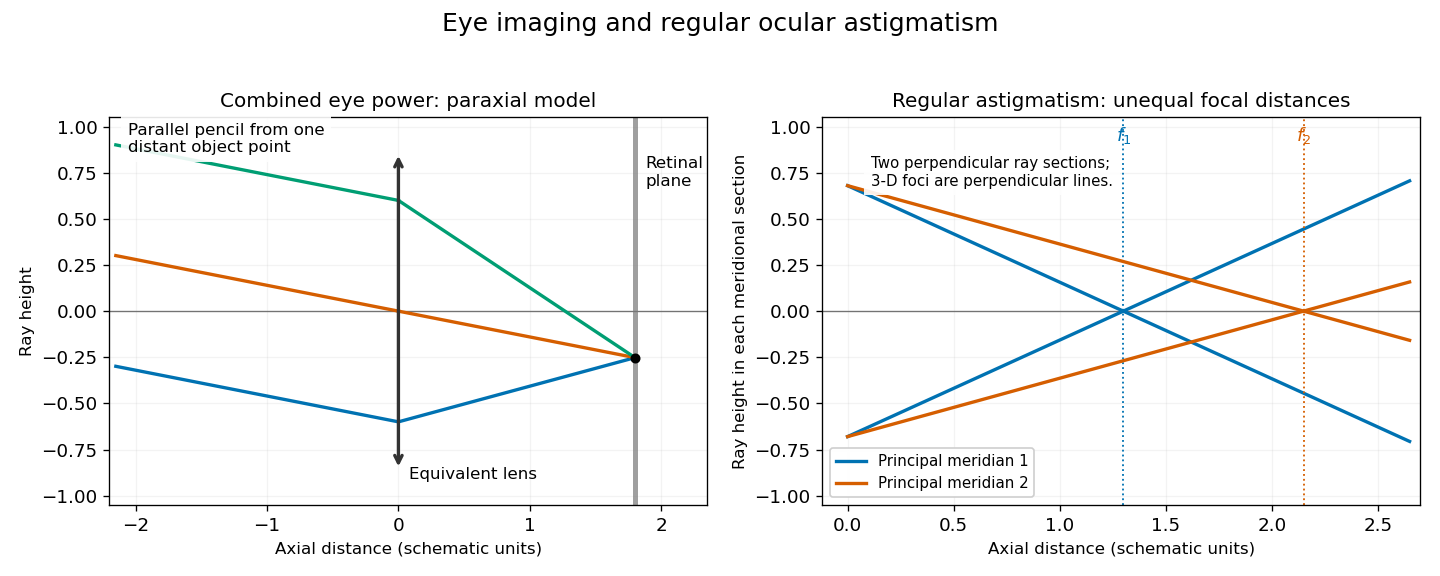

In regular ocular astigmatism, the two principal meridians are perpendicular but have different refractive powers, commonly because the cornea has different curvatures in those meridians. A point object then gives two line foci at different depths rather than a single sharp point. The difference is not merely an overall spherical focusing error. Refraction with differently oriented cylindrical trial lenses can locate the power and axis; keratometry or corneal topography measures corneal shape. Cylindrical lens or toric lens correction supplies the missing meridional power with the proper orientation. Spectacles and appropriately fitted toric contact lenses can provide such correction. A method for measuring corneal curvature should not be confused with a complete measurement of the eye's total refractive error.[ref]
Physiology of Astigmatism by the American Academy of Ophthalmology. Regular astigmatism and principal meridians
[ref]Original question.
When plane polarised light, after passing through a tube filled with an aqueous solution of sugar, is plane analysed, what phenomena are observed ?
Describe Biot's Saccharometer, and the method of using it for determining the amount of sugar present in diabetic urine.
An optically active glucose solution rotates the direction of linear polarization. With monochromatic illumination, rotating the polarimeter analyzer again produces a maximum and an extinction, but at angles shifted from the water-filled reference tube. In an ideal transparent sample, Malus's law givesThe specific rotation is defined for a stated temperature, wavelength, solvent and concentration convention. With in decimetres and in grams per millilitre, the conventional numerical value of must use the matching units. A broadband source generally gives coloured appearances because the rotation varies with wavelength; one analyser angle need not extinguish every colour.
Biot's saccharimeter is an angular polarimeter: a polarizing element, a tube of accurately known optical path length holding the sample between plane end windows, and a rotatable analysing element with an angular scale. The original arrangement used a black-glass polarizing mirror and a calcite analyser; later two-prism designs implement the same angular measurement. It should be distinguished from a later quartz-wedge compensating saccharimeter, which cancels the sample's rotation instead of directly reading the analyser rotation.[ref]
A Handbook of Sugar Analysis by Charles Albert Browne Jr.. pp.84–85, original Biot polariscope and simple angular polariscope; chapter VI, quartz-wedge compensation
For a historical urine estimate, clarify a sample without changing its sugar inventory, fill the tube without bubbles, make a solvent blank at the same settings, and measure the signed rotation relative to that blank. With a known dilution factor and an appropriate equilibrium glucose calibration,Repeat the reading and check a known glucose solution. Mutarotation makes the time since preparation relevant. The inference is selective only to the extent that other optically active solutes have been excluded or accounted for; a net rotation is not proof that every contribution is glucose. This is a historical analytical application, not a replacement for present clinical assessment of diabetes.
Original question.
Describe experiments shewing the conversion of work into heat (1) directly, (2) indirectly through electricity.
How much work must be done upon half a kilogram of copper (specific heat 0·095) in order to raise its temperature from C to C ?
For direct conversion, descending masses can drive paddles in an insulated vessel of water. Measure the lost gravitational potential energy and the temperature rise, including the vessel's heat capacity and corrections for unwanted heat transfer. Repeated reversal of the paddles and fixed baffles inhibit simple bulk co-rotation, directing more of the input towards dissipative fluid motion. Joule's paddle-wheel experiment tests a quantitative mechanical-to-thermal balance, rather than merely observing that stirring can warm water.[ref]
On the Mechanical Equivalent of Heat by James Prescott Joule. 1850, friction experiments and calorimetric corrections
For conversion through electricity, mechanical work drives a generator, whose electric current passes through a resistor in a calorimeter. The measured electrical input is , or for constant electric current and electrical resistance. Joule heating increases the internal energy of the resistor and surrounding water. Compare the generator's mechanical input with the total thermal gains, including generator and circuit losses if the system boundary contains them. A battery alone demonstrates electrical-to-thermal conversion; without accounting for a mechanically driven source it does not establish the requested mechanical intermediate chain.
Using the given value relative to water, the copper requiresWith the modern thermochemical calorie, , so the ideal required work isEquivalently it is about using standard gravity. A nineteenth-century numerical equivalent of heat could give a slightly different rounded result. The stipulated constant specific heat capacity is used here; an unprovided vessel heat capacity and environmental losses would add to the required input.
Original question.
How is the latent heat of a vapour estimated ? How has it been proposed to employ the absorption of heat attending the change from the liquid to the gaseous state as a means of destroying sensation in any part of the body, on which an operation is to be performed ?
Evaporation cools the remaining material when the escaping vapour takes energy from it faster than the surroundings supply heat. For an observable demonstration, compare two similar thermometer bulbs at the same initial temperature, one dry and the other wetted with a volatile liquid. Expose both to the same controlled airflow. The wetted bulb falls in temperature; the effect depends on vapour removal and environmental conditions. Another demonstration is continued heating during boiling at constant pressure: vapour is produced while the boiling liquid's temperature remains nearly constant. The supplied energy has not vanished; it contributes to the latent heat and expansion associated with the phase transition.
One calorimetry method estimates the specific latent heat of vaporization by condensing a known mass of dry saturated steam at into a known mass of cooler water. Let be the vessel's heat capacity, and the initial and final water temperatures. Assuming complete condensation without escaped steam or thermal losses,soThe last term removes the sensible cooling of the condensed steam. Weighing the receiving vessel before and after gives only if splashing, evaporation and liquid carried in with the steam are controlled. A steam trap and an insulated transfer path address two distinct errors: droplets falsely counted as condensing steam, and cooling before the calorimeter.
The historical local application was Richardson's ether spray. A bellows atomizer dispersed diethyl ether into fine droplets, promoting rapid vaporization and withdrawal of heat from the surface; the cooling could produce local loss of sensation. Benjamin Ward Richardson's 1866 account describes this evaporative method and its apparatus. Its historical physiological language is not adopted as a modern description of nerve signalling, and the account does not establish that the method is appropriate for every operation.[ref]
On a New and Ready Mode of Producing Local Anæsthesia by Benjamin Ward Richardson. 1866, description of the spray apparatus and cooling mechanism
Original question.
When a closed vessel containing a gas is heated at the bottom, explain how the gas becomes heated throughout.
In ventilating a room, at what places should the cold air be admitted ? Give your reasons for your answer.
At the heated bottom, thermal conduction first transfers energy into the adjacent gas. A warmer parcel ordinarily has lower density than its cooler surroundings at approximately the same local pressure, so buoyancy drives it upward. Cooler gas replaces it below, creating natural convection. Motion and mixing transport warm gas through the vessel, with conduction continuing across smaller temperature differences. In a sealed rigid vessel the mean pressure can rise as heating continues; “less dense at the same local pressure” is the buoyancy comparison, not a claim that the vessel's overall pressure stays fixed.
A useful control heats an otherwise similar vessel at the top: the resulting warm-over-cold arrangement is stably stratified, suppressing the overturning seen with bottom heating. Heat still spreads by thermal conduction; absence of bulk overturning does not mean absence of heat transfer.
For unwarmed cold outside air, use distributed high-level inlets or upper window openings that let the incoming stream mix with warmer room air before descending into the occupied region. A concentrated low-level cold stream can pass directly across people's feet without first mixing. Provide a separate route for outgoing air and avoid an inlet-to-outlet shortcut that leaves the occupied region poorly ventilated. The UK Health Security Agency's guidance specifically notes that a top window opening allows incoming air to warm as it mixes, reducing cold draughts.[ref]
Ventilation to Reduce the Spread of Respiratory Infections by the UK Health Security Agency. Natural ventilation in the home, top window openings and mixing
This is not a universal rule that every inlet belongs at the ceiling. A low inlet beside a heat source can warm the air before it rises, and deliberately designed displacement systems use other arrangements. Wind, opening heights, available pressure differences and the exhaust path determine the actual flow. The relevant principles are controlled air replacement, buoyancy and mixing, not height in isolation.
Original question.
When a plate of copper, and a plate of amalgamated zinc are placed in a vessel containing dilute sulphuric acid, state what takes place (1) when the plates are not connected, (2) when they are connected by a wire.
With the electrodes disconnected, the copper has no sustained external route through which to receive electrons from the zinc. It is not appreciably attacked by a clean, dilute nonoxidizing sulfuric acid solution. Zinc can in principle reduce acid while dissolving, but amalgamation suppresses much of the local action associated with impurities and promotes a high kinetic barrier for hydrogen evolution on the amalgamated surface. Thus the intended historical observation is little visible action with the circuit open, not a thermodynamic assertion that zinc cannot react with acid.
Closing the external wire supplies an electron path. At the zinc anode,at the copper cathode,The net redox is thereforeThe zinc dissolves, and bubbles of hydrogen appear chiefly at the copper. Electrons flow through the wire from zinc to copper; conventional electric current flows oppositely there. Ionic transport through the electrolyte completes the circuit and prevents indefinite charge accumulation in the solution. The copper primarily provides a conducting surface: there is no stipulated copper-ion solution from which metallic copper must be deposited, so this is not the Daniell cell reaction.
The chemical energy supplies the electrical work. Accumulation of hydrogen and changing interfacial conditions can polarize the cell, reducing the current. A complete description therefore distinguishes the initial closed-circuit response from an indefinitely constant-current idealization. Electrochemical overpotential explains why a favorable reaction and its observable rate are different questions.
Original question.
Explain the construction of Nobili's astatic Multiplier.
In physiological research should the Multiplier be constructed with a long or a short coil ? Give your reasons for your answer.
For Ørsted's experiment, place a long straight conducting wire close to and parallel with a freely moving horizontal compass needle. With no electric current, the needle follows the horizontal terrestrial magnetic field. Closing the circuit deflects it; reversing the electric current reverses the deflection, and moving the wire from above to below the needle also reverses the effect. For a long straight wire, the modern idealization iswith the circular direction given by the right-hand rule. These controls distinguish a magnetic action of the current from a fixed magnetized piece of wire or a mechanical disturbance.
Nobili's astatic galvanometer increases sensitivity in two ways. A coil with many turns multiplies the magnetic action of a given electric current. Two nearly equal magnetized needles are rigidly connected with opposite magnetic dipole moments and suspended by a fine thread. Their torques in the approximately uniform terrestrial field nearly cancel. In a common arrangement one needle lies inside the coil and the other above it, outside its strongest field, so the coil retains a substantial torque while the terrestrial restoring torque is reduced. A weak residual magnetic or suspension torque still provides a reproducible equilibrium; “astatic” means nearly cancelled terrestrial torque, not magnetic shielding. A museum instrument dated 1840 has many turns of fine wire and is identified with measurements of muscle currents.[ref]
Astatic Galvanometer, Nobili Pattern by Museo Galileo. Inventory 1417: construction and muscle-current provenance
For weak physiological sources, use a long fine-wire winding with many turns, rather than the short thick winding appropriate to a low-resistance thermoelectric source. The physiological source commonly has a large effective internal resistance; a moderate added coil resistance is then outweighed by the gain in turns. This is a source-and-detector matching argument, not a claim that arbitrarily much wire always improves sensitivity.
For example, at fixed mean turn length and fixed copper winding volume, . For source electromotive force and resistance , the small-angle driving torque is proportional toDifferentiation gives its maximum at . This simple optimal turn count for fixed winding volume model explains why high-source-resistance work favors more turns, while also exposing the limit. Actual instruments additionally trade response time, damping, geometry and source loading against their steady deflection.
Articles by others on the same topic
There are currently no matching articles.