In a vibrating-sample magnetometer, a magnetized specimen vibrates sinusoidally in a nominally uniform applied field. Its motion changes the magnetic flux through stationary pickup coils, producing an induced voltage by Faraday's law of induction. The component at the vibration frequency is proportional to the sample magnetic moment times vibration amplitude and frequency, for a calibrated coil geometry.
A lock-in detector referenced to the vibration extracts this small signal. Calibrate with a known moment, stabilize the vibration amplitude and sweep the applied field to measure a magnetization loop. Dividing moment by film volume gives in ; the silicon substrate and holder background must be subtracted for such a thin film.[ref]
Along the easy axis, expect an approximately rectangular loop: after saturation the remanent magnetization is close to , and reversal occurs near through nucleation and domain-wall motion. Permalloy is magnetically soft, so is ordinarily small, although defects and growth conditions set its actual value.
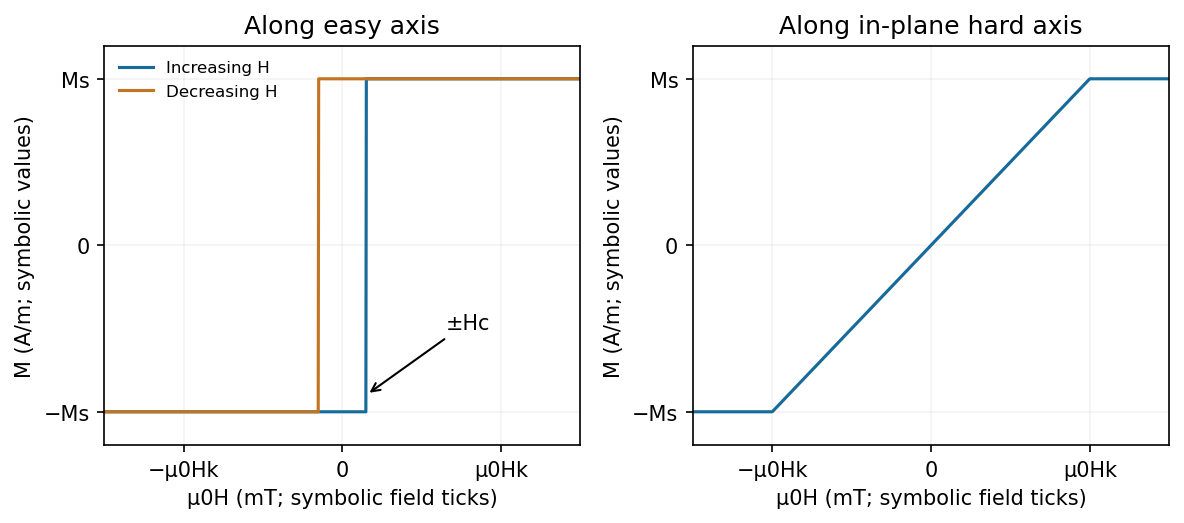

The axes are in and applied in . are symbolic because their measured values are not supplied. The deposition field establishes an axis; it is not the measured coercive or anisotropy field.
Along the in-plane hard axis, the ideal uniform-magnetization model gives reversible rotation from the easy direction toward the applied field. With uniaxial anisotropy energy density , minimization givesfollowed by saturation at . The right panel of the preceding figure therefore has a nearly linear central section, essentially zero remanence and ideally no hysteresis. Actual domains, misalignment and defects can produce rounding or a small loop. This is an in-plane hard axis; the much larger out-of-plane demagnetizing field is a different effect.
Articles by others on the same topic
There are currently no matching articles.