Let run along the wire and across it. In a separable approximation,Transverse confinement gives discrete levels , but the long unconfined direction has a nearly continuous longitudinal wave vector and a plane-wave factor. The result is a family of one-dimensional subbands, not a completely discrete spectrum in both in-plane directions. For a hard-wall width , ; an electrostatic confinement potential gives different thresholds. The suppressed out-of-plane degree of freedom is already frozen into the 2DEG subband.
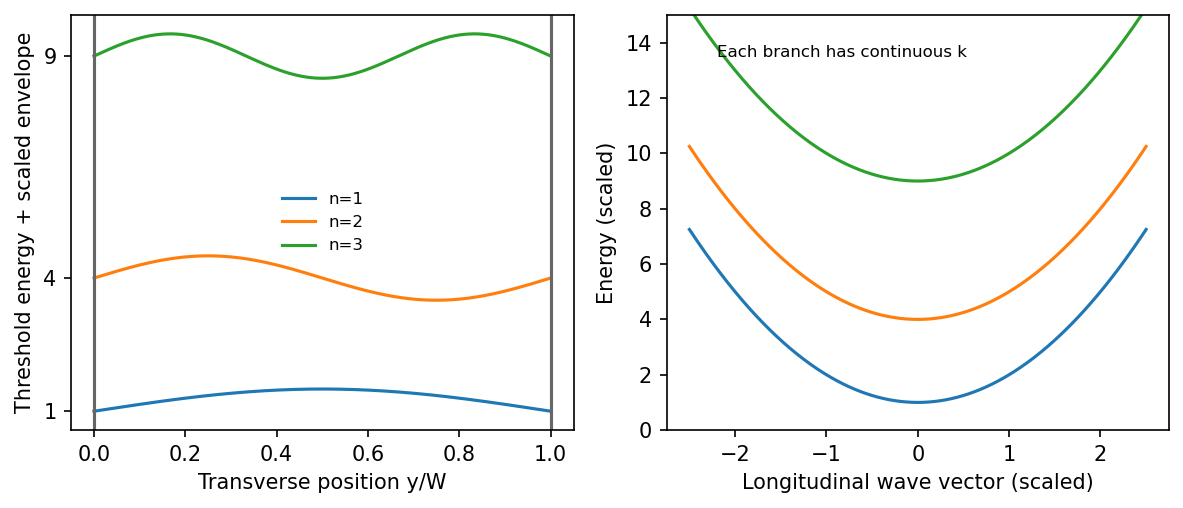
Discrete transverse thresholds coexist with continuous longitudinal dispersion
. Source. Details. One suitable platform is a monolayer molybdenum disulfide semiconductor. An electrostatic accumulation gate supplies conduction electrons whose motion is confined to the atomic sheet; source and drain contacts act as reservoirs. A clean insulating substrate and dielectric or encapsulation reduce disorder and prevent gate leakage. Two split gates deplete the adjacent sheet and leave a narrow conducting gap, thereby confining the in-plane transverse direction while retaining transport along the gap.
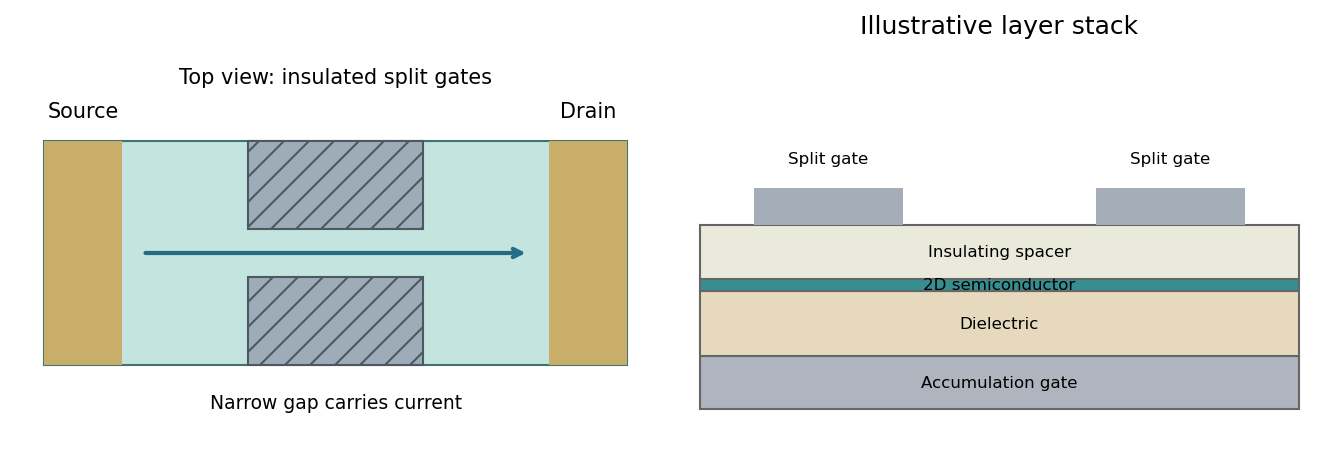
Apply a small source-drain voltage, measure the current and determine linear-response conductance while tuning the split-gate voltage and carrier density. A graphene sheet is another two-dimensional carrier system, but its lack of an ordinary gap complicates purely electrostatic confinement; etched boundaries or a suitable gapped architecture may be needed. A two-dimensional material does not by itself guarantee ballistic transport or resolved subbands.[ref]
Split-gated point-contact in MoS2-hBN structures by Chithra H. Sharma and Madhu Thalakulam. Electrostatic confinement in a two-dimensional semiconductor platform
For a clean, adiabatically connected GaAs channel at low temperature and small bias, opening successive spin-degenerate subbands givesConductance therefore shows a staircase of plateaux, rather than the continuously geometry-dependent classical Ohmic result. Each fully transmitted mode contributes approximately . More positive, or less negative, depletion-gate voltage opens a conventional GaAs constriction; more negative voltage closes it.
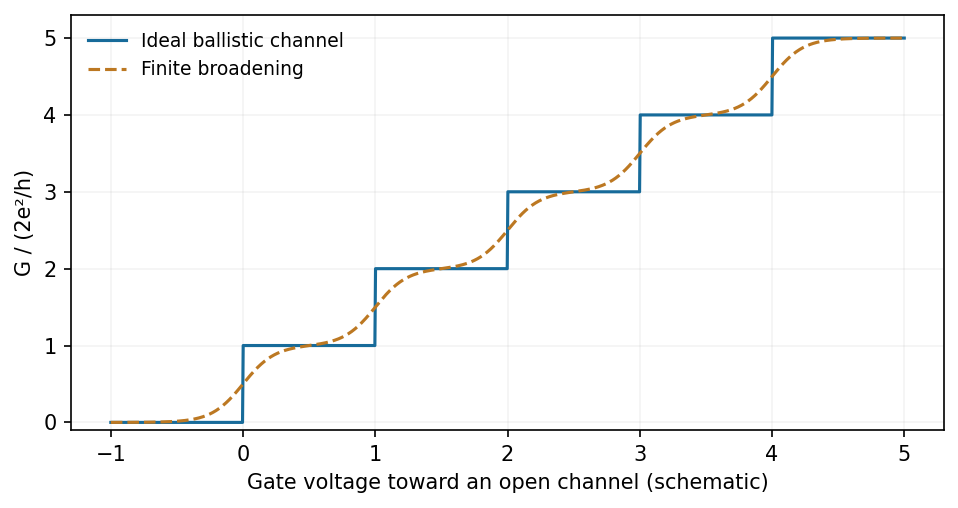
Require subband spacings larger than thermal and bias broadening and a mean free path exceeding the constriction length. The general Landauer formula is with each spin/valley channel counted separately. A material with additional valley degeneracy need not have the same step sequence as GaAs, and imperfect transmission or contact resistance blurs the ideal plateaux.
In a vibrating-sample magnetometer, a magnetized specimen vibrates sinusoidally in a nominally uniform applied field. Its motion changes the magnetic flux through stationary pickup coils, producing an induced voltage by Faraday's law of induction. The component at the vibration frequency is proportional to the sample magnetic moment times vibration amplitude and frequency, for a calibrated coil geometry.
A lock-in detector referenced to the vibration extracts this small signal. Calibrate with a known moment, stabilize the vibration amplitude and sweep the applied field to measure a magnetization loop. Dividing moment by film volume gives in ; the silicon substrate and holder background must be subtracted for such a thin film.[ref]
Along the easy axis, expect an approximately rectangular loop: after saturation the remanent magnetization is close to , and reversal occurs near through nucleation and domain-wall motion. Permalloy is magnetically soft, so is ordinarily small, although defects and growth conditions set its actual value.
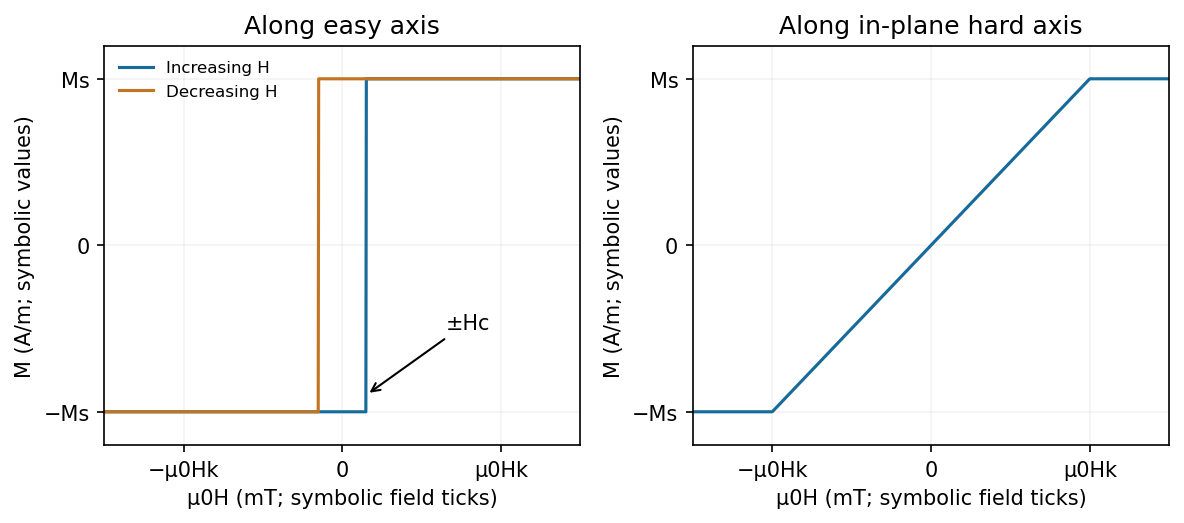


The axes are in and applied in . are symbolic because their measured values are not supplied. The deposition field establishes an axis; it is not the measured coercive or anisotropy field.
Along the in-plane hard axis, the ideal uniform-magnetization model gives reversible rotation from the easy direction toward the applied field. With uniaxial anisotropy energy density , minimization givesfollowed by saturation at . The right panel of the preceding figure therefore has a nearly linear central section, essentially zero remanence and ideally no hysteresis. Actual domains, misalignment and defects can produce rounding or a small loop. This is an in-plane hard axis; the much larger out-of-plane demagnetizing field is a different effect.
Articles by others on the same topic
There are currently no matching articles.