Use substrate-supported chemical vapor deposition. Prepare a clean quartz support with a suitable supported transition-metal catalyst, often nanoscale Fe-containing particles. Catalyst loading, support chemistry and pretreatment control the active particle size and density. A heated carbon-containing gas supplies carbon to those particles, from which carbon nanotubes grow.
At sufficiently high nucleation density, neighboring tubes constrain one another's lateral motion, producing a roughly aligned carbon nanotube forest normal to the support. This is collective crowding, not a requirement that quartz epitaxially orient every tube. Gas delivery, catalyst lifetime and growth time set length and uniformity. Depending on catalyst–support adhesion, catalyst particles can remain near the support or move with growing tips.
The catalyst is supported and the carpet remains attached to a substrate. Check particle distribution and film uniformity separately from tube diameter and alignment; a dense black coating alone does not establish a nanotube forest. The original growth sketch contrasts this supported route with a floating-catalyst reactor.
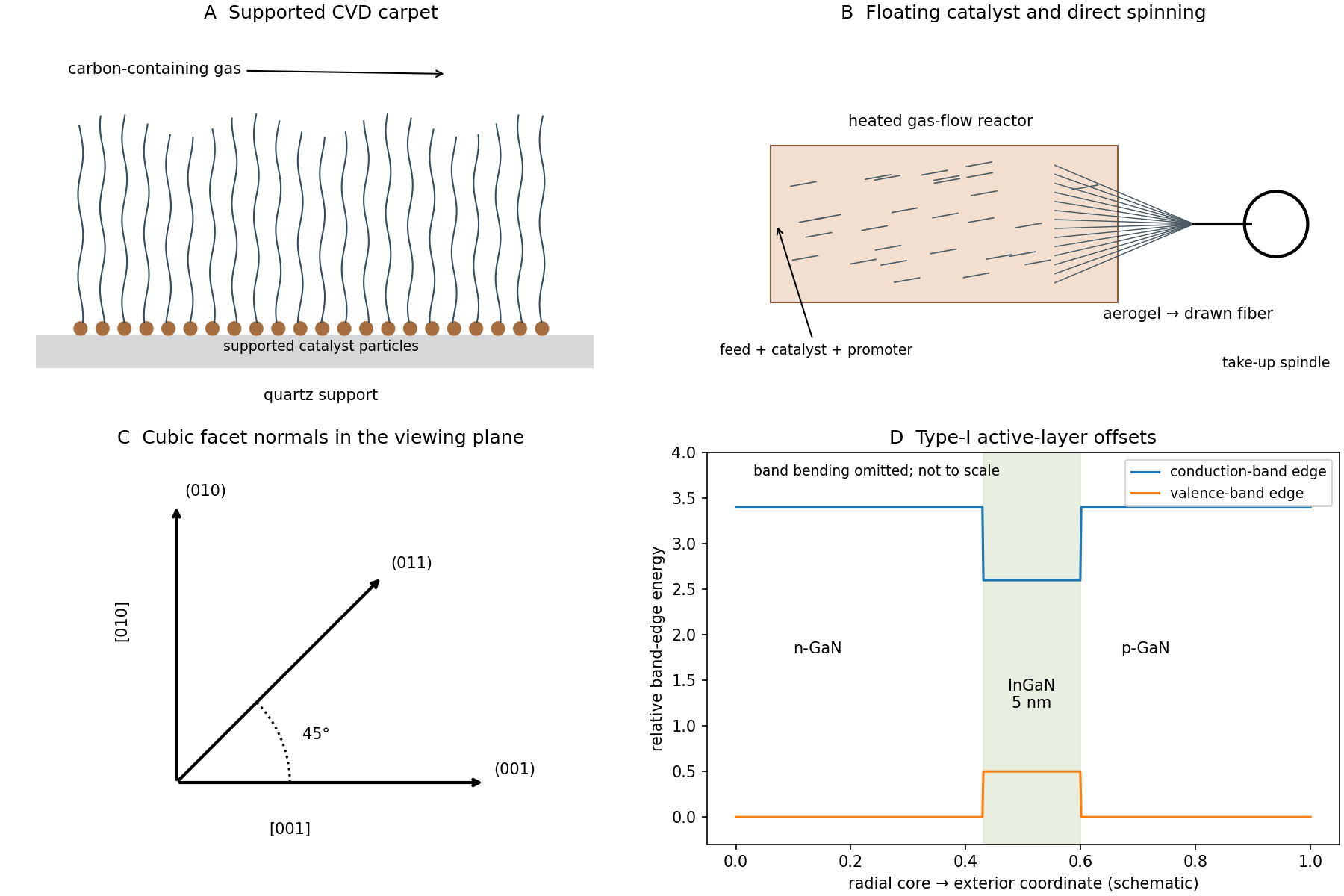
Supported and floating-catalyst nanotube growth, with radial LED band confinement
. Original process schematics and qualitative band-offset profile. No source microscopy is reproduced. The band sketch isolates the active-layer offsets rather than claiming a solved radial junction potential. Details.
Use floating-catalyst chemical vapor deposition to form a continuous suspended network. Introduce a carbon feed together with a volatile catalyst precursor into a hot gas-flow reactor. Catalyst nanoparticles nucleate in the gas stream; tubes grow while moving through the reaction zone and assemble into an interconnected aerogel.
Withdraw that network continuously, collect it on a rotating spindle, and consolidate or twist it into a fiber. Long tubes, suitable number density and adequate overlap allow the network to transmit the drawing force without breaking into isolated clumps. The take-up rate must be matched to network production; collection is not simply a geometrically scaled version of a substrate carpet.
The catalyst and tubes form in the flowing gas, and the product is drawn directly from a growing aerogel. This differs both from a supported carpet and from later spinning of a separately prepared nanotube dispersion. The original demonstration combined CVD synthesis with continuous product withdrawal from the furnace.[ref]
Direct Spinning of Carbon Nanotube Fibers from Chemical Vapor Deposition Synthesis by Ya-Li Li and others. Science304, pp.276–278, synthesis-zone spinning and rotating collection
Articles by others on the same topic
There are currently no matching articles.