Original source: Original FOI download archive. Source: NanoMPhil Paper 2 2018.pdf, physical PDF pages 1–14 of that ZIP member. All nonbiology options, including both 21A and 21B, are covered. Questions 15 and 20 are user-deferred; question 13 is restricted to magnetic and materials physics.
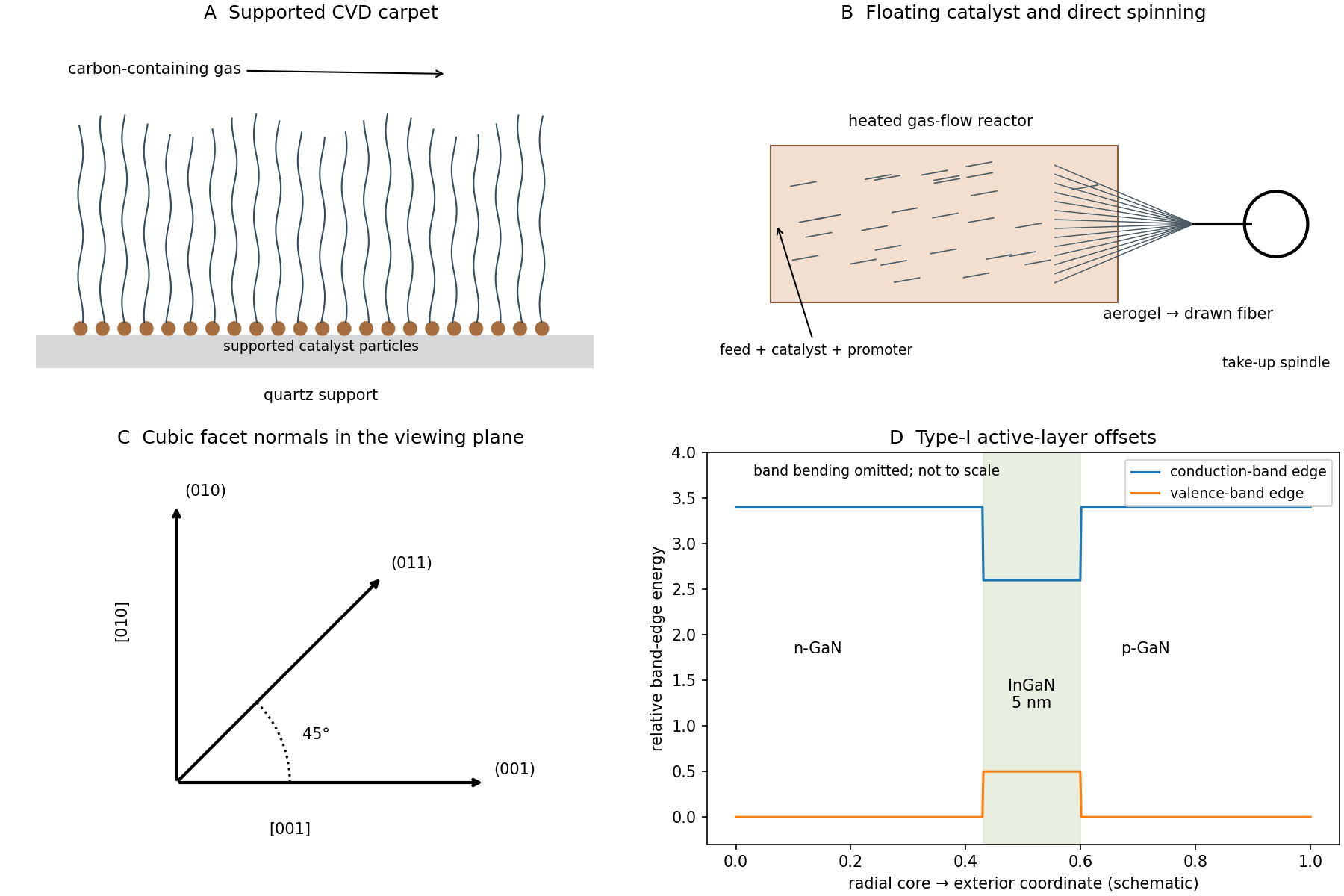
Use substrate-supported chemical vapor deposition. Prepare a clean quartz support with a suitable supported transition-metal catalyst, often nanoscale Fe-containing particles. Catalyst loading, support chemistry and pretreatment control the active particle size and density. A heated carbon-containing gas supplies carbon to those particles, from which carbon nanotubes grow.
At sufficiently high nucleation density, neighboring tubes constrain one another's lateral motion, producing a roughly aligned carbon nanotube forest normal to the support. This is collective crowding, not a requirement that quartz epitaxially orient every tube. Gas delivery, catalyst lifetime and growth time set length and uniformity. Depending on catalyst–support adhesion, catalyst particles can remain near the support or move with growing tips.
The catalyst is supported and the carpet remains attached to a substrate. Check particle distribution and film uniformity separately from tube diameter and alignment; a dense black coating alone does not establish a nanotube forest. The original growth sketch contrasts this supported route with a floating-catalyst reactor.
Supported and floating-catalyst nanotube growth, with radial LED band confinement
. Original process schematics and qualitative band-offset profile. No source microscopy is reproduced. The band sketch isolates the active-layer offsets rather than claiming a solved radial junction potential. Details.
Use floating-catalyst chemical vapor deposition to form a continuous suspended network. Introduce a carbon feed together with a volatile catalyst precursor into a hot gas-flow reactor. Catalyst nanoparticles nucleate in the gas stream; tubes grow while moving through the reaction zone and assemble into an interconnected aerogel.
Withdraw that network continuously, collect it on a rotating spindle, and consolidate or twist it into a fiber. Long tubes, suitable number density and adequate overlap allow the network to transmit the drawing force without breaking into isolated clumps. The take-up rate must be matched to network production; collection is not simply a geometrically scaled version of a substrate carpet.
The catalyst and tubes form in the flowing gas, and the product is drawn directly from a growing aerogel. This differs both from a supported carpet and from later spinning of a separately prepared nanotube dispersion. The original demonstration combined CVD synthesis with continuous product withdrawal from the furnace.[ref]
Direct Spinning of Carbon Nanotube Fibers from Chemical Vapor Deposition Synthesis by Ya-Li Li and others. Science304, pp.276–278, synthesis-zone spinning and rotating collection
The floating-catalyst direct-spinning route commonly requires a small sulfur promoter addition. sulfur changes catalyst-particle nucleation and surface chemistry, influencing the active Fe-particle population, carbon incorporation and whether sufficiently long, numerous tubes form a drawable aerogel.
A sulfur-rich catalyst surface or Fe–S-containing state can alter surface energy, wetting and particle coarsening; a low-melting interfacial state can also affect catalyst activity. These are process-dependent mechanisms, not a statement that sulfur is a structural constituent required in every carbon nanotube. Excess sulfur can suppress useful growth or worsen impurities. The useful dose therefore has a window and depends on catalyst and feed chemistry.
A controlled comparison changes sulfur supply while holding the carbon/catalyst feed and collection conditions fixed, then measures tube population, catalyst residue and spinnability rather than judging only the presence of soot. The primary direct-spinning study specifically treats sulfur-dependent processing and purity.[ref]
Read the displayed axes as horizontal and vertical ; the viewing direction is therefore consistent with . crystal facets edge-on in this projection have normals in the plane. The flat upper/lower boundaries are approximately horizontal, the end face vertical, and the bevels approximately to both.
A probable low-index assignment is upper face , end face and lower-right bevel , with the upper-right bevel if it is also indexed. Thus the flat faces belong to and the diagonal faces to .
For example,giving and between normals. The upper normal and lower bevel normal instead make ; their acute unoriented plane angle is . Adjacent polygon corners between a flat edge and bevel have internal angles near .
The distinction between a normal angle, an acute plane angle and an internal polygon angle avoids a supplementary-angle error. This is a probable projected indexation, not a unique full three-dimensional crystal facet reconstruction. The associated work uses tomography precisely to recover information absent from one projection.[ref]
Three-Dimensional Elemental Mapping at the Atomic Scale in Bimetallic Nanocrystals by Bart Goris and others. 2013, study scope: three-dimensional structure and composition from electron-tomography data
The original facet-normal diagram in the growth-and-LED figure shows the relation independently of the source micrograph.The Wulff construction minimizes total orientation-dependent surface free energy at fixed crystal volume:Planes at distances proportional to their surface energies bound the equilibrium shape. The construction is thermodynamic; observed growth rates need not select the same shape.
For a mixed-metal particle, minimize a more complete free energy including bulk mixing/ordering, Au–Ag interface energy, exposed-surface composition, adsorbates and elastic strain, while conserving the amount of each metal. Important parameters include orientation-dependent surface energies, metal chemical potentials, interface coherency, lattice mismatch, temperature and ligand coverage. surface segregation can change the exposed composition and hence the relevant .
A generalized free-energy minimization can address a multicomponent particle; the elementary Wulff construction alone does not predict its core-shell composition. Sequential Au-core formation and Ag deposition can preserve a kinetically trapped interface when diffusion is too slow to reach equilibrium. If shape relaxation is fast but interdiffusion slow, an external shape may approach a constrained minimum even though the complete particle is not at global equilibrium. Growth kinetics, ligand stabilization and finite-size effects limit a bare-surface equilibrium model. A faceted image is therefore insufficient proof that either shape or composition is an equilibrium state.
Since energy and angular frequency are related by , the given eigenvalue relation yieldsWith ,The are dimensionless modal eigenvalues, not optical wavelengths despite the symbol. The same multiplies both mode and bulk angular frequencies and cancels in the energy ratio. These are bare-core predictions of the stipulated lossless Drude model; adding a dielectric/metallic shell, interband response or damping changes the actual resonances.
Only the magnetic-response physics is addressed here; biological and clinical application is user-deferred.
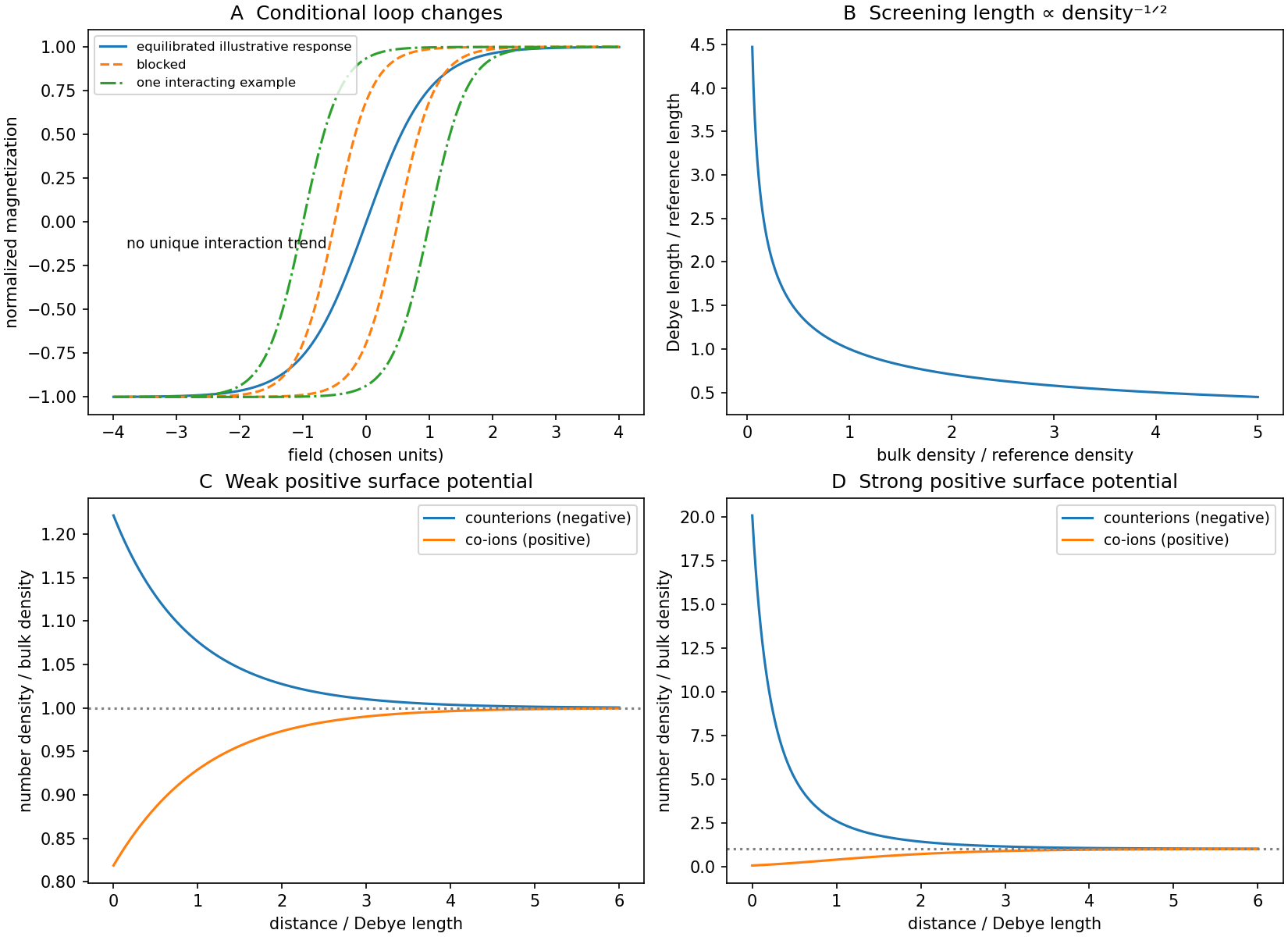
A single-domain particle has an approximately coherent magnetic dipole moment, but single-domain does not by itself imply rapid thermal reversal. If moments equilibrate within the measurement time, a dilute, noninteracting ensemble is superparamagnetic: its quasistatic magnetization is reversible, odd in field and approaches saturation with negligible remanence or magnetic coercivity.
For freely orientable classical moments,At small field, ; at large field moments align. This Langevin form is an ideal limit, not a universal exact curve for anisotropic fixed-axis particles.
The missing timescale/magnetic anisotropy information must be stated: blocked single-domain particles can already show hysteresis. Also, a reversible quasistatic curve does not preclude a finite-frequency loss loop when relaxation lags an alternating field. The original curves illustrate an equilibrated dilute limit and possible blocked/interacting alternatives, not measured treatment performance.
Conditional magnetic loops and electrostatic screening profiles
. Original illustrative magnetic curves and calculated planar mean-field ion profiles. Magnetic-loop broadening is one possible interaction outcome, not a concentration-dependent experimental fit or a clinical prediction. Details.
Thermally activated moment reversal, or Néel relaxation, often has an activated timescaleLowering temperature increases . When it becomes comparable to the observation time , the ensemble crosses an operational magnetic blocking temperature,Above this blocking crossover, an equilibrated ensemble remains reversible; its low-field susceptibility can increase as temperature falls. Below it, moments cannot fully relax during the field sweep, so magnetic coercivity and remanence can emerge and the loop opens. A distribution of particle volumes/anisotropies broadens the crossover.
This is a timescale-dependent blocking effect, not necessarily a thermodynamic phase transition. Rotation of whole particles in a fluid can supply an additional relaxation channel, and the particle orientation distribution affects the observed loop. Compare sweep rates and temperatures before interpreting one curve as an intrinsic static material law.
At greater concentration, the mean separation falls and the independent-moment approximation can fail. The magnetic dipole interaction has characteristic scalewith sign and angular dependence set by moment orientation. Correlated clusters, chains or frustrated arrangements change local fields and relaxation barriers.
A plausible example is a progressively less reversible loop with larger remanence/magnetic coercivity when interactions slow collective relaxation; the figure illustrates that case. The trend is not universal: some arrangements reduce susceptibility or suppress remanence, and aggregation can introduce a different response from a uniform concentrated dispersion. Neither loop area nor magnetic coercivity must vary monotonically with concentration.
At the actual drive frequency, the dissipated energy per cycle per unit volume is proportional to . Measure this dynamic loop rather than inferring dissipation from an unrelated slow sweep. Compare equal magnetic-material amounts, inspect dispersion state, and vary frequency to separate concentration-driven interactions from simple signal scaling. No biological efficacy is inferred.
For the nonbiology fabrication objective, reduce unwanted dipolar coupling while preserving a useful single-particle dynamic response. Lithographically reduce magnetic volume or adjust aspect ratio to control and magnetic anisotropy. Reducing reduces the characteristic pair interaction approximately as , but also changes and relaxation time.
A nonmagnetic spacer coating or stable surface layer can maintain minimum center-to-center separation after release and reduce aggregation. At a fixed magnetic volume fraction this geometric constraint has a real packing cost; separation cannot be increased without limit while claiming unchanged loading.
Tune particle volume, magnetic anisotropy and spacing together, then measure dynamic susceptibility/loop area at the specified temperature and frequency. In a simple single-relaxation model, useful phase lag occurs near ; making particles so small that reversal is essentially instantaneous can reduce dissipative response. Clinical treatment optimization remains user-deferred; these are materials/fabrication controls, not a treatment recommendation.
For a nonrelativistic electron,Using the supplied constants givesThis is comparable with atomic lattice spacings. A suitable crystalline surface or sufficiently thin crystal can therefore diffract the electron beam; the reciprocal-lattice geometry and scattering conditions determine the actual angles. A grating or slit can also diffract matter waves if its scale and coherence conditions are suitable. The kinetic energy is tiny compared with the electron rest energy, so relativistic corrections are negligible at the stated precision.
The printed rounded coefficients have normThus the expected rounded answer is . If the decimal coefficients are treated as literal exact inputs and the state normalized, the exact probability for that input is . This distinction avoids treating rounding error as a physical departure from wavefunction normalization.
Orthonormal energy eigenstates contribute incoherently to the expectation of energy:Therefore for the normalized literal decimals. Ignoring the small rounding-induced norm error gives , conventionally reported at this precision as about . The mean need not equal an individual energy eigenvalue.
Each energy component acquires its own phase:The factor normalizes the printed rounded input; it can be omitted if the coefficients are regarded as an already normalized rounded representation.
The energy probabilities and remain constant under this time-independent hamiltonian because phase factors have unit modulus. position probabilities can nevertheless vary: interference between different energy components generally changes with their relative phases. A stationary energy distribution is not the same thing as a stationary spatial probability distribution.
The result projects the state onto the corresponding nondegenerate energy eigenstate. Immediately after an ideal measurement,for an unobservable overall phase . Subsequent isolated evolution adds but does not mix in other energy eigenstates. A repeat ideal energy measurement gives with probability one, provided the hamiltonian is unchanged and no intervening disturbance occurs.
Let be the electrostatic potential in volts, relative to the bulk value, and the distance normal to the surface. The positive quantity is the elementary charge; the monovalent ions carry . The bulk number density refers to each ionic species in a symmetric electrolyte, so the total bulk ion density is . is vacuum permittivity, relative permittivity, the Boltzmann constant and absolute temperature. The hyperbolic sine acts on the dimensionless potential .
The printed sign is inconsistent with physical Poisson–Boltzmann screening under these usual definitions. Indeed,and Poisson's equation gives , with a plus sign. The literal printed equation and the physical screened solution must therefore be distinguished.
The dimensionally meaningful small-potential condition is , not a comparison of volts directly with energy. Expanding gives the physical linearized equationFor a single plane with bulk boundary condition , . At fixed temperature and permittivity, : the curve decreases with increasing density, diverging in the ideal zero-salt limit.
Literal expansion of the printed minus-sign equation instead gives , with sine/cosine solutions. A nonzero such solution cannot decay to zero at infinity. That literal equation does not describe a Debye length. The figure and following ion profiles use the physically derived plus-sign equation, with this correction explicit.
Take a positive surface potential , so positive ions are co-ions and negative ions counterions. With ,The counterion density is slightly enhanced at the surface, the co-ion density slightly depleted, and both approach over a Debye length. To first order their sum is , while their difference supplies the screening charge. Reverse the surface sign and the ionic roles interchange. These are number-density profiles, not trajectories of individual ions.
For large positive dimensionless surface potential , use the nonlinear Boltzmann distribution rather than their linear expansion:The counterions become strongly enriched near the wall and co-ions strongly depleted. A planar mean-field solution isIt approaches the linear screening form far from the wall. Nonlinearity preserves positive densities and produces a much stronger near-wall asymmetry; an extrapolated linear co-ion profile could incorrectly become negative. The total local ion density is , no longer constant.
The original figure compares weak- and strong-potential profiles. At very large local concentrations, finite ion size, specific adsorption and ion correlations limit this ideal point-ion mean-field model; it does not predict unlimited physically realizable counterion packing.
Interpret the given noise correlation as the three-dimensional dot-product correlation. Each Cartesian component then has . For the usual Gaussian thermal-noise idealization, each coordinate is an Ornstein-Uhlenbeck process. With ,For a particle initially at ,Hence its long-time displacement about the trap/elastic equilibrium hasThis also follows from equipartition theorem: each of three quadratic coordinates contributes .
A different common experimental quantity is the stationary time-lag displacement. It obeyswith long-lag RMS . The factor of two distinguishes fluctuations about a mean position from differences between two decorrelated positions. The observation convention must be stated rather than silently interchanged.
For a no-slip spherical tracer of radius in an isotropic incompressible elastic continuum, a small translation produces restoring force . ThusCombining this with the equilibrium three-dimensional positional variance givesEquivalently, if is the stationary three-dimensional displacement-MSD plateau, . For a single measured coordinate, and .
This is passive microrheology. Calibrate bead radius, position sensitivity, temperature and localization noise; subtract drift and test that a plateau is resolved. The continuum must be meaningful on the bead scale, the bead must couple without slip, and thermal equilibrium must hold. Boundaries, compressibility, active motion, probe attachment and unresolved relaxation can change the inferred response. An imposed optical trap adds stiffness and must be removed or independently calibrated rather than mistaken for material elasticity.
Across a radial section, the narrow-gap indium gallium nitride layer lies between wider-gap n-GaN and p-GaN. A suitable type-I band alignment has a downward conduction-band offset and upward valence-band offset in the indium gallium nitride, confining electrons and holes to the active layer. The original band sketch isolates those offsets; the complete junction also has doping-induced band bending.
At thermal equilibrium the Fermi level is common throughout. Forward bias separates the electron and hole quasi-Fermi levels, injects carriers from the n- and p-regions and permits electron-hole recombination in the thin active layer. A full radial line through the wire crosses two copies of the shell well; a core-to-exterior radial coordinate crosses one.
The 5 nm indium gallium nitride shell is the quantum well active region, not a metallic contact. Finite band offsets, confinement and polarization fields affect its transition energy; the bulk gap alone is insufficient.
A plausible role for the SiN mask is selective-area growth: restrict nucleation to exposed windows and suppress parasitic deposition between wires. Retained insulating material can also help prevent unwanted electrical paths during later processing. Which role dominates depends on the actual fabrication sequence. The cited source concerns core-shell single-wire LEDs and contact engineering, so a qualitative band sketch does not reproduce its complete device model.[ref]
InGaN/GaN Core-Shell Single Nanowire Light Emitting Diodes with Graphene-Based P-Contact by Maria Tchernycheva and others. 2014, pp.2456–2465, device/material system and contact architecture
Two suitable epitaxial techniques are metalorganic vapour-phase epitaxy and molecular beam epitaxy.
MOVPE supplies metalorganic group-III precursors and a reactive nitrogen source in a flowing gas. Surface reactions, mass transport and selective nucleation control growth; it is well suited to conformal radial growth and relatively high throughput. molecular beam epitaxy supplies molecular/atomic beams in high vacuum, with beam fluxes and shutters controlling delivery. It offers precise flux switching and in-situ surface monitoring, but flux, geometry and nitrogen activation can limit growth rate and conformality. Neither method automatically gives identical growth on all wire crystal facets.
For an overall target near , MOVPE is a natural choice. This is a practical selection, not a theorem that molecular beam epitaxy cannot attain that rate.
Prepare the substrate/buffer and patterned SiN growth mask; grow donor-doped gallium nitride cores with controlled axial morphology; change conditions to favor radial deposition and incorporate indium for the thin indium gallium nitride active shell; then overgrow acceptor-doped p-GaN without degrading the active layer. Finally expose/contact the core and shell appropriately. Monitor facet-dependent thickness and indium content, and characterize the interfaces. If the active-layer normal rate itself were , 5 nm would take 7.5 s; the stated overall rate does not establish that the alloy shell actually grows at that same rate.
One possible cause is a different indium gallium nitride thickness or indium content that shifts this wire's emission away from 420 nm. The detected intensity at one wavelength then falls even if its integrated radiative efficiency is unchanged. Since , composition, strain, confinement and internal fields can all move the transition relative to that detection energy.
A second physically different possibility is poor active-layer quality: roughness, composition segregation or strain relaxation can introduce defects and nonradiative recombination. Locally thinner or discontinuous shell regions may also permit carrier leakage.
Measure the full spectrum and integrated emission, rather than one spectral channel. Time-resolved luminescence, excitation-dependent measurements and local structural/compositional characterization can distinguish a spectral shift, changed carrier injection and an increased nonradiative rate. The single-wavelength observation alone does not uniquely identify lower internal quantum efficiency or one growth defect.
A common implementation uses a gallium arsenide/aluminium gallium arsenide heterostructure with a two-dimensional electron gas near the interface. electrons supplied by remote donors occupy quantized normal-direction states, while an undoped spacer reduces ionized-impurity scattering. Surface metallic gates, insulated from the conducting layer, deplete selected regions when negatively biased.
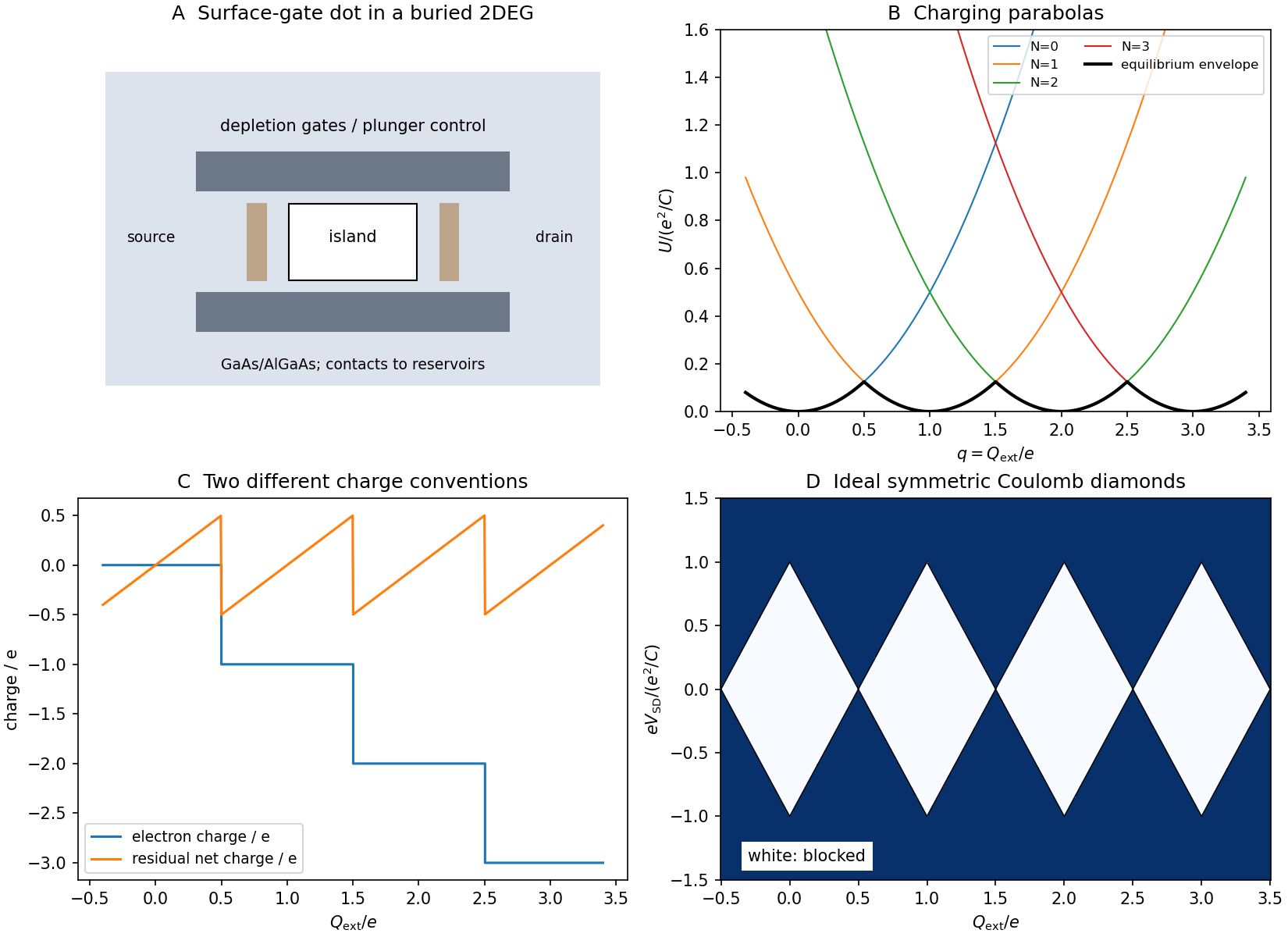
Leave a small conducting island bounded by depleted regions and connect it weakly to source and drain reservoirs through two tunable constrictions. A plunger gate controls the island potential/population; barrier gates control tunnel coupling. Ohmic contacts connect the reservoirs to the measurement circuit. Vertical heterostructure confinement plus lateral depletion force defines the dot. A 2DEG without lateral gates would remain extended in its plane.
The original device diagram labels the gates, island, tunnel barriers and reservoirs. Charge stability and spectroscopy versus gate/bias should verify that an isolated weakly coupled island has actually formed; a lithographic outline alone is insufficient.
Gate-defined dot, charging parabolas, charge steps and Coulomb diamonds
. Original schematic and constant-capacitance model plots. The conductance map is an idealized symmetric-bias cartoon, not experimental data or a microscopic tunnelling calculation. Details.
Let be the island's total electrostatic capacitance and the charge offset induced by gates, reservoir potentials and fixed background charges. In the constant-capacitance model,Taking the difference givesChanging gate voltage changes approximately linearly, for example through .
For fixed , is a parabola. At small temperature/bias, the preferred integer is the one nearest ; the equilibrium energy follows the lower envelope of these parabolas. Adjacent charge states become degenerate at , allowing small-bias sequential current when the two barriers are transmissive.
The excess-electron charge is a staircase. If “net charge” includes the induced compensating charge, define ; that residual charge is a sawtooth between and in equilibrium. The opposite sign convention reverses the sawtooth. State the charge convention: an integer electron-charge staircase and a residual electrostatic-charge sawtooth describe different quantities.
A larger source–drain bias opens an energy window between reservoir electrochemical potentials. When a charge-addition/removal transition enters that window, sequential tunnelling becomes allowed even away from a zero-bias degeneracy. The low-conductance regions in a gate/bias map are Coulomb diamonds.
For an illustrative symmetric device with reservoir potentials , let and . In the charge- interval, the classical blockade domain isIt shrinks to zero at . Unequal capacitances change edge slopes and voltage division; the figure's symmetry is a chosen model, not a universal device property.
Quantum confinement adds discrete single-particle levels and spin structure. In a constant-interaction approximation, successive addition energies contain plus the relevant orbital spacing, so diamond sizes need not all match. Excited-state tunnelling can produce extra conductance lines. At stronger coupling, cotunnelling and charge fluctuations can give leakage beyond a simple sequential classical model. Thus temperature and coupling must be small enough to resolve the charging and level structure separately.
An initially localized escaping electron occupies a superposition of lead momentum states. In a uniform free one-dimensional lead,A packet centered at moves with group velocity and generally spreads because its components have different velocities. For an initially unchirped minimum-uncertainty Gaussian wave packet,This illustrates dispersive evolution; the actual emission contact determines and whether only outward-propagating components are appreciable. It does not instantaneously become a single lead plane wave.
A single-electron transistor used as a sensitive electrometer exploits Coulomb blockade: a nearby charge shifts the offset and therefore the conductance peaks. This requires stable calibrated capacitances and low charge noise, rather than merely a small conductor.
Articles were limited to the first 100 out of 122 total.
Articles by others on the same topic
There are currently no matching articles.