Use substrate-supported chemical vapor deposition. Prepare a clean quartz support with a suitable supported transition-metal catalyst, often nanoscale Fe-containing particles. Catalyst loading, support chemistry and pretreatment control the active particle size and density. A heated carbon-containing gas supplies carbon to those particles, from which carbon nanotubes grow.
At sufficiently high nucleation density, neighboring tubes constrain one another's lateral motion, producing a roughly aligned carbon nanotube forest normal to the support. This is collective crowding, not a requirement that quartz epitaxially orient every tube. Gas delivery, catalyst lifetime and growth time set length and uniformity. Depending on catalyst–support adhesion, catalyst particles can remain near the support or move with growing tips.
The catalyst is supported and the carpet remains attached to a substrate. Check particle distribution and film uniformity separately from tube diameter and alignment; a dense black coating alone does not establish a nanotube forest. The original growth sketch contrasts this supported route with a floating-catalyst reactor.
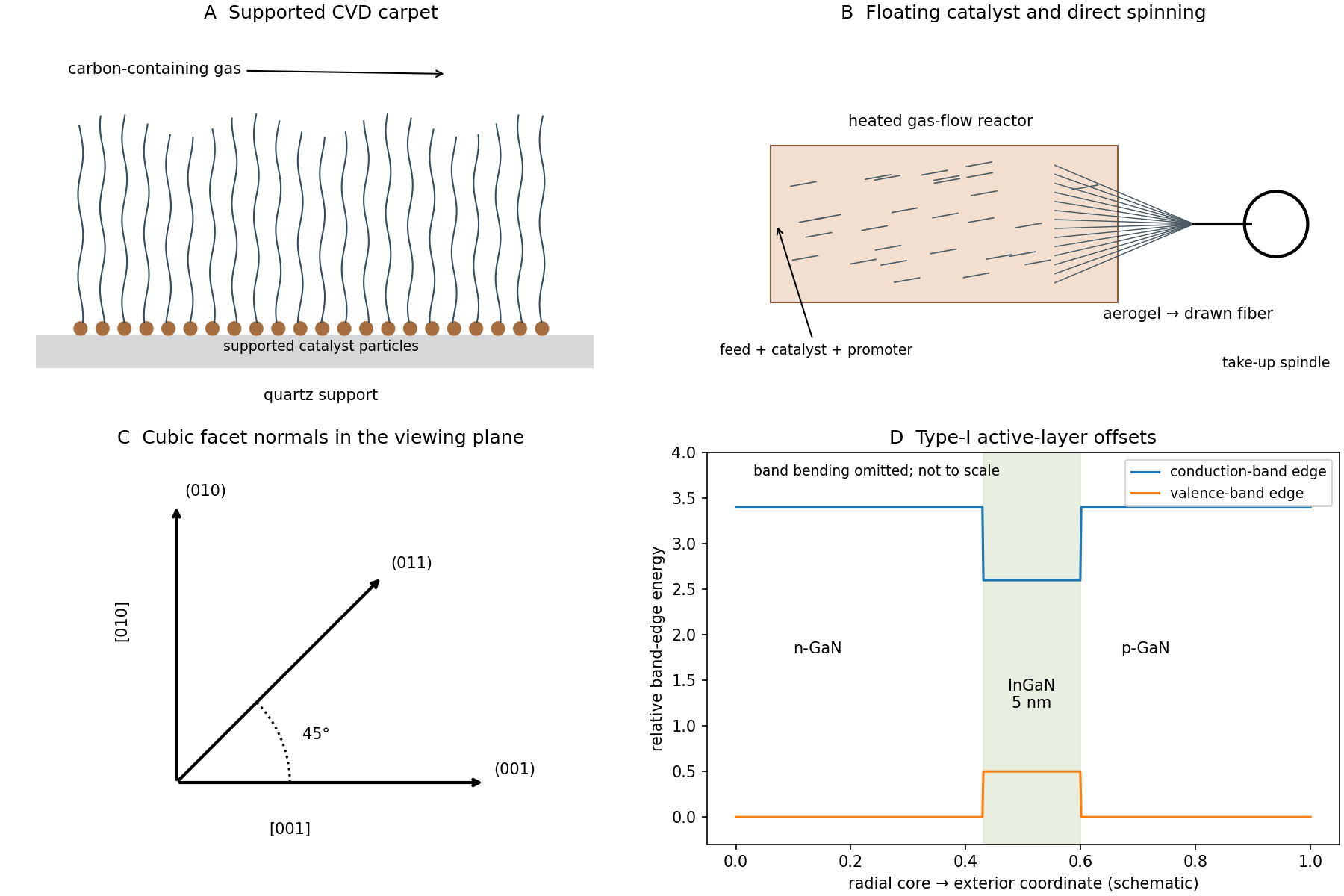
Supported and floating-catalyst nanotube growth, with radial LED band confinement
. Original process schematics and qualitative band-offset profile. No source microscopy is reproduced. The band sketch isolates the active-layer offsets rather than claiming a solved radial junction potential. Details.
Use floating-catalyst chemical vapor deposition to form a continuous suspended network. Introduce a carbon feed together with a volatile catalyst precursor into a hot gas-flow reactor. Catalyst nanoparticles nucleate in the gas stream; tubes grow while moving through the reaction zone and assemble into an interconnected aerogel.
Withdraw that network continuously, collect it on a rotating spindle, and consolidate or twist it into a fiber. Long tubes, suitable number density and adequate overlap allow the network to transmit the drawing force without breaking into isolated clumps. The take-up rate must be matched to network production; collection is not simply a geometrically scaled version of a substrate carpet.
The catalyst and tubes form in the flowing gas, and the product is drawn directly from a growing aerogel. This differs both from a supported carpet and from later spinning of a separately prepared nanotube dispersion. The original demonstration combined CVD synthesis with continuous product withdrawal from the furnace.[ref]
Direct Spinning of Carbon Nanotube Fibers from Chemical Vapor Deposition Synthesis by Ya-Li Li and others. Science304, pp.276–278, synthesis-zone spinning and rotating collection
The floating-catalyst direct-spinning route commonly requires a small sulfur promoter addition. sulfur changes catalyst-particle nucleation and surface chemistry, influencing the active Fe-particle population, carbon incorporation and whether sufficiently long, numerous tubes form a drawable aerogel.
A sulfur-rich catalyst surface or Fe–S-containing state can alter surface energy, wetting and particle coarsening; a low-melting interfacial state can also affect catalyst activity. These are process-dependent mechanisms, not a statement that sulfur is a structural constituent required in every carbon nanotube. Excess sulfur can suppress useful growth or worsen impurities. The useful dose therefore has a window and depends on catalyst and feed chemistry.
A controlled comparison changes sulfur supply while holding the carbon/catalyst feed and collection conditions fixed, then measures tube population, catalyst residue and spinnability rather than judging only the presence of soot. The primary direct-spinning study specifically treats sulfur-dependent processing and purity.[ref]
Read the displayed axes as horizontal and vertical ; the viewing direction is therefore consistent with . crystal facets edge-on in this projection have normals in the plane. The flat upper/lower boundaries are approximately horizontal, the end face vertical, and the bevels approximately to both.
A probable low-index assignment is upper face , end face and lower-right bevel , with the upper-right bevel if it is also indexed. Thus the flat faces belong to and the diagonal faces to .
For example,giving and between normals. The upper normal and lower bevel normal instead make ; their acute unoriented plane angle is . Adjacent polygon corners between a flat edge and bevel have internal angles near .
The distinction between a normal angle, an acute plane angle and an internal polygon angle avoids a supplementary-angle error. This is a probable projected indexation, not a unique full three-dimensional crystal facet reconstruction. The associated work uses tomography precisely to recover information absent from one projection.[ref]
Three-Dimensional Elemental Mapping at the Atomic Scale in Bimetallic Nanocrystals by Bart Goris and others. 2013, study scope: three-dimensional structure and composition from electron-tomography data
The original facet-normal diagram in the growth-and-LED figure shows the relation independently of the source micrograph.The Wulff construction minimizes total orientation-dependent surface free energy at fixed crystal volume:Planes at distances proportional to their surface energies bound the equilibrium shape. The construction is thermodynamic; observed growth rates need not select the same shape.
For a mixed-metal particle, minimize a more complete free energy including bulk mixing/ordering, Au–Ag interface energy, exposed-surface composition, adsorbates and elastic strain, while conserving the amount of each metal. Important parameters include orientation-dependent surface energies, metal chemical potentials, interface coherency, lattice mismatch, temperature and ligand coverage. surface segregation can change the exposed composition and hence the relevant .
A generalized free-energy minimization can address a multicomponent particle; the elementary Wulff construction alone does not predict its core-shell composition. Sequential Au-core formation and Ag deposition can preserve a kinetically trapped interface when diffusion is too slow to reach equilibrium. If shape relaxation is fast but interdiffusion slow, an external shape may approach a constrained minimum even though the complete particle is not at global equilibrium. Growth kinetics, ligand stabilization and finite-size effects limit a bare-surface equilibrium model. A faceted image is therefore insufficient proof that either shape or composition is an equilibrium state.
Since energy and angular frequency are related by , the given eigenvalue relation yieldsWith ,The are dimensionless modal eigenvalues, not optical wavelengths despite the symbol. The same multiplies both mode and bulk angular frequencies and cancels in the energy ratio. These are bare-core predictions of the stipulated lossless Drude model; adding a dielectric/metallic shell, interband response or damping changes the actual resonances.
Articles by others on the same topic
There are currently no matching articles.