A useful five-part classification is electrostatic double-layer, dispersion, steric, depletion force and solvent-mediated interactions. It is a practical classification rather than a unique exhaustive list.
Electrostatic double-layer forces arise from surface charge and mobile-ion redistribution. Like-charged surfaces often repel; opposite charges can attract. Their range changes with salt screening. London dispersion forces comes from correlated electronic fluctuations and is one contribution to Van der Waals force; its sign and strength across a medium depend on dielectric response.
steric stabilization occurs when adsorbed or grafted layers overlap, increasing chain confinement and/or local osmotic free energy. depletion force arises when smaller nonadsorbing solutes are excluded from a narrow gap: their greater accessible volume outside favors bringing the large particles together. Structured-solvent forces include short-range hydration force and hydrophobic attraction; their microscopic origin differs from the depletion force of an added solute.
The original sketches show double-layer overlap, a polymer-coated gap, depletion force exclusion and solvent structure, alongside a dispersion-potential curve. A realistic suspension can experience several simultaneously. Charge neutrality of a particle does not remove dispersion, steric or solvent-mediated interactions.
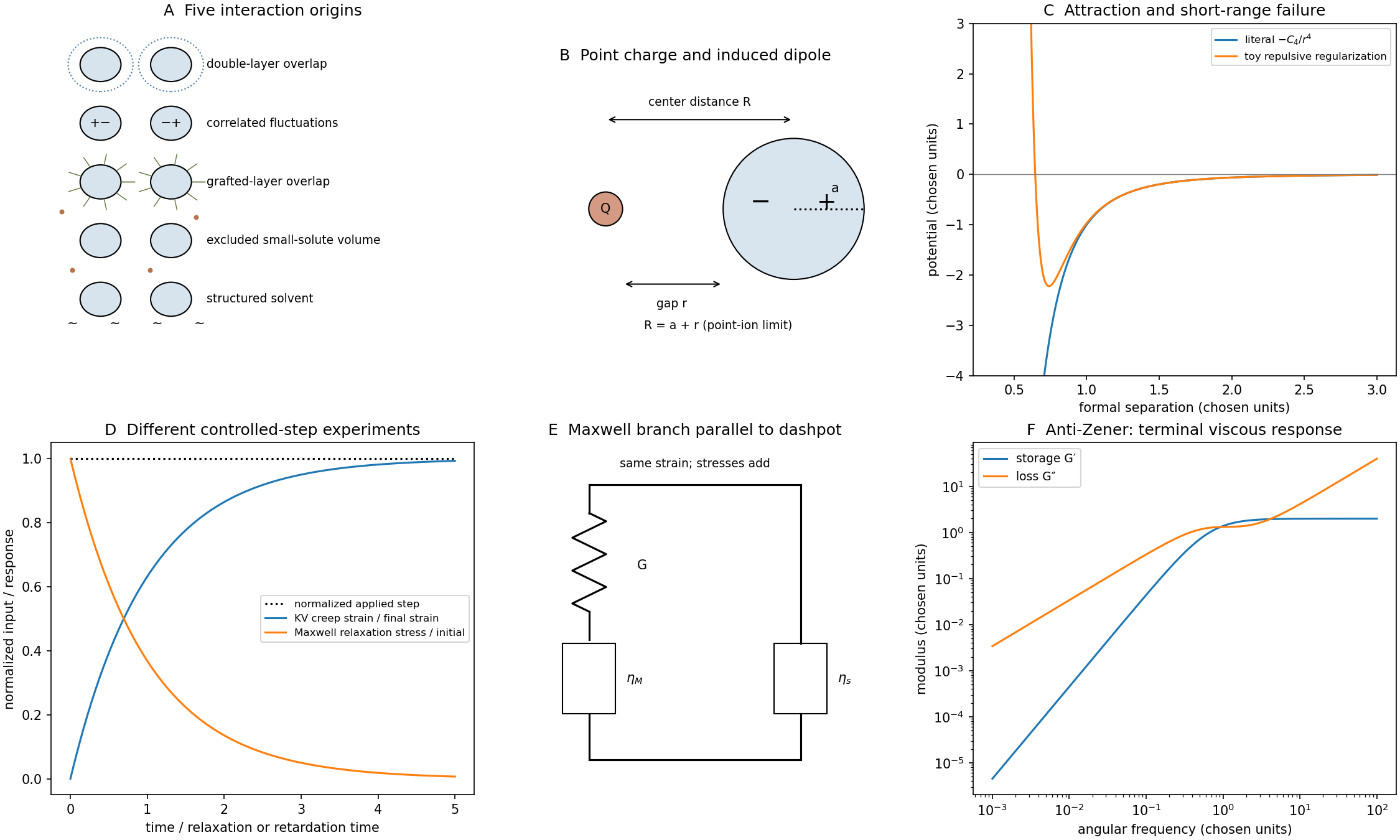
Colloidal interaction mechanisms and viscoelastic material response
. Original interaction cartoons, model potentials, step-response curves and parallel Maxwell–dashpot rheology. Potential parameters and rheological constants are chosen illustrative values, not fitted measurements. Details.
Articles by others on the same topic
There are currently no matching articles.