A useful five-part classification is electrostatic double-layer, dispersion, steric, depletion force and solvent-mediated interactions. It is a practical classification rather than a unique exhaustive list.
Electrostatic double-layer forces arise from surface charge and mobile-ion redistribution. Like-charged surfaces often repel; opposite charges can attract. Their range changes with salt screening. London dispersion forces comes from correlated electronic fluctuations and is one contribution to Van der Waals force; its sign and strength across a medium depend on dielectric response.
steric stabilization occurs when adsorbed or grafted layers overlap, increasing chain confinement and/or local osmotic free energy. depletion force arises when smaller nonadsorbing solutes are excluded from a narrow gap: their greater accessible volume outside favors bringing the large particles together. Structured-solvent forces include short-range hydration force and hydrophobic attraction; their microscopic origin differs from the depletion force of an added solute.
The original sketches show double-layer overlap, a polymer-coated gap, depletion force exclusion and solvent structure, alongside a dispersion-potential curve. A realistic suspension can experience several simultaneously. Charge neutrality of a particle does not remove dispersion, steric or solvent-mediated interactions.
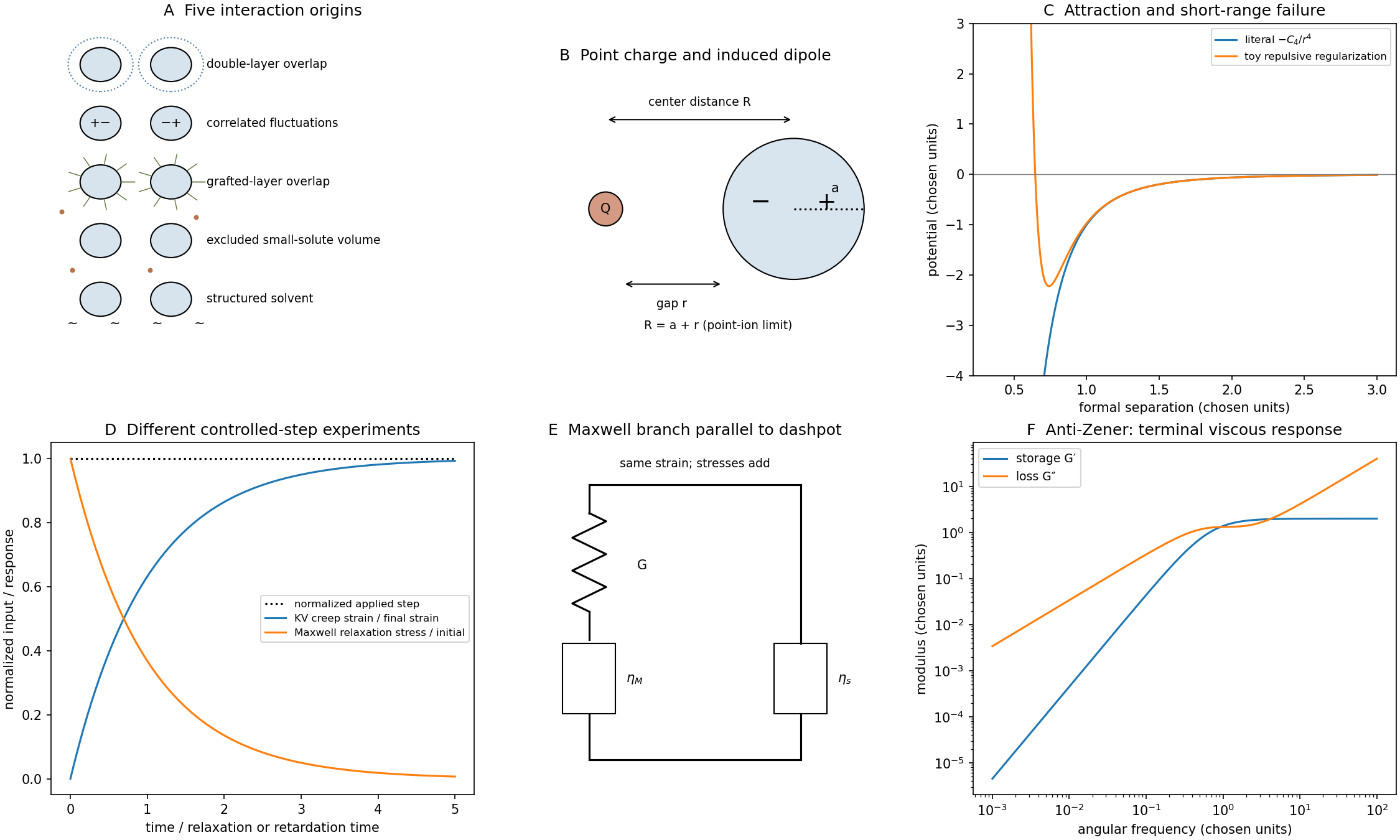
Colloidal interaction mechanisms and viscoelastic material response
. Original interaction cartoons, model potentials, step-response curves and parallel Maxwell–dashpot rheology. Potential parameters and rheological constants are chosen illustrative values, not fitted measurements. Details.
Write . Differentiating the stipulated potential givesFor positive , the force points toward smaller separation for either sign of .
Its physical origin is charge-induced dipole attraction, rather than London dispersion forces. A point-charge field induces and the energy cost of inducing that moment gives . The charge changes the electric dipole moment; it does not, within this linear model, change the intrinsic coefficient . For a conducting sphere in a uniform medium, ; other dielectric contrasts give another electric polarizability.
There is a distance inconsistency in the stated model: the point-charge field uses center-to-center separation , whereas the question calls a surface gap. For a point ion and sphere, . A controlled far-field dipole model therefore uses , with . The boxed derivative is the literal result for the given mathematical ; it is not a justification for extending that dipole formula to contact.
For , the given model predicts attraction proportional to in force, independent of the ion's charge sign; the energy is proportional to and vanishes at large separation. A larger electric polarizability gives a stronger interaction.
This is induction by a charged object. Ordinary nonretarded London interaction between two small neutral polarizable objects instead has an energy dependence; geometry-integrated colloidal dispersion laws can have other powers. Calling the specified law a generic dispersion force would conceal its charge-dependent origin.
Attraction can favor association or adsorption. A stable suspension normally requires an opposing free-energy barrier, such as double-layer or steric repulsion, relative to Brownian motion. Salt, surface coatings and solvent quality alter that balance. However, one ion–particle pair potential alone does not establish the phase behavior or aggregation rate of a many-particle suspension; concentrations, diffusion, surface chemistry and the remaining interactions also matter.
The literal curve is monotone increasing from at toward zero from below as :Taken literally at a zero gap, it predicts an unbounded collapse energy and force. That extrapolation is outside the far-field dipole approximation and cannot describe actual touching matter.
Finite atomic/ionic dimensions, electronic overlap and Pauli repulsion supply short-distance constraints. Solvent and hydration layers, steric coatings and surface chemistry can add further contributions. An illustrative regularized model is with ; it has a finite minimum at and becomes repulsive at shorter distances. This is a schematic regularization, not a derived complete ion–sphere contact law.
Separately, correcting the center-distance convention to already removes this particular divergence from the far-field expression, but does not make a dipole approximation accurate at contact. Near-field multipoles and microscopic repulsion still require a better model. Calibrated colloidal probe technique measurements can test where a long-range force model ceases to agree with actual approach curves.[ref]
direct measurement of colloidal forces using an atomic force microscope by William A. Ducker and others. 1991, pp.239–241, sphere–plane force measurements and short-range deviations
Articles by others on the same topic
There are currently no matching articles.