A faceted, approximately equiaxed crystal is indicated. A truncated octahedron bounded by low-energy and facets is a plausible three-dimensional shape for an fcc metal particle; the hexagonal section alone does not uniquely distinguish it from other faceted polyhedra.
The Wulff construction minimizes at fixed particle volume. Place a plane with normal a distance from a common centre and take the inner envelope. Low-surface-energy orientations survive as large facets. Annealing permits diffusion toward this equilibrium morphology, provided the time is sufficient. For a supported or strained alloy, substrate adhesion and elastic energy modify this simple free-particle construction.
For the upper core-shell precursor, first reduce a precursor of metal A to make seeds; then introduce and reduce a precursor of B under conditions favouring heterogeneous deposition on those seeds rather than independent nucleation. Control added quantity, reduction rate and surface ligands to build a shell.
For the lower disordered-alloy precursor, reduce both metal precursors together so both metals enter the growing particles. Match their effective reduction rates by precursor chemistry, temperature, complexation or controlled feeding; otherwise sequential reduction can produce segregation instead of co-incorporation. Quenching or sufficiently mild growth can retain a disordered alloy before the later anneal. These routes need not initially produce equilibrium atomic arrangements.[ref]
Bimetallic Nanocrystals by Kyle D. Gilroy and others. Liquid-phase synthesis of core-shell and alloy architectures
Both starting arrangements converge toward the same chemically ordered alloy, exhibiting chemical ordering in alloys. This supports a lower free energy for the ordered unlike-metal neighbour pattern than for the segregated core-shell or disordered precursor at the final temperature. In a simple nearest-neighbour model, ordering is favoured whenwith consistent bond-energy conventions. Bulk mixing and ordering then compensate the loss of configurational entropy on cooling. Annealing alone does not supply numerical bond or surface energies, and elastic mismatch or adsorbed ligands can also matter.
The final morphology does not show a thick single-metal skin: the surface-energy difference is not large enough to overwhelm the bulk preference for ordering throughout the particle. Some atomic-scale surface enrichment is compatible with the drawing, so exact equality of the two surface free energies is not established.
If B has a much lower surface free energy, Surface segregation of B and an A-rich interior become favourable. A nearly continuous B shell is likely if enough B is present and the surface-energy gain exceeds the cost of disrupting favourable A-B bonds; otherwise only partial enrichment occurs.
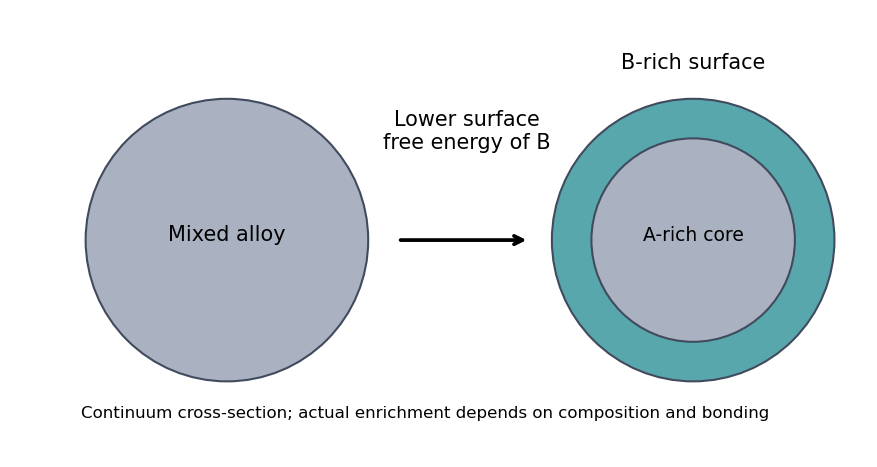
An illustrative surface-energy preference enriches the outermost layers without fixing a universal shell thickness
. Source. Details. 
Articles by others on the same topic
There are currently no matching articles.