Negligible rail resistance makes all left-hand groove ends equipotential and all right-hand ends equipotential. The equal hydraulic resistances therefore connect in parallel:Here uses the total inlet flow. The two blind rail ends carry no flow beyond their final grooves.
For a triangular resistance network with edge resistances , replacing it by a star gives the arm at each terminal as the product of its two adjacent triangle resistances divided by . This Delta-star transformation preserves the pressure-flow relation at all three terminals, just as in a linear electrical network.
Apply it recursively to the two-rail ladder. Represent the first grooves by a three-terminal star with arms leading respectively to the fixed inlet, frontier of the left rail and frontier of the right rail. Grooves are added from inlet toward outlet. Adding the next pair of rail segments gives and ; the new groove closes a triangle between the old star centre and the two new rail endpoints. Convert that triangle to a star and combine its centre arm in series with .
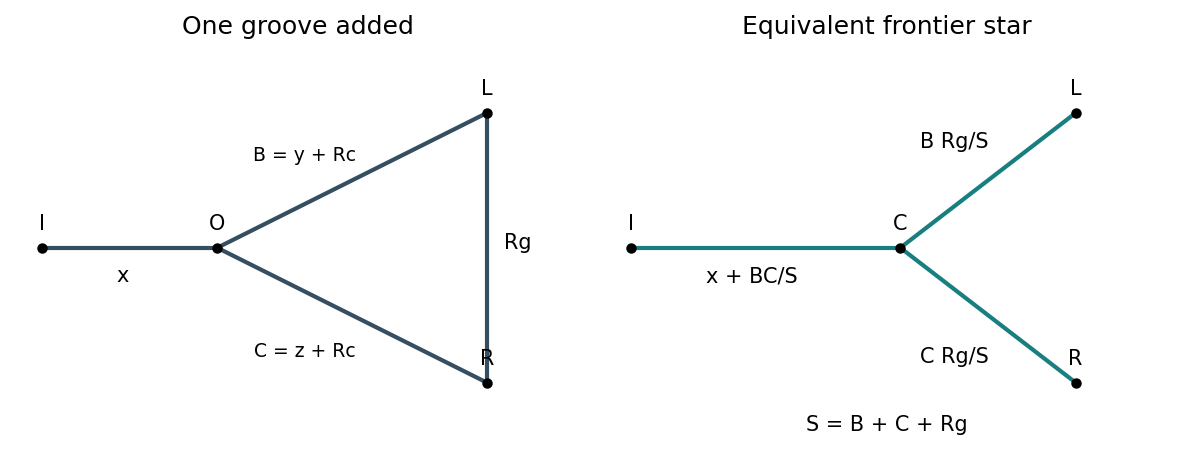

This method retains unequal pressure drops and unequal flow division along the rails; their finite resistances cannot be ignored when assigning the groove flows.
For the hydraulic ladder network, using the frontier star just defined, start at a single groove with . Put , and . The exact update isAfter all grooves have been included, the left frontier is a blind end, so no external flow passes through . The inlet-to-outlet resistance is . Iterate 49 times to obtain .
An equivalent closed form, for , isThus substitute ; no single number follows without . Checks are , , and as . The formula counts only the inter-groove segments in each rail; extra inlet/outlet lead resistances, if present, must be added separately. All elements obey linear laminar-flow pressure-drop laws.
Articles by others on the same topic
There are currently no matching articles.