Nucleation is the formation of a sufficiently large embryo of the new metallic phase. Producing metal atoms from dissolved precursor can create supersaturation; aggregation lowers bulk free energy but initially creates costly metal-medium interface. In the simplest spherical classical nucleation theory,where is the metal-medium interfacial free energy and is the bulk driving force per volume. Clusters below the critical size tend to redissolve; larger ones can grow.
In homogeneous nucleation, the critical cluster forms in the solution without a pre-existing interface: the initial products are free particles. In heterogeneous nucleation, a substrate, vessel wall or suspended seed replaces part of that costly new interface. For a spherical cap on a planar substrate,A wetting substrate therefore lowers the barrier; this assumes the same bulk driving force and isotropic interfacial energies.
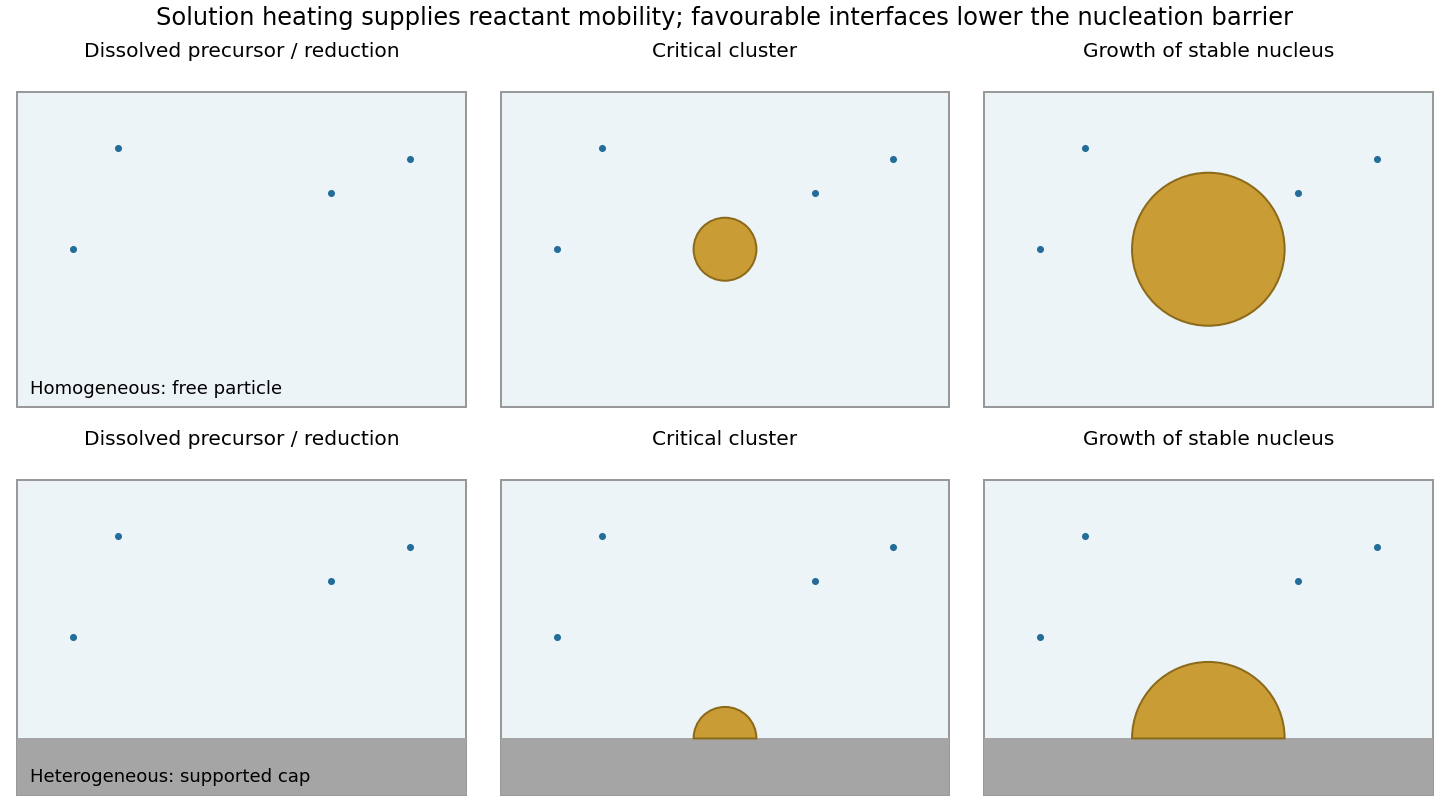

A final supported particle need not have nucleated heterogeneously: a free particle can nucleate in solution and later adsorb on the support. Conversely, a particle nucleated heterogeneously on a suspended seed can remain freely dispersed as a composite particle. Nucleation location and final support status are different classifications.
Microwave absorption heats the medium and possibly the support, changing reduction, diffusion and supersaturation. Preferential local heating can change the relative rates of the two routes. Microwave irradiation alone does not remove the thermodynamic nucleation barrier or demonstrate a special nonthermal mechanism.
- Can the precursor produce metal? Evaluate the reaction Gibbs free energy, including reduction, ligand exchange, precursor and reductant activities, solvation and byproducts. A nominal metal concentration is not the metal-atom chemical potential.
- What is the driving force for condensation? Compare the chemical potential of available metal species with that of the condensed phase. The resulting supersaturation supplies the bulk free-energy gain and competes with the surface cost of a critical nucleus.
- Where does it wet and nucleate? Let , and denote support-medium, particle-medium and support-particle interfacial free energies. For an isotropic cap, the contact angle through the particle obeys . This wetting balance determines the extent of substrate contact and the heterogeneous barrier.
- Which crystal faces survive? At fixed particle volume, minimize the sum of orientation-dependent surface and interface energies, plus any important strain or defect energy. For a free crystal, the Wulff construction gives facet distances proportional to their surface free energies. A Winterbottom construction incorporates the support interface and truncates the corresponding equilibrium shape.
Adsorbed ligands and solvent can change different facet energies by different amounts, so the relevant energies belong to the actual chemical environment. Small particles have large surface-to-volume ratios and are particularly sensitive to these terms.
This sequence identifies thermodynamic factors rather than guaranteeing that an equilibrium shape is reached. Facet-specific attachment rates, precursor delivery and limited annealing can preserve a kinetically selected shape even when another shape has lower free energy.
Write the reaction using the species actually supplied by solution. For either halide, a bulk contribution per converted formula unit isThe stated room-temperature feasibility means that the overall reaction free energy is negative under those conditions; it does not say that each microscopic step is downhill. Equal nominal concentrations also do not make iodide and bromide activities or solvation free energies identical.
At the nanoscale the balance additionally contains changing interfaces:Here is the number of converted formula units, and includes solvent-facing surfaces and contact with the titanium-dioxide support. Surface terms scale approximately as size squared whereas bulk terms scale as size cubed. Particle size, wetting, expansion during conversion and new grain interfaces can therefore shift both the conversion driving force and the nucleation barrier.
Microscopically, conversion requires desolvation, uptake of the organic cation and halide, redistribution through the precursor, and reorganization of the lead-halide framework. A study using these conversion conditions found energetically costly dispersed-ion intercalation for both compounds, with a much larger calculated penalty for MABr in PbBr than for MAI in PbI. The iodide's layered framework accommodates the cation more favorably; the bromide's undulated framework gives poorer coordination and greater local distortion. Stabilization on forming intermediate compounds and the final perovskite can nevertheless make the complete reaction favorable. The calculations are approximate energetic comparisons, not measured finite-temperature activation free energies.[ref]
Kinetics and energetics of metal halide perovskite conversion reactions at the nanoscale by Neha Arora and others. Fig. 4 and accompanying discussion: solvation reference, intercalation and conversion intermediates
Thus both reactions can be spontaneous yet proceed at very different rates: the same study observed faster MAPbI formation. One must distinguish net reaction free energy from intermediate penalties and diffusion barriers. Spontaneity alone supplies no quantitative ranking of the complete iodide and bromide reaction free energies.
In catalytic chemical vapor deposition, a metal nanoparticle activates a carbon-containing feedstock and supplies mobile carbon to the growing rim. Carbon can diffuse over the particle surface and, depending on the catalyst state, through its bulk. Once a curved carbon cap nucleates, continued incorporation extends the tube. Strong catalyst-support adhesion favors base growth; weaker adhesion can allow the particle to lift with the tube tip. A liquid catalyst is not universally required.
Particle size constrains tube diameter, but semiconducting character requires a particular wrapping family: . Merely making particles smaller does not select that congruence class. Routes toward predominantly semiconducting carbon nanotubes include controlling catalyst composition, exposed facets and size distribution to bias cap/rim nucleation and growth, or adjusting carbon chemical potential and growth/etching conditions so that metallic tubes are less likely to survive.
These are mechanistic strategies rather than a universal recipe. Experiments with catalyst conditioning found that high semiconducting selectivity depended sensitively on oxidizing/reducing gas conditions and came with a strong yield penalty, motivating a catalyst-deactivation model.[ref]
A phenomenological model for selective growth of semiconducting single-walled carbon nanotubes based on catalyst deactivation by Shunsuke Sakurai and others. Catalyst conditioning, gas composition and selectivity-yield tradeoff
The useful distinction is between selecting a structure at nucleation, selecting its growth rate, and selectively terminating or removing unwanted tubes. Each can enrich the semiconducting fraction, but they do not establish the same growth mechanism.
Articles by others on the same topic
There are currently no matching articles.