Nucleation is the formation of a sufficiently large embryo of the new metallic phase. Producing metal atoms from dissolved precursor can create supersaturation; aggregation lowers bulk free energy but initially creates costly metal-medium interface. In the simplest spherical classical nucleation theory,where is the metal-medium interfacial free energy and is the bulk driving force per volume. Clusters below the critical size tend to redissolve; larger ones can grow.
In homogeneous nucleation, the critical cluster forms in the solution without a pre-existing interface: the initial products are free particles. In heterogeneous nucleation, a substrate, vessel wall or suspended seed replaces part of that costly new interface. For a spherical cap on a planar substrate,A wetting substrate therefore lowers the barrier; this assumes the same bulk driving force and isotropic interfacial energies.
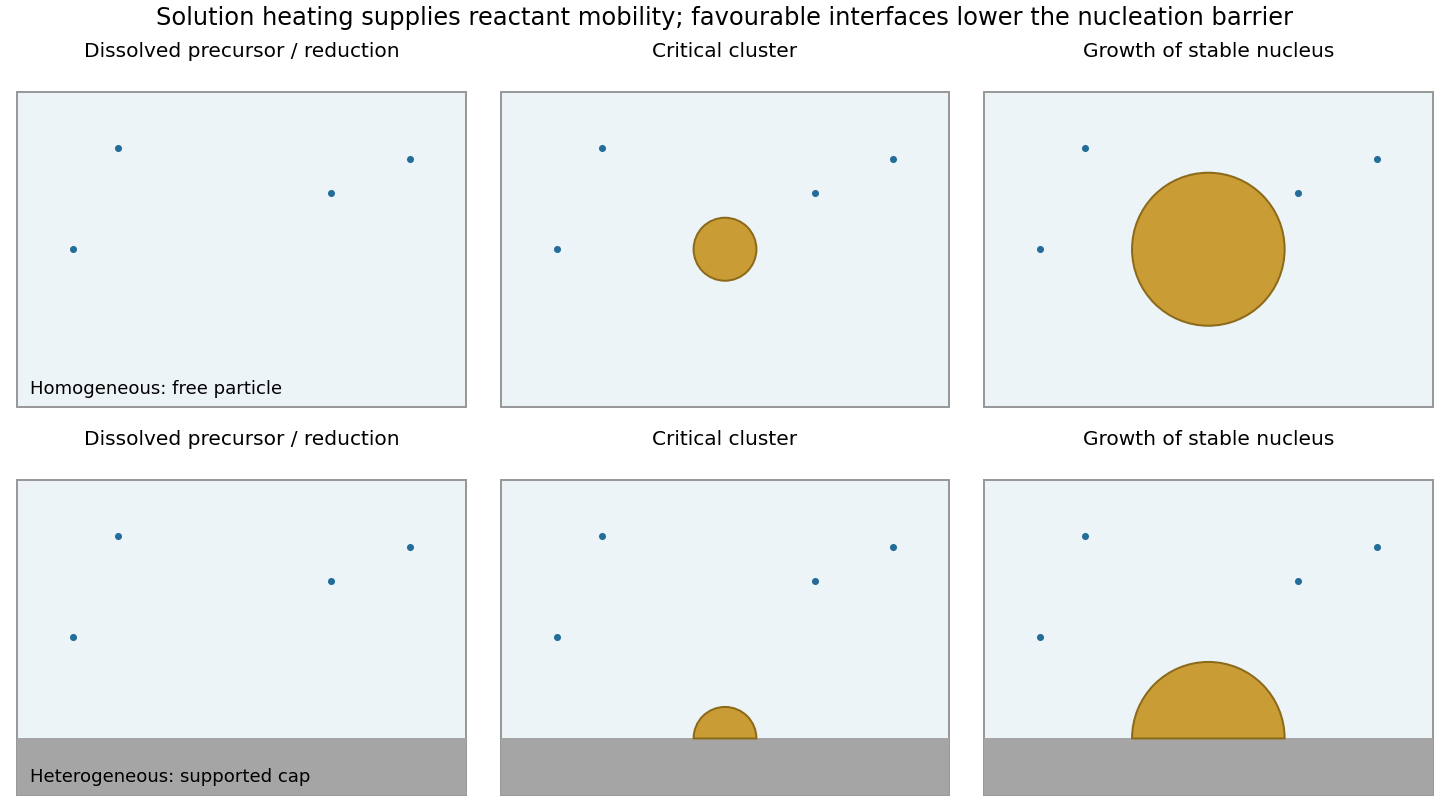

A final supported particle need not have nucleated heterogeneously: a free particle can nucleate in solution and later adsorb on the support. Conversely, a particle nucleated heterogeneously on a suspended seed can remain freely dispersed as a composite particle. Nucleation location and final support status are different classifications.
Microwave absorption heats the medium and possibly the support, changing reduction, diffusion and supersaturation. Preferential local heating can change the relative rates of the two routes. Microwave irradiation alone does not remove the thermodynamic nucleation barrier or demonstrate a special nonthermal mechanism.
- Can the precursor produce metal? Evaluate the reaction Gibbs free energy, including reduction, ligand exchange, precursor and reductant activities, solvation and byproducts. A nominal metal concentration is not the metal-atom chemical potential.
- What is the driving force for condensation? Compare the chemical potential of available metal species with that of the condensed phase. The resulting supersaturation supplies the bulk free-energy gain and competes with the surface cost of a critical nucleus.
- Where does it wet and nucleate? Let , and denote support-medium, particle-medium and support-particle interfacial free energies. For an isotropic cap, the contact angle through the particle obeys . This wetting balance determines the extent of substrate contact and the heterogeneous barrier.
- Which crystal faces survive? At fixed particle volume, minimize the sum of orientation-dependent surface and interface energies, plus any important strain or defect energy. For a free crystal, the Wulff construction gives facet distances proportional to their surface free energies. A Winterbottom construction incorporates the support interface and truncates the corresponding equilibrium shape.
Adsorbed ligands and solvent can change different facet energies by different amounts, so the relevant energies belong to the actual chemical environment. Small particles have large surface-to-volume ratios and are particularly sensitive to these terms.
This sequence identifies thermodynamic factors rather than guaranteeing that an equilibrium shape is reached. Facet-specific attachment rates, precursor delivery and limited annealing can preserve a kinetically selected shape even when another shape has lower free energy.
Write the reaction using the species actually supplied by solution. For either halide, a bulk contribution per converted formula unit isThe stated room-temperature feasibility means that the overall reaction free energy is negative under those conditions; it does not say that each microscopic step is downhill. Equal nominal concentrations also do not make iodide and bromide activities or solvation free energies identical.
At the nanoscale the balance additionally contains changing interfaces:Here is the number of converted formula units, and includes solvent-facing surfaces and contact with the titanium-dioxide support. Surface terms scale approximately as size squared whereas bulk terms scale as size cubed. Particle size, wetting, expansion during conversion and new grain interfaces can therefore shift both the conversion driving force and the nucleation barrier.
Microscopically, conversion requires desolvation, uptake of the organic cation and halide, redistribution through the precursor, and reorganization of the lead-halide framework. A study using these conversion conditions found energetically costly dispersed-ion intercalation for both compounds, with a much larger calculated penalty for MABr in PbBr than for MAI in PbI. The iodide's layered framework accommodates the cation more favorably; the bromide's undulated framework gives poorer coordination and greater local distortion. Stabilization on forming intermediate compounds and the final perovskite can nevertheless make the complete reaction favorable. The calculations are approximate energetic comparisons, not measured finite-temperature activation free energies.[ref]
Kinetics and energetics of metal halide perovskite conversion reactions at the nanoscale by Neha Arora and others. Fig. 4 and accompanying discussion: solvation reference, intercalation and conversion intermediates
Thus both reactions can be spontaneous yet proceed at very different rates: the same study observed faster MAPbI formation. One must distinguish net reaction free energy from intermediate penalties and diffusion barriers. Spontaneity alone supplies no quantitative ranking of the complete iodide and bromide reaction free energies.
In catalytic chemical vapor deposition, a metal nanoparticle activates a carbon-containing feedstock and supplies mobile carbon to the growing rim. Carbon can diffuse over the particle surface and, depending on the catalyst state, through its bulk. Once a curved carbon cap nucleates, continued incorporation extends the tube. Strong catalyst-support adhesion favors base growth; weaker adhesion can allow the particle to lift with the tube tip. A liquid catalyst is not universally required.
Particle size constrains tube diameter, but semiconducting character requires a particular wrapping family: . Merely making particles smaller does not select that congruence class. Routes toward predominantly semiconducting carbon nanotubes include controlling catalyst composition, exposed facets and size distribution to bias cap/rim nucleation and growth, or adjusting carbon chemical potential and growth/etching conditions so that metallic tubes are less likely to survive.
These are mechanistic strategies rather than a universal recipe. Experiments with catalyst conditioning found that high semiconducting selectivity depended sensitively on oxidizing/reducing gas conditions and came with a strong yield penalty, motivating a catalyst-deactivation model.[ref]
A phenomenological model for selective growth of semiconducting single-walled carbon nanotubes based on catalyst deactivation by Shunsuke Sakurai and others. Catalyst conditioning, gas composition and selectivity-yield tradeoff
The useful distinction is between selecting a structure at nucleation, selecting its growth rate, and selectively terminating or removing unwanted tubes. Each can enrich the semiconducting fraction, but they do not establish the same growth mechanism.
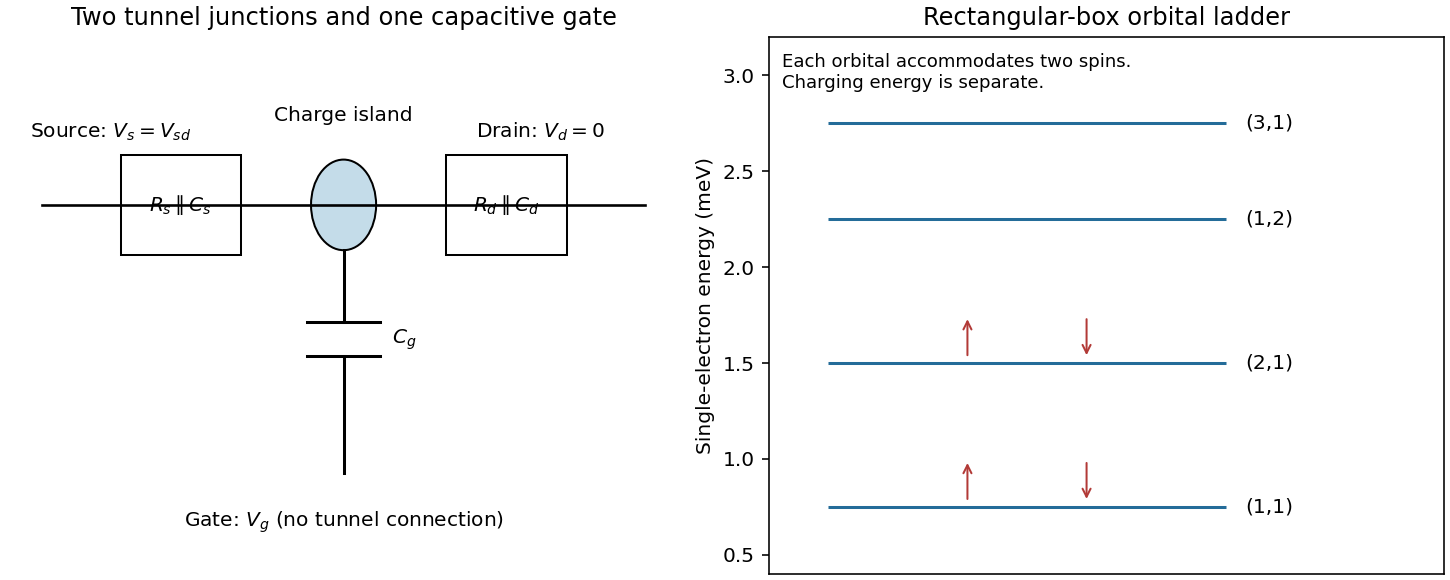
The pattern is characteristic of a single-electron transistor: a small conducting island is connected to source and drain by two tunnel junctions, and to a gate through a capacitance. Inside a Coulomb diamond, changing the island's integer charge costs more energy than the leads can supply, so sequential tunnelling is blocked. Outside it, an island electrochemical potential lies in the transport window and current can flow.
For clear Coulomb blockade, the island charging scale must exceed thermal broadening, and the tunnel junctions must be sufficiently resistive to preserve well-defined charge states:in the simplest circuit. Stray capacitances should be included in if appreciable. The gate changes electrostatic energy but should not provide a conducting leakage path. Lifetime broadening and cotunnelling should be small enough not to wash out the blocked regions.

The almost identical unconfined diamonds are consistent with a constant interaction model having negligible or unresolved changes in single-particle level spacing.
The zero-bias gate period in the first plot is . In the constant interaction model, changing the gate-induced island charge by one electron givesThe tip is at above or below zero; use this half-height, not the full vertical extent. The addition energy is , giving
To distinguish the junction capacitances, explicitly adopt the circuit convention and . The diamond with zero-bias endpoints and has its positive tip near . Its two edge slopes are therefore and .
Writing the island electrochemical potential as a charge-dependent constant minus , alignment with the drain gives slope , while alignment with the source gives . ThusThe source/drain names are exchanged if the opposite lead is biased under the voltage convention. The figure alone establishes the pair unless that wiring convention is specified. Symmetric-looking diamond heights do not imply equal junction capacitances.
Inside the rectangle the effective-mass Schrödinger equation iswith at all four walls because the confining potential is infinite outside. Separate . Each factor obeys a one-dimensional particle in a box equation. For ,so is proportional to with ; the zero and negative integers give no new physical states. The same argument applies in .
The normalized spatial states and their energies areThe product form and energy sum follow from separability. Each spatial orbital can accommodate two opposite-spin electrons under the stated spin degeneracy. These are single-particle confinement energies; the electrostatic charging contribution must still be added when interpreting transport addition energies.
The enlarged diamonds reach instead of . Subtract the unchanged charging contribution:Thus the two observed closed-orbital gaps are each approximately .
Define and , and choose the labels so . With two spins per orbital, the first two closed orbitals correspond to occupancies and . The lowest state is and the next is , soThe next orbital is , yielding the second observed gapThis ordering is self-consistent: , , and , as shown in the original level diagram.
Using givesThe axes can be interchanged. Assigning the same directly to both and would instead give a square box with degenerate and orbitals. That would require four electrons in that shell and would not give the stated second closed-orbital occupancy .
At terminal speed the downward buoyant weight balances the Stokes drag:Positive gives downward settling; a lighter particle would rise. With , , and ,about , or per day.
The very small Reynolds number makes inertial corrections to Stokes flow negligible for an isolated particle. On short particle-scale distances, Brownian motion is much faster than this systematic drift. Nevertheless the nonzero settling speed can produce concentration gradients over sufficiently long times and large sample heights; Brownian motion does not cancel gravity.
The sedimentation scale height simplifies because the same drag coefficient controls both drift and diffusion:Applying the given criterion givesEquivalently, the gravitational Péclet number on the particle-radius scale is and must be at most one.
At the limiting radius is , corresponding to diameter approximately . Viscosity cancels from this equilibrium criterion, although it affects the time to approach equilibrium.
For the radius particle in part (i), and , about particle radii. It is therefore firmly diffusion-dominated on its own size scale. This does not mean uniform concentration over an arbitrarily tall vessel: the equilibrium density still decays on the finite scale . The supplied size criterion is an approximate gravity-versus-diffusion criterion, not a universal definition of every stable colloid.
For ideal hard spheres, potential energy is zero for nonoverlapping configurations and infinite for overlaps. At fixed temperature and volume, the accessible fluid and crystal configurations therefore have no energetic preference of the ordinary bonding kind: the phase with larger entropy has lower Helmholtz free energy.
Ordering particle centers costs some configurational freedom, but at a high packing fraction it can give each particle more usable cage/free volume than a disordered crowded arrangement. The total number of allowed vibrational and positional configurations can then be greater in a crystal despite its visible long-range order. This is entropy-driven hard-sphere crystallization.
The crystal need not be at close packing. At the stated volume fraction near , substantial free space remains for thermal motion. Close packing near is the geometric upper bound for equal spheres, not the fraction at which the crystal first becomes thermodynamically favorable. Treating crystallization as an inevitable decrease in total entropy would confuse visible positional order with the full phase-space count.
Let be projected area. Close-packed circular footprints cover and the exposed flat substrate covers . A hemisphere's curved area is twice its circular footprint, so the actual wetted solid area isThe Wenzel roughness factor is therefore , not or .
Using the Wenzel wetting relation,The nanostructure makes this surface more wettable, because planar PMMA already has . Under complete Wenzel wetting, roughening amplifies the underlying hydrophilic character; it does not turn this material hydrophobic.
The calculation assumes identical chemistry on spheres and substrate, complete liquid penetration, ideal hemispheres, a macroscopic contact angle and negligible pinning/line-tension effects. Actual dried particles may have different contact geometry, deformation, contamination or trapped air. A hydrophobic coating with planar angle above would make roughness increase the angle instead. Designing a texture that retains air in a Cassie–Baxter state is another route, but its stability against liquid penetration must be checked.
Define , and as the solid-vapor, solid-liquid and liquid-vapor interfacial free energies per actual area. For the corresponding planar material, Young's contact-angle equation isConsider advancing the macroscopic liquid footprint over projected area , while retaining the specified wetting only to each sphere's equator. The newly wetted upper hemispheres have actual area . The gaps occupy projected area , across which a liquid-vapor interface remains instead of solid-liquid contact.
The microscopic free-energy change, apart from the outer macroscopic droplet surface, isEquating this with , the macroscopic wetting contribution, yieldsThe factor comes from the curved hemisphere area; the negative gap term is the trapped liquid-vapor interface. This combines Wenzel roughness on the wetted solid fraction with Cassie-type air gaps. It differs from both homogeneous Wenzel wetting and a Cassie formula that treats the solid contacts as flat.
For and , this gives and . The hybrid state is less wettable than the fully penetrated hemispherical model, but still not hydrophobic. The result is conditional on the assumed equatorial meniscus and retained air: pinning or metastability may be required, and allowing further penetration can change the equilibrium geometry.
Articles by others on the same topic
There are currently no matching articles.