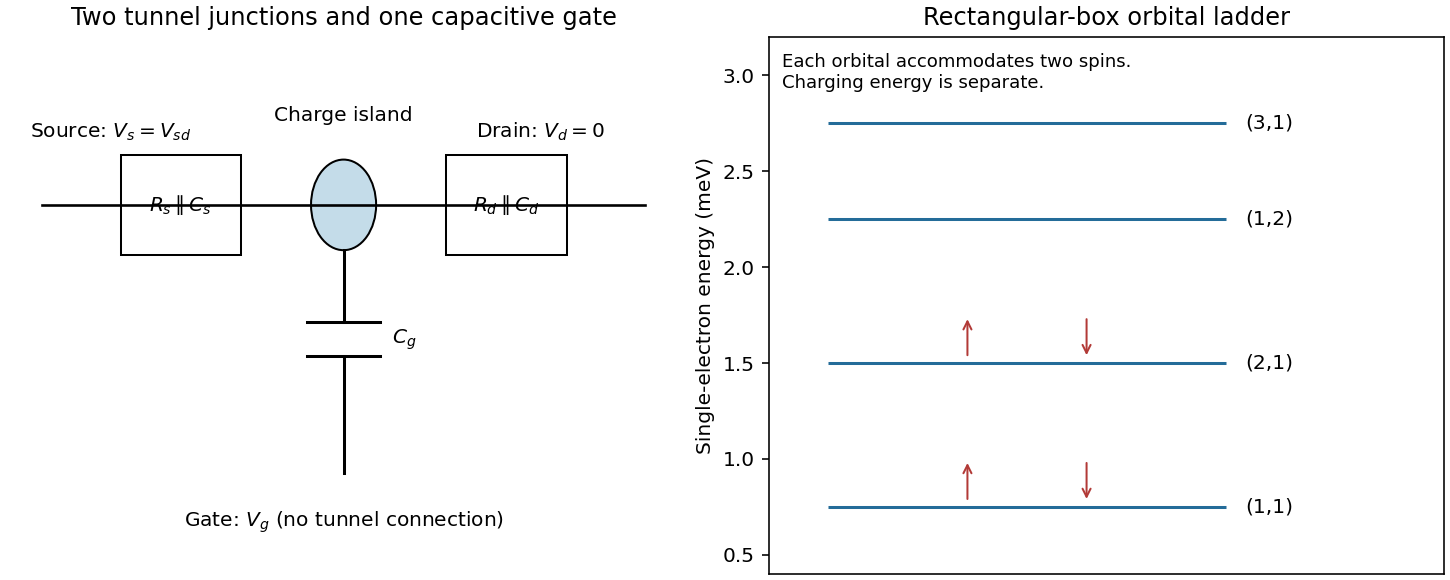
The pattern is characteristic of a single-electron transistor: a small conducting island is connected to source and drain by two tunnel junctions, and to a gate through a capacitance. Inside a Coulomb diamond, changing the island's integer charge costs more energy than the leads can supply, so sequential tunnelling is blocked. Outside it, an island electrochemical potential lies in the transport window and current can flow.
For clear Coulomb blockade, the island charging scale must exceed thermal broadening, and the tunnel junctions must be sufficiently resistive to preserve well-defined charge states:in the simplest circuit. Stray capacitances should be included in if appreciable. The gate changes electrostatic energy but should not provide a conducting leakage path. Lifetime broadening and cotunnelling should be small enough not to wash out the blocked regions.

The almost identical unconfined diamonds are consistent with a constant interaction model having negligible or unresolved changes in single-particle level spacing.
Articles by others on the same topic
There are currently no matching articles.