The pattern is characteristic of a single-electron transistor: a small conducting island is connected to source and drain by two tunnel junctions, and to a gate through a capacitance. Inside a Coulomb diamond, changing the island's integer charge costs more energy than the leads can supply, so sequential tunnelling is blocked. Outside it, an island electrochemical potential lies in the transport window and current can flow.
For clear Coulomb blockade, the island charging scale must exceed thermal broadening, and the tunnel junctions must be sufficiently resistive to preserve well-defined charge states:in the simplest circuit. Stray capacitances should be included in if appreciable. The gate changes electrostatic energy but should not provide a conducting leakage path. Lifetime broadening and cotunnelling should be small enough not to wash out the blocked regions.

The almost identical unconfined diamonds are consistent with a constant interaction model having negligible or unresolved changes in single-particle level spacing.
The zero-bias gate period in the first plot is . In the constant interaction model, changing the gate-induced island charge by one electron givesThe tip is at above or below zero; use this half-height, not the full vertical extent. The addition energy is , giving
To distinguish the junction capacitances, explicitly adopt the circuit convention and . The diamond with zero-bias endpoints and has its positive tip near . Its two edge slopes are therefore and .
Writing the island electrochemical potential as a charge-dependent constant minus , alignment with the drain gives slope , while alignment with the source gives . ThusThe source/drain names are exchanged if the opposite lead is biased under the voltage convention. The figure alone establishes the pair unless that wiring convention is specified. Symmetric-looking diamond heights do not imply equal junction capacitances.
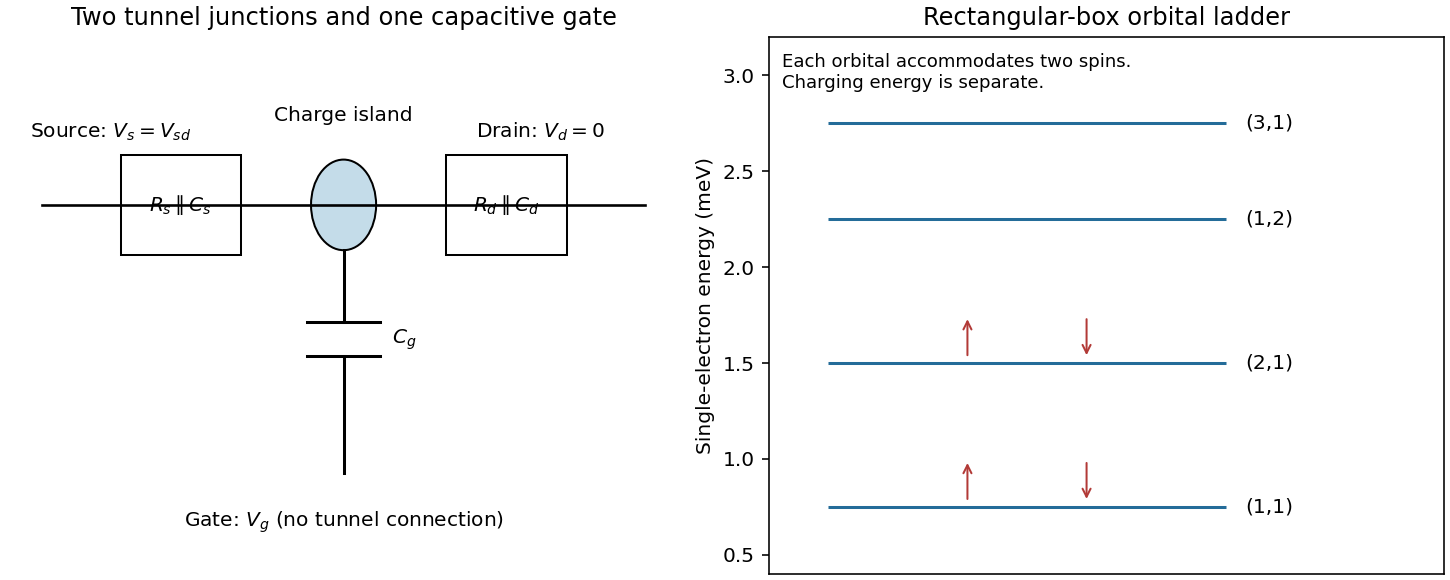
Inside the rectangle the effective-mass Schrödinger equation iswith at all four walls because the confining potential is infinite outside. Separate . Each factor obeys a one-dimensional particle in a box equation. For ,so is proportional to with ; the zero and negative integers give no new physical states. The same argument applies in .
The normalized spatial states and their energies areThe product form and energy sum follow from separability. Each spatial orbital can accommodate two opposite-spin electrons under the stated spin degeneracy. These are single-particle confinement energies; the electrostatic charging contribution must still be added when interpreting transport addition energies.
The enlarged diamonds reach instead of . Subtract the unchanged charging contribution:Thus the two observed closed-orbital gaps are each approximately .
Define and , and choose the labels so . With two spins per orbital, the first two closed orbitals correspond to occupancies and . The lowest state is and the next is , soThe next orbital is , yielding the second observed gapThis ordering is self-consistent: , , and , as shown in the original level diagram.
Articles by others on the same topic
There are currently no matching articles.