At low accumulated displacements per atom, a stainless steel can undergo substantial microscopic damage while its macroscopic volume changes little. Irradiation-generated vacancies and self-interstitials recombine, reach defect sinks, or form small clusters and dislocation loops. These processes can harden the steel before a large population of growing cavities appears. Thus dimensional stability during this interval does not imply an undamaged microstructure.
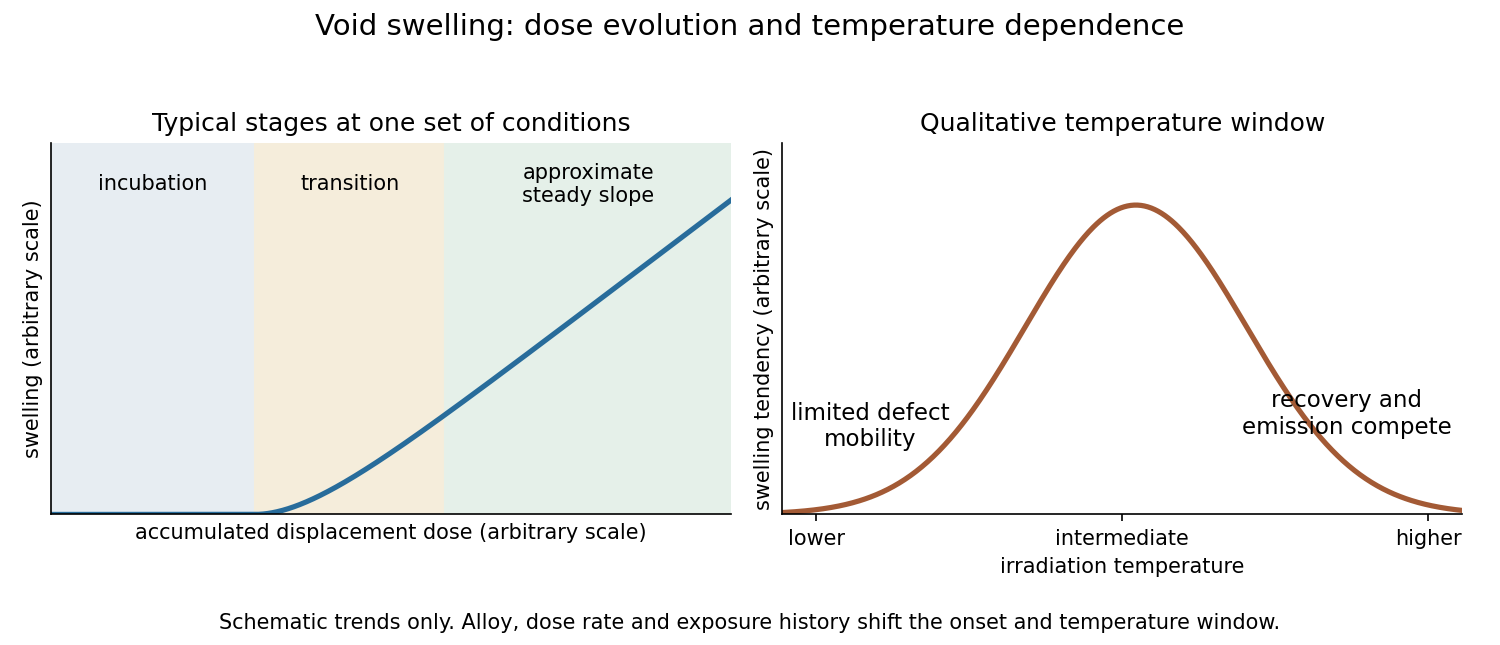
Void swelling commonly has an incubation interval, a transition into appreciable swelling, and a later interval with an approximately steady swelling rate per unit dose. The transition reflects the evolution of both stable cavity nuclei and the competing sink population. Gas atoms can help stabilize small cavities, but a vacancy void need not be filled with high-pressure gas.
The driving imbalance is a vacancy supersaturation. Dislocations generally capture interstitial defects more efficiently than vacancies, giving an interstitial bias. Once stable voids exist, the resulting excess vacancy supply can enlarge them. Growing and evolving dislocation structures compete with the cavities for defects. A roughly steady balance can give an approximately linear volume increase with dose over part of the exposure range, rather than proving indefinite linear growth.
If cavities occupy a fraction of the current volume and the matrix volume is otherwise unchanged, the void swelling volume fraction relation isSince cavity volume scales as radius cubed, numerous tiny clusters and a smaller population of larger voids can have very different dimensional consequences.
The original Cawthorne-Fulton observation of voids in irradiated steel used thin-foil electron microscopy on type316 stainless steel exposed in the Dounreay Fast Reactor. It connected microscopic cavities with the dimensional-instability problem that had emerged during fast-reactor fuel development.[ref]
Voids in irradiated stainless steel by C. Cawthorne and E. J. Fulton. Opening description: irradiated fuel cladding and mechanical-test specimens examined by the thin-foil electron-microscope technique

Articles by others on the same topic
There are currently no matching articles.