At low accumulated displacements per atom, a stainless steel can undergo substantial microscopic damage while its macroscopic volume changes little. Irradiation-generated vacancies and self-interstitials recombine, reach defect sinks, or form small clusters and dislocation loops. These processes can harden the steel before a large population of growing cavities appears. Thus dimensional stability during this interval does not imply an undamaged microstructure.
Void swelling commonly has an incubation interval, a transition into appreciable swelling, and a later interval with an approximately steady swelling rate per unit dose. The transition reflects the evolution of both stable cavity nuclei and the competing sink population. Gas atoms can help stabilize small cavities, but a vacancy void need not be filled with high-pressure gas.
The driving imbalance is a vacancy supersaturation. Dislocations generally capture interstitial defects more efficiently than vacancies, giving an interstitial bias. Once stable voids exist, the resulting excess vacancy supply can enlarge them. Growing and evolving dislocation structures compete with the cavities for defects. A roughly steady balance can give an approximately linear volume increase with dose over part of the exposure range, rather than proving indefinite linear growth.
If cavities occupy a fraction of the current volume and the matrix volume is otherwise unchanged, the void swelling volume fraction relation isSince cavity volume scales as radius cubed, numerous tiny clusters and a smaller population of larger voids can have very different dimensional consequences.
The original Cawthorne-Fulton observation of voids in irradiated steel used thin-foil electron microscopy on type316 stainless steel exposed in the Dounreay Fast Reactor. It connected microscopic cavities with the dimensional-instability problem that had emerged during fast-reactor fuel development.[ref]
Voids in irradiated stainless steel by C. Cawthorne and E. J. Fulton. Opening description: irradiated fuel cladding and mechanical-test specimens examined by the thin-foil electron-microscope technique
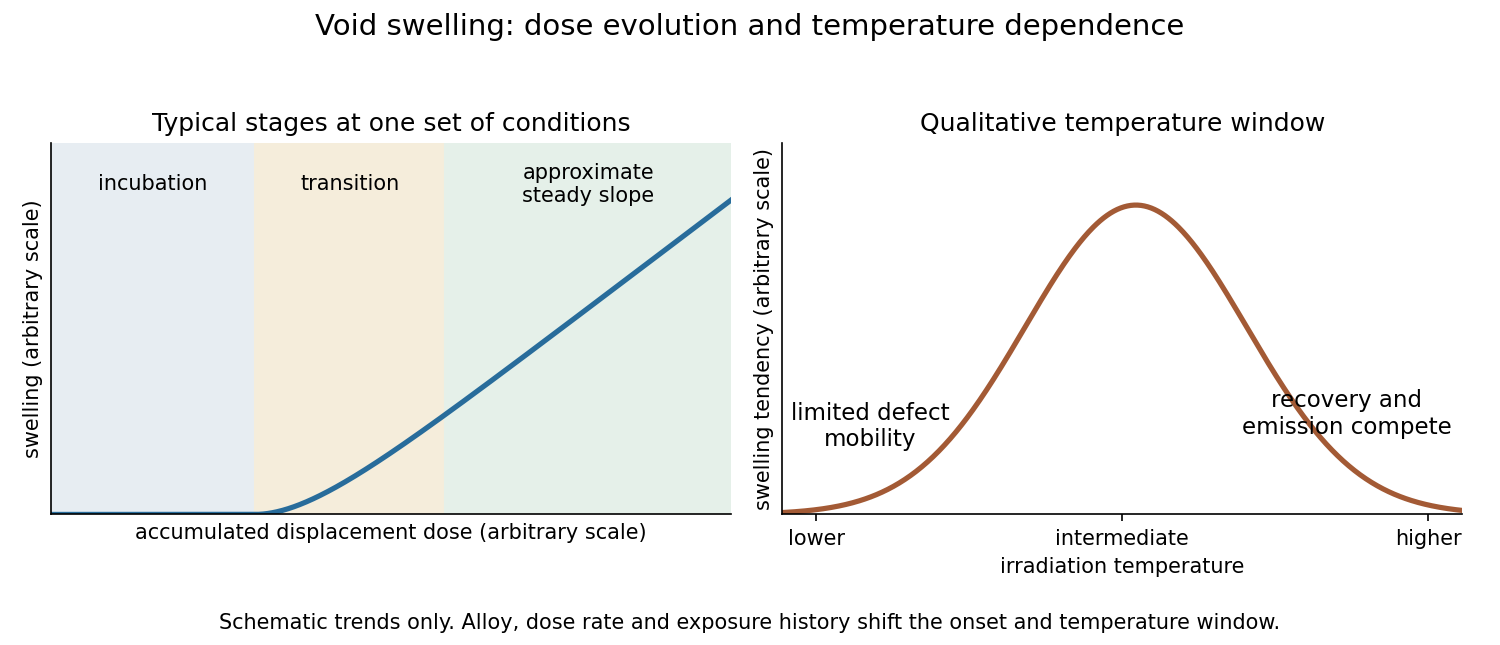
Original schematic of incubation, growing swelling rate and approximate steady swelling; no measured steel data are reproduced
. Details. 
Temperature controls the competition between defect creation, diffusion, recombination, sink absorption and thermal vacancy emission. Consequently void swelling is normally largest in an intermediate temperature window, whose location depends on alloy, dose rate and exposure history.
At low temperature, many generated defects lack sufficient mobility to feed a growing cavity. Considerable irradiation hardening can still occur through small defect clusters, while large-scale void growth remains limited.
At intermediate temperature, vacancies and interstitials migrate sufficiently to establish the biased defect fluxes described above. Cavity nuclei can survive and receive a net vacancy flux, producing strong swelling.
At sufficiently high temperature, thermal vacancy emission, recombination, recovery and changes in sink populations compete more strongly with vacancy absorption. Stable nucleation and net cavity growth can become less favorable. This does not imply that every radiation effect disappears: material creep, precipitation, segregation and gas-bubble evolution can remain important.
For austenitic stainless steels, the relevant range is typically several hundred degrees Celsius; an alloy-independent peak temperature is not justified. Raising the displacement dose rate changes the balance between production and thermally activated processes and can shift both the temperature window and the incubation dose. Temperatures from accelerated ion or electron experiments should therefore be interpreted together with dose rate, implantation, specimen thickness and surface-sink effects.
Reducing void swelling means delaying stable cavity growth and reducing its rate after incubation. Several approaches act on different parts of that mechanism.
Choose an alloy and initial microstructure with favorable defect sink populations. Grain boundaries, stable interfaces, precipitates and a controlled dislocation structure can remove mobile defects and promote recombination before they feed voids. The relevant quantity is sink efficiency and bias, rather than the number of visible microstructural features alone.
Cold working can increase the starting dislocation density and prolong incubation in suitable austenitic steels. Irradiation and thermal recovery can later change that structure, so an initial benefit need not persist indefinitely. Solute additions and controlled precipitation can also change vacancy mobility, defect trapping and cavity nucleation. Their effectiveness must be assessed together with corrosion, ductility and irradiation-assisted changes in composition.
Where other constraints permit, choose a more swelling-resistant material family, such as an appropriate ferritic-martensitic steel, rather than assuming every stainless steel has the response of an austenitic grade. This introduces its own tradeoffs in toughness, temperature window and compatibility.
Manage the operating temperature and accumulated dose to avoid the most unfavorable swelling regime, and account for transmutation-gas production. Neither simply minimizing temperature nor adding gas traps guarantees an improved component: the former can increase hardening and embrittlement, and gas-stabilized cavities can become nuclei for later swelling.
Useful comparisons require specimens with controlled composition and heat treatment, measured dose and temperature histories, and both dimensional measurements and transmission electron microscopy. Matching final dose alone does not establish that two irradiation conditions produce the same swelling.
Articles by others on the same topic
There are currently no matching articles.