With , define the semidiscrete Fourier transform byFor finite-support sequences, expand the squared modulus and use orthogonality:ConsequentlyFor a general square-summable sequence, truncate it to . The identity makes the transformed truncations Cauchy in , and completeness defines the transform as their limit. Passing to the limit proves the Parseval identityThe infinite series need not converge absolutely pointwise; the interpretation is sufficient for the stability analysis.
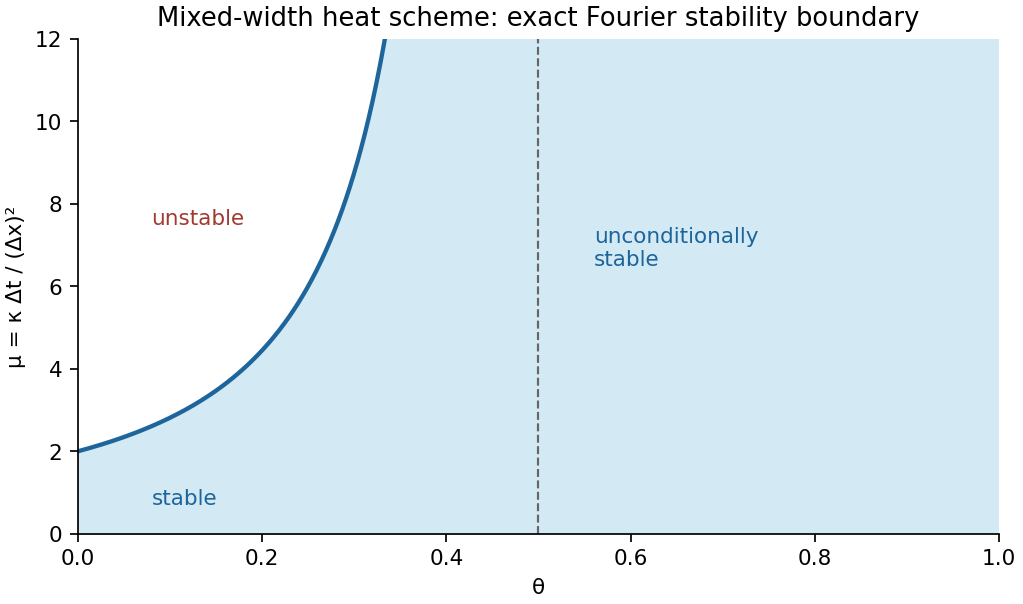
Transforming the spatial shifts and putting gives the real amplification factorFor the denominator is at least one, so the implicit step is a bounded Fourier multiplier on . Set and use . The numerator is no greater than the denominator, so . The other inequality isIf , the bracket is nonpositive and this always holds. If , the concave quadratic has its maximum at , with value . Therefore precisely under the stated conditionand without a mesh-ratio restriction when . The Parseval identity now givesIteration proves stability with constant one. It is conditional for and unconditional for . The sampled initial data have finite support, hence belong to . This is the Fourier stability threshold for a mixed-width heat scheme.

Articles by others on the same topic
There are currently no matching articles.