For propagation along z, write . A Jones vector contains the complex transverse components. Equal phase modulo gives linear polarization; equal magnitudes with phase difference give circular polarization. A common overall phase has no effect on the polarization ellipse. A deterministic optical element acts by a Jones matrix, with successive matrices ordered from right to left along the light path.
A circular polarizer uses a linear polarizer transmitting x and a quarter-wave plate whose principal axes are at . Up to an overall phase, convenient matrices in fixed physical x/y axes areThe plate is lossless, , and is circular in the supplied convention. Put P on side A and Q on side B: forward passage is .
Unpolarized light has no single Jones vector. Represent its intensity by the coherency matrix and propagate it as . Forward transmission givesThus the transmitted light is circular with intensity . The initial polarizer removes one incoherent linear component; the plate changes phase without restoring the lost intensity.
Reverse passage encounters Q before P and has in the same fixed transverse axes. It givesThe output is linearly polarized along x and again has intensity . A retarder alone leaves an unpolarized coherency matrix unchanged. Consequently an unpolarized scene appears darker from either side, although the transmitted polarization differs. No polarization-dependent response of the observer is needed to explain this reduction.
For the mirror calculations below, use an ideal near-normal isotropic reflector, up to a common phase. In fixed physical transverse axes reflection leaves the polarization ellipse unchanged; it reverses circular helicity because the propagation direction reverses. A reciprocal plate has the same relative phase delay on the return traversal in this fixed-axis convention. In particular : two passes exchange x and y linear states.
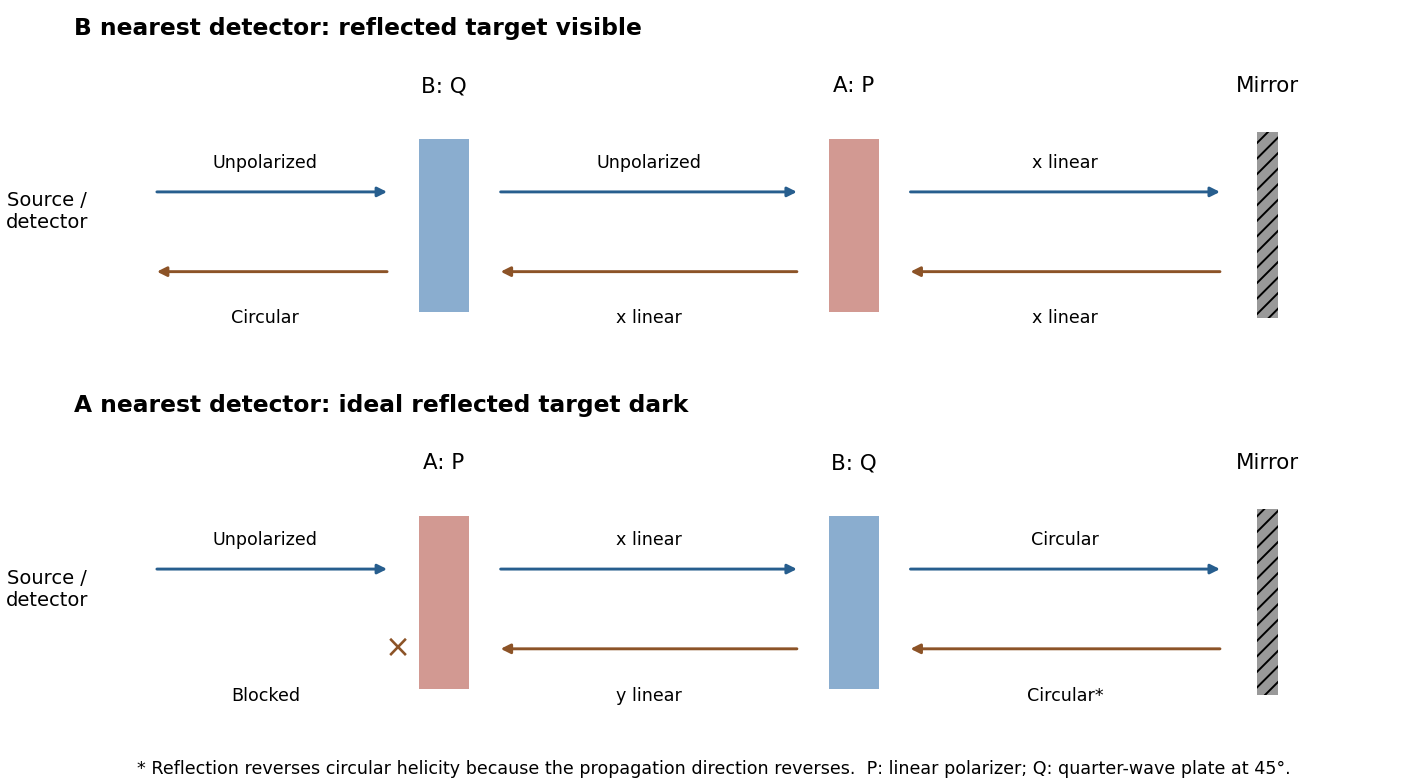
Original outward and return polarization-state diagrams for the two orientations of a polarizer-plus-quarter-wave-plate filter in front of a mirror
. Details. 
With B nearest the observer, light from the reflecting target near the observer first crosses Q and then P on its way to the mirror. Unpolarized light remains unpolarized through Q, then becomes x linear after P. Mirror reflection preserves that linear orientation. On return it passes the same P without further ideal rejection and then Q, becoming circular toward the observer. Thus the reflected target remains visible.
Algebraically, with input and output at the observer side,The target here is used only as a source/reflector of ordinary unpolarized light; no physiological model is involved.
With A nearest the observer, the outward order is P then Q. The initially unpolarized light becomes x linear, then circular, before reaching the mirror. Reflection reverses its helicity. Its return through Q gives y linear, which is blocked by P:Hence the ideal reflected filter is dark and the target cannot be seen through it. This is a double-pass polarization rejection effect, not unequal one-pass transmission from its two sides. Real mirrors at oblique incidence, imperfect retardance, finite bandwidth and depolarization can leave leakage.
Articles by others on the same topic
There are currently no matching articles.