Original paper: Public original PDF, physical pages 254–257; cover on page 254 and questions on pages 255–257.
The wavelength is , and the aperture diameter is . A uniformly illuminated circular aperture has normalized power pattern , where . Its first null is at , while its half-power point has . ThusThe first-null small-angle estimate is , or roughly ; using the sine gives about . This is a broad beam because the diameter is only about two wavelengths. Real illumination and aperture efficiency alter the exact beam shape; a required allowable gain loss would specify the pointing tolerance more precisely.
For a matched, correctly polarized half-wave dipole, with . For an efficient dish, . Received available powers are proportional to these areas. With both voltages referred to the same matched receiver resistance,For ideal aperture efficiency this is about one fifth, or five times greater voltage from the dish. Terminal voltages without a common impedance or matching convention are not fixed by aperture alone: for the respective matched loads. A short-dipole rather than half-wave convention changes the order-one gain factor, not the main estimate.
Spatial coherence compares the electric fields at different positions at a common time; temporal coherence compares the field with itself at a delay. Experimentally, they control whether separated apertures or unequal optical paths can form stable interference fringes. They are correlation properties, not a requirement that every emitted wave have a deterministic phase.
The source diameter is . At a representative visible wavelength ,For a uniformly bright circular disc, the first visibility zero is at ; the coefficient depends on the chosen coherence criterion and brightness distribution. Atmospheric phase fluctuations can further spoil measured coherence.
For an explicitly assumed broad visible band from to , the frequency span is . ConsequentlyThus broadband planetary light has millimetre-scale transverse and micrometre-scale longitudinal coherence. The receiver band is not supplied: a narrow filter would increase the temporal coherence length, so this is a stated broadband estimate, not a unique source-only constant.
Use ideal large plates and neglect edge effects. A Lorentz boost normal to the plates does not contract either transverse plate dimension. Charge is invariant, so charge per plate area remains . Gauss's law then givesThe plate separation contracts, but the infinite-plate field is independent of separation. It is therefore incorrect to infer a stronger field merely from the shorter gap. The ideal field is parallel to the boost, so there is no induced transverse magnetic field from this boost.
For a long solenoid at rest, , where n is turns per unit axial length and I is the current around a turn. Under a boost along its axis, longitudinal contraction gives . The circumference of a turn is transverse to the boost and does not contract; time dilation reduces its charge-circulation rate, measured relative to the moving material of that turn, to . HenceEquivalently, the transverse volume-current density of an ideal continuous current sheet is unchanged by an axial boost. The increase in turn density must not be included while leaving the per-turn current unchanged. End effects and the microscopic winding geometry are outside this ideal-solenoid argument.
Let run from the charge's present position to the observation point, and let be constant. Lorentz-transforming the Coulomb field givesAt fixed R, the radial magnitude is proportional to . It is reduced by along the motion and enhanced by perpendicular to it. The field is therefore concentrated around the transverse plane at high speed. For negative charge all electric-field arrows reverse.
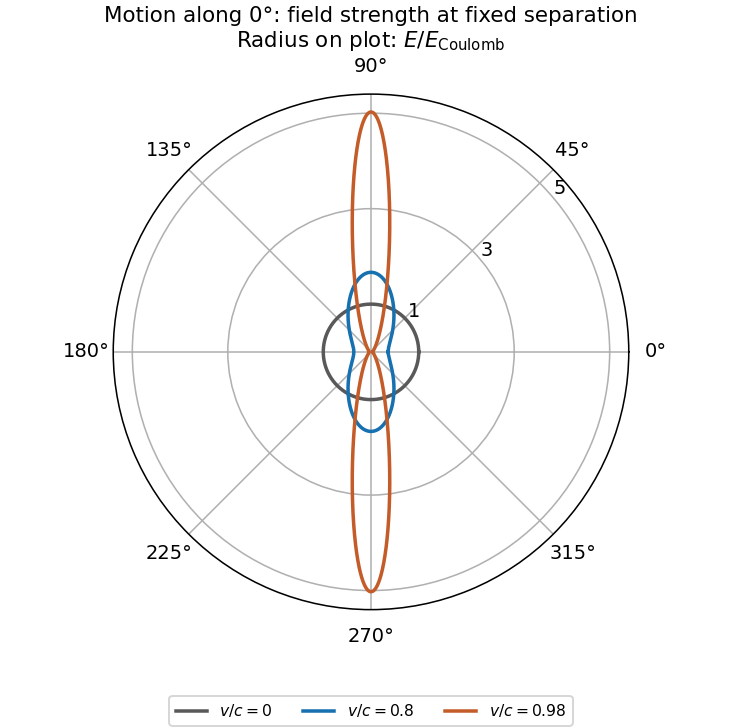
Original angular field-strength comparison for a uniformly moving charge, measured from its instantaneous position, with the direction of motion marked
. Details. 
Although the fields depend causally on retarded motion, for constant velocity the electric-field direction points along the separation from the present position. This does not imply instantaneous action: the velocity-dependent part of the retarded field removes a naive directional lag. Both fields fall as ; uniform straight-line motion produces no acceleration-radiation term proportional to .
Sunlight is approximately unpolarized before its interaction with the environment. For Rayleigh scattering by small isotropic scatterers, the induced electric dipoles radiate only their components transverse to the viewing direction. For unpolarized incident light scattered through angle , the perpendicular and parallel intensities are proportional to 1 and . The degree of linear polarization is thereforeAt single scattering is fully linearly polarized perpendicular to the scattering plane. This explains the polarized sky away from the Sun; multiple scattering and aerosols reduce the ideal contrast.
Reflection at a dielectric surface treats the two linear polarizations differently. At Brewster incidence, , the reflected p component vanishes for ideal transparent nonmagnetic media. The remaining reflected glare is s polarized, perpendicular to the incidence plane, approximately horizontal for a horizontal water surface. Away from this angle the reflection is generally partially polarized. The transmitted beam also has unequal s/p transmission.
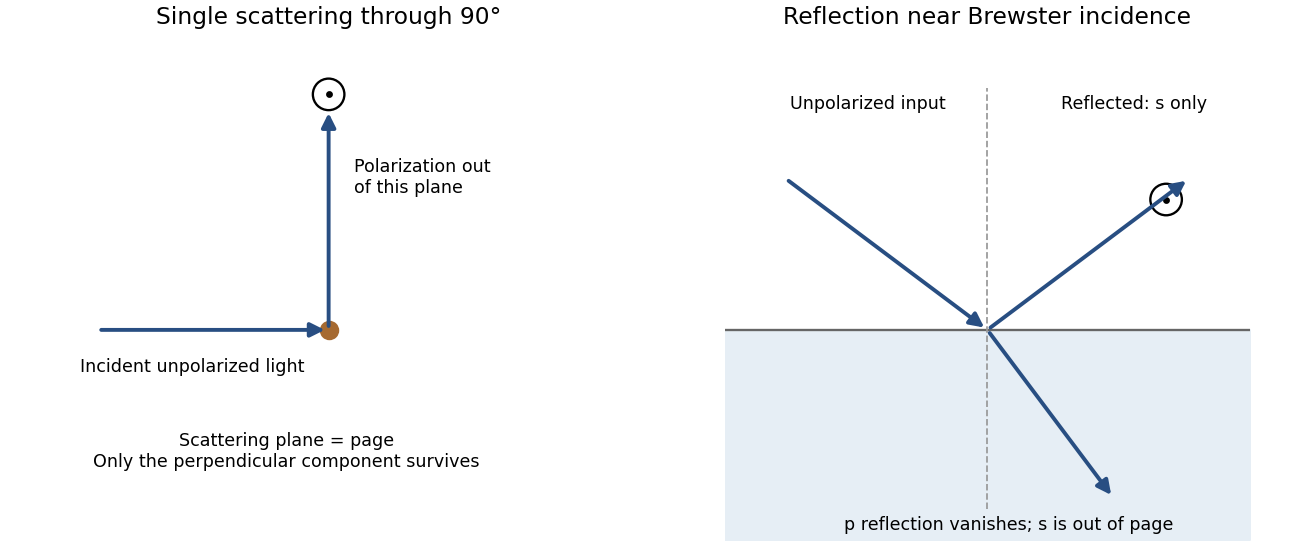
Original diagrams of polarization perpendicular to a single-scattering plane and of s-polarized reflection near Brewster incidence at a dielectric surface
. Details. 
Refraction and internal reflection in water droplets likewise have polarization-dependent Fresnel coefficients, producing strong linear polarization in rainbow light. These are generic scattering and boundary-condition mechanisms; no biological detection mechanism is required.
An accelerated charge radiates. For ultrarelativistic circular motion, the emitted radiation is concentrated into a cone of angular width of order about the instantaneous velocity. As the cone sweeps past a distant observer, propagation-time compression produces a short pulse of width of order , where is orbit curvature radius. Its Fourier spectrum extends to high harmonics, with conventional critical angular frequencyThis is a spectral scale, not a sharp upper cutoff. For transverse acceleration and , the classical radiated power isThe radiation is linearly polarized for an observer in the orbit plane, with elliptical polarization away from it. The two sides of the orbit plane have opposite handedness. The strong forward preference and high-frequency spectrum follow from the relativistic radiation calculation.[ref]
On the Classical Radiation of Accelerated Electrons by Julian Schwinger. 1949, abstract: angular distribution, forward preference and high-frequency radiation
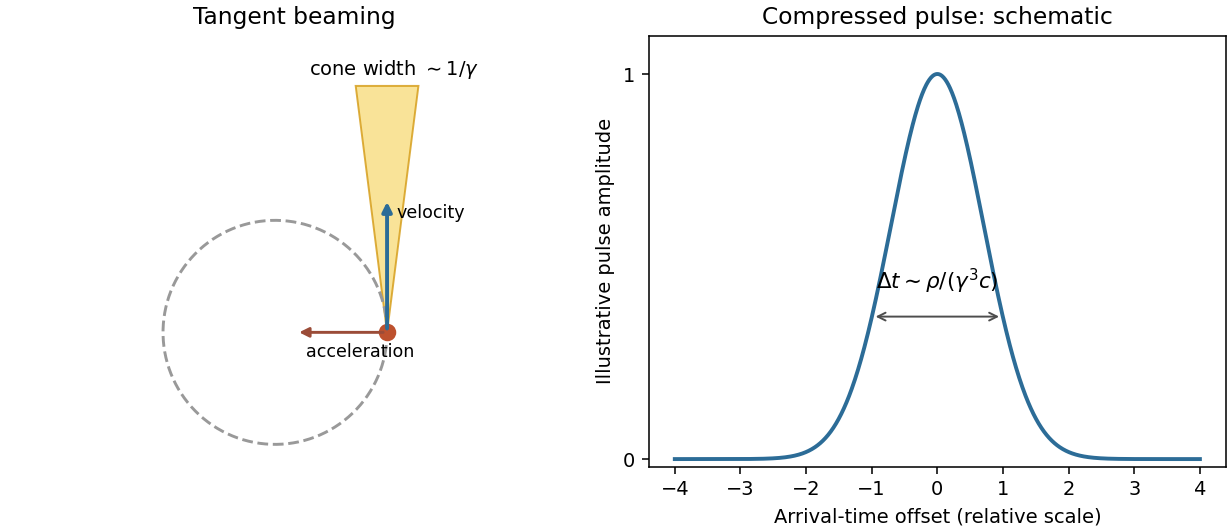
Original tangent-beaming geometry and normalized illustrative pulse showing the origin of a broad synchrotron spectrum; the pulse curve is schematic rather than measured
. Details. 
Magnetic bending fields steer the charge but do no work, so maintaining a storage-ring beam requires energy replacement by accelerating fields. Bright electron beams provide useful radiation from infrared to X-rays; stronger curvature or higher electron energy shifts the spectral scale. The classical formulas assume negligible quantum recoil.
For propagation along z, write . A Jones vector contains the complex transverse components. Equal phase modulo gives linear polarization; equal magnitudes with phase difference give circular polarization. A common overall phase has no effect on the polarization ellipse. A deterministic optical element acts by a Jones matrix, with successive matrices ordered from right to left along the light path.
A circular polarizer uses a linear polarizer transmitting x and a quarter-wave plate whose principal axes are at . Up to an overall phase, convenient matrices in fixed physical x/y axes areThe plate is lossless, , and is circular in the supplied convention. Put P on side A and Q on side B: forward passage is .
Unpolarized light has no single Jones vector. Represent its intensity by the coherency matrix and propagate it as . Forward transmission givesThus the transmitted light is circular with intensity . The initial polarizer removes one incoherent linear component; the plate changes phase without restoring the lost intensity.
Reverse passage encounters Q before P and has in the same fixed transverse axes. It givesThe output is linearly polarized along x and again has intensity . A retarder alone leaves an unpolarized coherency matrix unchanged. Consequently an unpolarized scene appears darker from either side, although the transmitted polarization differs. No polarization-dependent response of the observer is needed to explain this reduction.
For the mirror calculations below, use an ideal near-normal isotropic reflector, up to a common phase. In fixed physical transverse axes reflection leaves the polarization ellipse unchanged; it reverses circular helicity because the propagation direction reverses. A reciprocal plate has the same relative phase delay on the return traversal in this fixed-axis convention. In particular : two passes exchange x and y linear states.
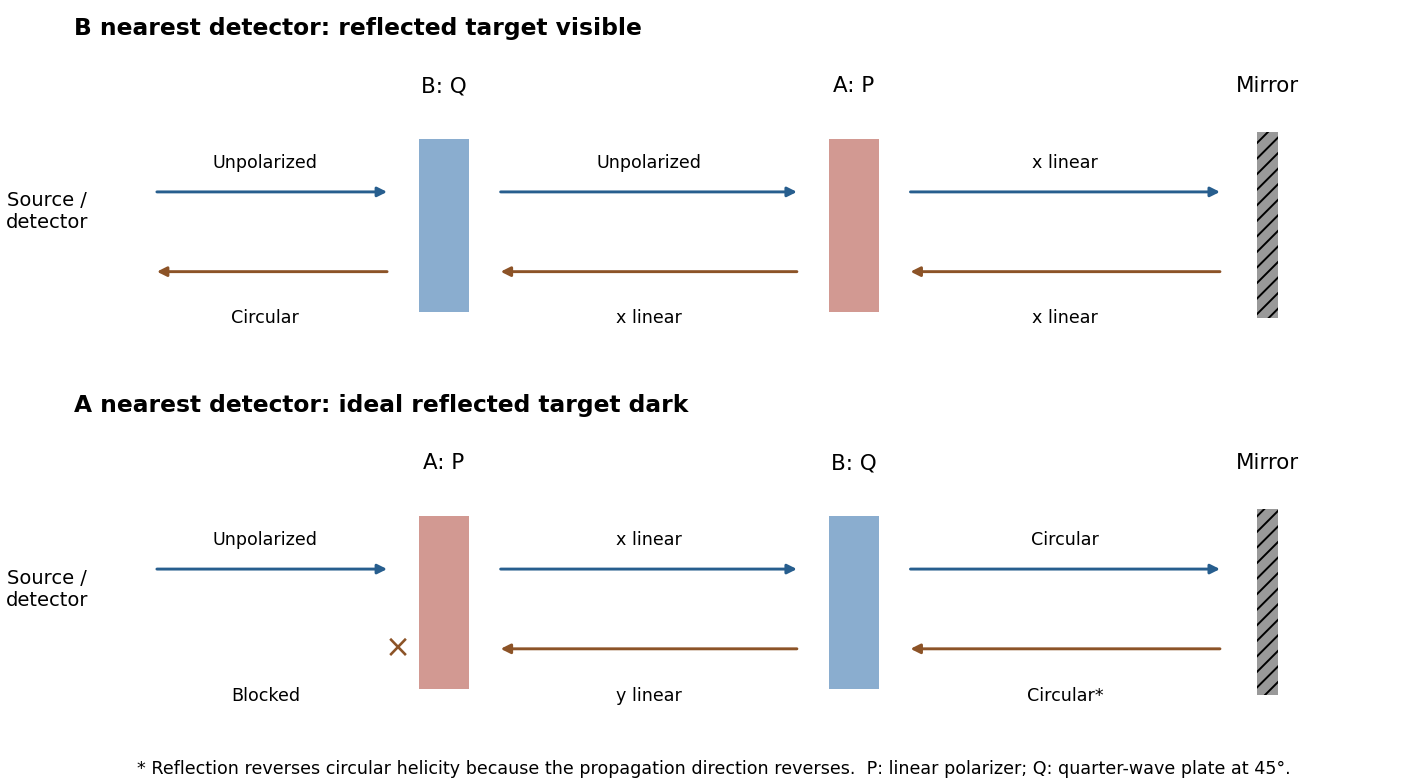
Original outward and return polarization-state diagrams for the two orientations of a polarizer-plus-quarter-wave-plate filter in front of a mirror
. Details. 
With B nearest the observer, light from the reflecting target near the observer first crosses Q and then P on its way to the mirror. Unpolarized light remains unpolarized through Q, then becomes x linear after P. Mirror reflection preserves that linear orientation. On return it passes the same P without further ideal rejection and then Q, becoming circular toward the observer. Thus the reflected target remains visible.
Algebraically, with input and output at the observer side,The target here is used only as a source/reflector of ordinary unpolarized light; no physiological model is involved.
With A nearest the observer, the outward order is P then Q. The initially unpolarized light becomes x linear, then circular, before reaching the mirror. Reflection reverses its helicity. Its return through Q gives y linear, which is blocked by P:Hence the ideal reflected filter is dark and the target cannot be seen through it. This is a double-pass polarization rejection effect, not unequal one-pass transmission from its two sides. Real mirrors at oblique incidence, imperfect retardance, finite bandwidth and depolarization can leave leakage.
A Hertzian dipole is an ideal localized oscillating source much smaller than its radiation wavelength. Its electric version is an infinitesimal current element; its magnetic version is a small current loop with moment . Such elements model the far-field radiation and radiation resistance of electrically small antennas. The approximation requires source dimensions much smaller than .
The supplied magnetic field has a quasistatic term, an induction term and a transverse radiation term. The electric field has induction and radiation terms. Brackets mean evaluation at the retarded time , not a time average. Near terms mainly exchange stored energy; only the fields give a nonvanishing outgoing power integral as .
For a fixed dipole axis the radiation fields satisfy . The radial Poynting flux is thereforeUsing yieldsFor a general changing dipole direction, replace the squared scalar acceleration by .
Radiation resistance is the equivalent input resistance whose mean power equals radiated power, not ohmic heating. For a fixed small loop carrying , , soThis uses peak current ; with rms current the power is .
The satellite loop needs its changing orientation as well as its induced current. Put the spin axis along z, the external field along x, and let . With and resistance , the resistance-only approximation givesWrite . The full magnetic moment isIt has a static component and a rotating component at . Consequently , andHolding the dipole axis fixed while inserting the sinusoidal current would instead give , eight times smaller. That is the fixed-axis-loop result; it does not describe the stated rotating loop. This is frequency doubling of an induction-driven rotating loop; the changing vector direction is essential.
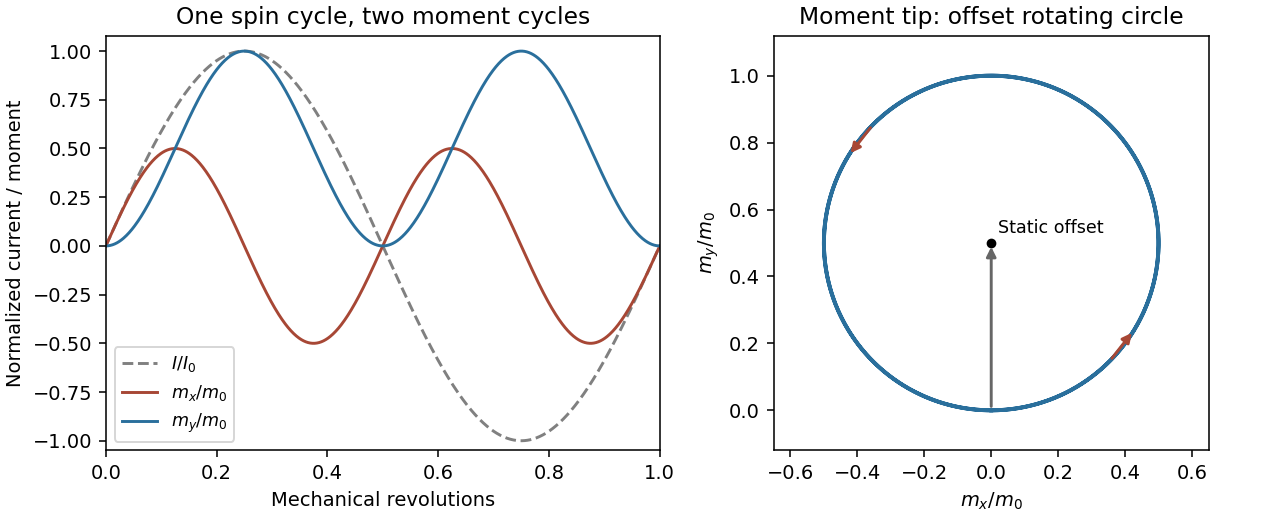
Original calculated rotation-induced current and vector magnetic-moment components, illustrating the static plus twice-spin-frequency decomposition
. Details. 
The resistance-only model is conditional: loop inductance is not supplied. If self-inductance L matters, solve . In the steady state . Its phase changes the static moment direction but not the twice-frequency component's magnitude, so the power becomesThe first expression is the requested resistive idealization and an upper estimate within this passive RL correction. Radiation reaction is negligible compared with the stipulated ohmic resistance. The radiated energy comes from rotational kinetic energy: the induced magnetic torque brakes the loop. Most lost rotational energy is Joule heating; a small part escapes as radiation. Maintaining a constant spin would require external mechanical power.
For scale only, take , a representative near-Earth field rather than a supplied orbital measurement. The terrestrial surface range reported by NOAA is roughly –; the actual orbital value depends on position.[ref]
Geomagnetism Frequently Asked Questions by National Oceanic and Atmospheric Administration. What are the magnetic elements? Total field intensity range
With and , the resistance-only model givesInductance would reduce this power. The kilohertz signal is exceptionally weak and a metre-scale receiving antenna is electrically tiny. Ionospheric absorption/reflection and strong natural or instrumental low-frequency backgrounds make ordinary ground reception impractical. This is not a theorem that the ionosphere blocks every low-frequency mode: field-guided propagation and condition-dependent leakage are real, as the VIPER mission's measurements were designed to test.[ref]NASA Rocket Mission Studying Escaping Radio Waves by National Aeronautics and Space Administration. VIPER description: absorption/reflection layers and condition-dependent trans-ionospheric propagation
At a separation , , so the observer is not securely in the far field. The radiation term alone has at most the characteristic magnetic amplitudein this optimistic resistance-only vacuum model. Near and induction fields must be retained for a full prediction; a simple far-field inverse-square power estimate is not an exact received signal here. Another satellite avoids the whole ground ionospheric path, but plasma propagation, receiving sensitivity, bandwidth, orientation, integration time and spacecraft noise remain unspecified. Detection is not forbidden in principle, but routine practical detection is implausible at this scale; a definitive instrument-level yes/no does not follow from the supplied data.
Articles by others on the same topic
There are currently no matching articles.