Use retarded time and reserve for the large observation distance. The source velocity is nonrelativistic, . There are two errors in the original PDF that must be corrected before the radiation zone calculation: the vector-potential prefactor contains an extraneous , and the displayed magnetic radiation field has the wrong sign for the stated outward unit vector . The extra distance factor is dimensionally wrong; the magnetic sign would make the Poynting vector point inward. The following derivation uses dimensionally consistent retarded potentials and outgoing radiation.
The consistent Liénard–Wiechert potential obeys . To first order in , its large-distance form isTerms varying as give near fields and are negligible for the radiated power at large . Keep the first-order velocity term in : although small, its retarded-time derivative contributes a leading acceleration field. To the required order, and . Holding the observation direction fixed at leading order givesThus the outgoing electric field is transverse:Here . The magnetic field follows from , or from the outgoing plane electromagnetic wave relation:The minus sign is essential. Both fields fall as , are mutually orthogonal and obey . The corresponding Liénard-Wiechert field also contains nonradiative terms, omitted in this leading far-field calculation.
Since , the Poynting vector isThe area on a distant sphere corresponding to solid angle is . ConsequentlyThe average is over the source motion at retarded time. At leading nonrelativistic order, differences between source-time and reception-time averaging are beyond the approximation. The units are power per solid angle, .
The acceleration covariance in nonrelativistic radiation is another way to organize this result: with , the angular factor is . Integrating over all observation directions uses and gives the averaged Larmor formula, .
For the prescribed displacement along , the source acceleration is . If is the angle from the axis, . Averaging over one wave period givesThe angular distribution of electric dipole radiation has zero intensity on the oscillation axis and maximum intensity in the equatorial plane, with no azimuthal dependence. Its total power isThe condition is the required nonrelativistic condition. The plotted radial coordinate below is angular power, rather than field wave amplitude.
Denote the orbit radius by here to distinguish it from observation distance; it is the quantity called in this part of the paper. WriteFor observation at spherical coordinates , measured from the orbit normal,The acceleration magnitude is constant, . Therefore the radiation pattern of a circularly moving nonrelativistic charge isTime averaging removes the azimuthal dependence. The axial intensity is twice the equatorial intensity, and no direction has zero mean intensity: the instantaneous dipole axis continually rotates. This is also the sum of the two orthogonal linear-oscillation patterns with their relative phase quadrature. At equal radius and linear-oscillation amplitude, the total mean power is twice the linear result. The calculation requires ; relativistic synchrotron radiation is outside this approximation.
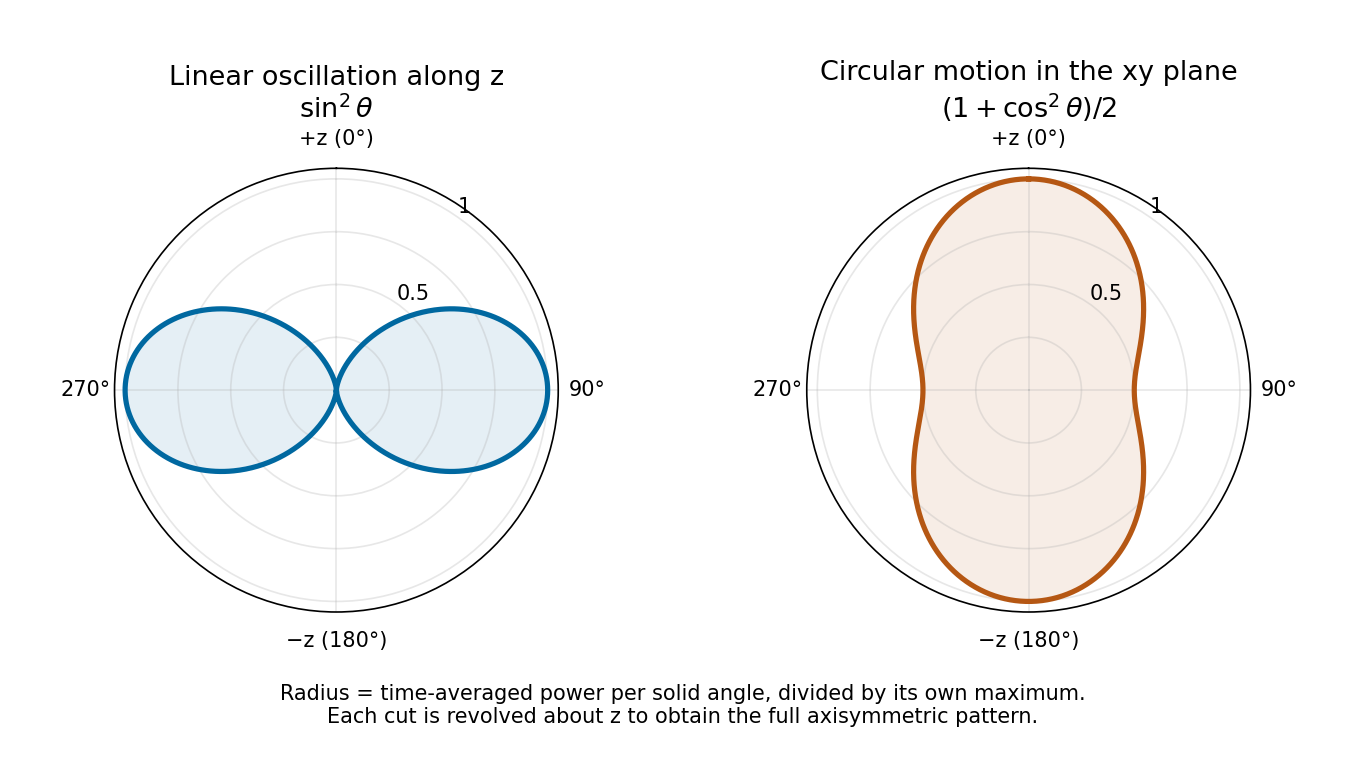
Normalized angular power for linear oscillation and nonrelativistic circular motion, with angle measured from the same z axis
. Details. 
Articles by others on the same topic
There are currently no matching articles.