Let , with at both endpoints. At an extremal the first variation is zero:Integrate the second term by parts once and the third term twice. The boundary term isThe given fundamental lemma therefore givesThis is the classical form under the usual smoothness hypotheses ensuring the displayed derivatives exist; without that extra regularity the variation first yields its distributional form.
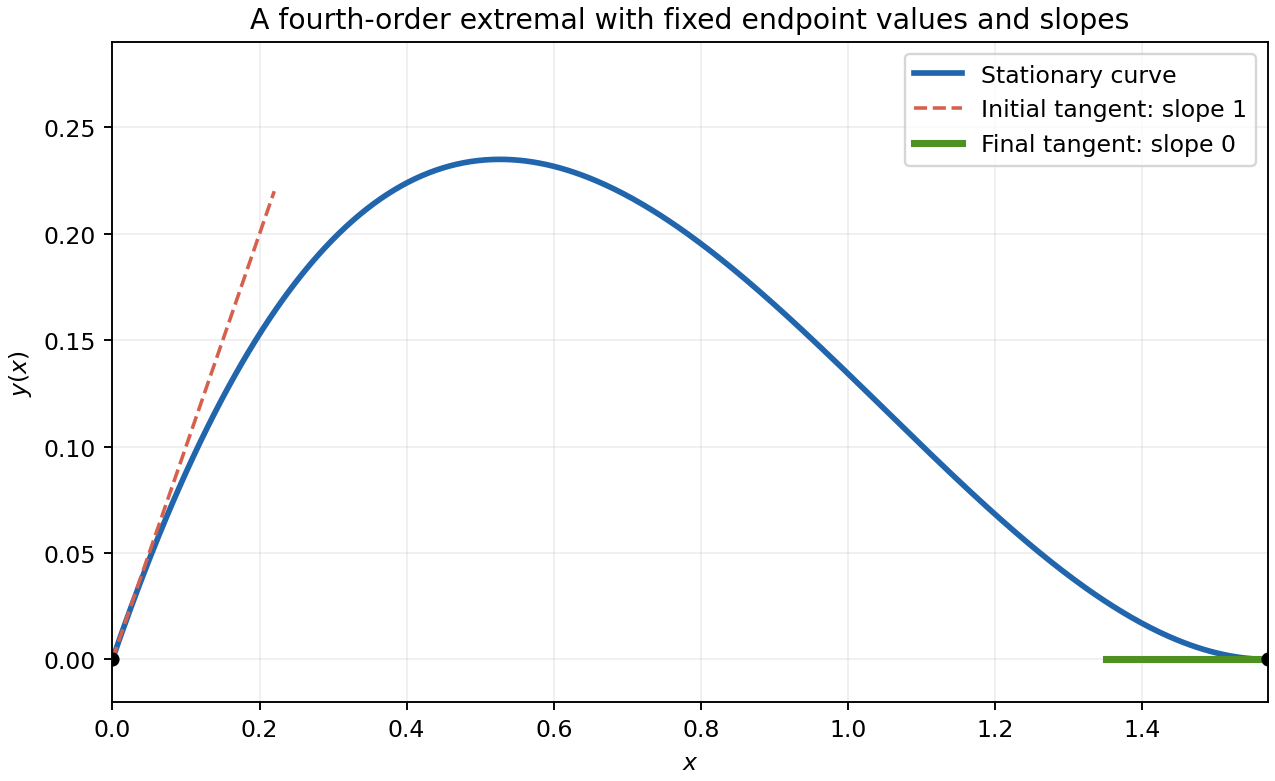
For the concrete functional the equation is . Write , and . A general solution is . The two initial conditions give and . The final derivative condition gives , and the final value condition then gives . Thus an extremal isIt solves the differential equation, has initial value zero and initial derivative one, and at both its value and derivative vanish, using . These checks verify all four prescribed endpoint conditions.

Articles by others on the same topic
There are currently no matching articles.