The initial table of content was limited to the first level because it is larger than 1000 articles. There are 1118 articles in total. Expand a branch to load its children.
The degree of a field extension is the dimension of the larger field as a vector space over the smaller one:The field extension is a finite field extension precisely when this dimension is finite, equivalently when finitely many elements of span over . Finiteness here concerns the dimension, not the number of elements of the fields; for example, has degree two over although both fields are infinite.
Let . The intermediate field is an -linear linear subspace of , so the finite-dimensional linear subspace theorem gives . To handle the other field extension, take an -basis of . Every is a sum with , so the same list spans as a -vector space. It need not remain linearly independent, but spanning suffices to give . Hence both intermediate extensions are finite.
The tower law for field extensions states that, for with both successive degrees finite,Indeed, if form an -basis of and form a -basis of , their products form an -basis of : expansion gives spanning, and independence follows first over and then over .
Starting from a unit segment, every straightedge and compass construction introduces coordinates by solving linear or quadratic equations over the coordinates already available. Thus a constructible number belongs to a tower of field extensions whose successive degrees are one or two; the total degree is a power of two. Doubling the volume of a unit cube would require the edge length . Its minimal polynomial over is , irreducible by Eisenstein's criterion at the prime number two. Thus . If that number lay in a construction field of degree , the tower law would make three divide , a contradiction. Therefore doubling the cube by straightedge and compass is impossible.
An isometry of the Euclidean plane is a map preserving all Euclidean distances, . Such a map of the whole plane is automatically bijective, and has the form with an orthogonal matrix.
The classification is identity, translations, rotations about a point, reflections in a line, and glide reflections. Here a glide reflection is a reflection followed by a nonzero translation parallel to its mirror. The cases preserving orientation have and are translations or rotations; the orientation-reversing cases have and are reflections or glide reflections. The identity is included by allowing a zero translation or rotation angle.
Put and . They are nonzero vectors with the same Euclidean norm. Choose the rotation matrix taking the direction to ; equal lengths then give . DefineThis is a translation by followed by a rotation about , so it is an isometry. Direct substitution gives and .
First use the preceding isometry to align the first two points, and put . It remains to align with while fixing . Use orthonormal coordinates in which and , , and write , . The prescribed distances giveSubtracting yields , and then . Therefore is either or its reflection across the line through . In the first case take ; in the second compose with that reflection. Both constructions fix the first two images and send the third point to its required image. The argument also covers three collinear points, when the two possible third images coincide. Thus all three points can be matched by one plane isometry.
Euler's totient function isEuler's theorem states that implies . For , let be the invertible residue classes modulo . Multiplication by permutes these classes, since it has an inverse modulo . Multiplying the resulting congruences givesEvery factor is a unit, so the product can be cancelled, proving the theorem. The case is immediate. For distinct prime numbers , removing multiples of either prime from gives
For the RSA cryptosystem, choose distinct large primes , put , and choose coprime to . Compute with . The public key is ; the private exponent is retained secretly. Represent a message by , encrypt by , and decrypt by .
To prove correct decryption even for messages not coprime to , write . Modulo , if then ; otherwise Fermat's little theorem gives . The same reasoning holds modulo . The Chinese remainder theorem therefore gives , and the chosen representative recovers . Thus decryption works for every message residue, not merely the units.
For a nonnegative measurable function, the Lebesgue integral is defined through nonnegative simple functions:The value may be infinite. A real measurable is Lebesgue integrable when ; then , where and .
If , every simple function below is also below . Taking the defining suprema proves monotonicity of the Lebesgue integral:Hence is integrable, and both its positive and negative parts have finite integrals.
The oscillatory function is measurable because it is continuous off the singleton and has a specified value there. The elementary bounds give the integrable majorantIndeed, . The comparison just proved gives , so is Lebesgue integrable over the whole real line, despite its oscillations near zero. Its odd symmetry also gives , now legitimately because absolute integrability has been established.
Fubini's theorem states that an absolutely integrable measurable function on a product of two -finite measure spaces has integrable sections almost everywhere, the corresponding iterated integrals exist, and both orders equal its product integral. In particular, for ,To establish integrability of the nonnegative function here, first use Tonelli's theorem: for a nonnegative measurable function the product integral equals either iterated integral with infinity allowed. This avoids assuming the conclusion needed for Fubini's theorem.
If , for every fixed . If , it isThe outer integral is finite exactly when , that is, . In that caseFor the outer integral diverges, including logarithmic divergence at . Nonnegativity means finiteness of this integral is exactly absolute integrability; after proving it, Fubini's theorem allows either order.
A basis of a topology is a collection such that every open set is a union of members of . Equivalently, for each open and every , there exists with . The empty union represents the empty set. In particular, the basis covers , and any intersection of two basis elements is itself a union of basis elements.
The following open rectangles form a basis of a topology for the product topology:These open rectangles in a finite product cover , and intersections remain rectangles since . One may equivalently take products of elements from a chosen basis of a topology in each factor.
Choose , using its nonemptiness. For each , the openness of in the product topology supplies open , such thatSince , every point of belongs to . Thus is open. Interchanging the factors, using a fixed , proves open. Therefore . Nonemptiness matters: an empty product is open whatever the other factor is.
Yes: at least one factor topology must be indiscrete. Suppose instead that both have a nonempty proper open set, say and . Thenis open in the product topology. Both coordinate projections of are the full factors, because are nonempty. If were a rectangle , this would force , , hence . But choosing and gives , a contradiction. Thus both factors cannot have nontrivial open sets. This is rectangularity of every product-open set.
Let send each point to its equivalence class. The quotient topology isIt is the finest topology on the quotient set making the canonical surjection continuous. The preimage test, rather than a choice of representatives, defines its open sets.
Use the equivalence relation of belonging to the same fibre:The map , , is well defined, injective by the definition of the relation, and surjective because is surjective. It is continuous by the quotient topology: for open , is open.
The quotient space is compact as the continuous image of compact , and is Hausdorff. The compact-to-Hausdorff continuous bijection theorem makes a homeomorphism. Indeed, images of closed subsets of a compact space are compact and hence closed in a Hausdorff space, so the inverse is continuous.
Collapse the equator to one point and identify no other points:Each closed hemisphere is a disk; collapsing its boundary gives a sphere. The two boundaries are the same equator, so the resulting spheres meet at the single collapsed point. This is the sphere with its equator collapsed.
An explicit verification avoids relying only on the picture. Away from the poles, use and defineAt the north and south poles use and , respectively. The angular terms tend uniformly to zero at both poles, making these extensions continuous. Both hemisphere formulas agree at the equator, with value . Their images lie on the two specified unit spheres and cover them; away from the common origin the height parameter and angle are recovered uniquely. Thus the fibres are exactly the stated equivalence classes. The preceding compact-to-Hausdorff argument gives .
The total derivative of at is a linear map satisfyingThe gradient is the vector of partial derivatives, . When is totally differentiable, these partial derivatives exist andThus the derivative is a linear functional represented by the gradient under the Euclidean inner product. Existence of partial derivatives alone does not imply total differentiability.
The denominator is positive on because . The quotient rule gives the gradientIn particular is continuously differentiable throughout .
The scalar-valued multivariable mean value theorem states that, if is differentiable on an open set containing the closed line segment from to , then for there exists such thatThis follows by applying the one-dimensional mean value theorem to on . The segment condition is necessary for this formulation on a possibly nonconvex domain.
For every , and . Consequently each of the three partial derivatives in the preceding gradient has absolute value below , soThe segment joining lies inside . The mean value theorem and Cauchy-Schwarz inequality therefore giveFor both sides vanish. This proves the required Lipschitz continuity uniformly on the ball.
A diffeomorphism is a bijection for which both and are continuously differentiable. If a higher regularity class is specified, both maps must belong to that class. In particular, a diffeomorphism is a homeomorphism, and the chain rule gives .
The inverse function theorem states: let be , with open, and suppose is invertible. Then there exist open neighbourhoods of and of such that is a diffeomorphism. Its inverse derivative satisfiesThe conclusion is local; invertibility of one Jacobian matrix does not assert global injectivity.
The map is on the open ball . Its Jacobian matrix isAt the origin and . The inverse function theorem therefore supplies the required open sets and , both containing zero, with a diffeomorphism. The explicit inverse formula on its image,also checks the local conclusion directly.
Take independent smooth variations and . Differentiating the functional and using integration by parts gives its first variationFirst choose variations vanishing at the endpoints. To use the stated form of the fundamental lemma of the calculus of variations, take with arbitrary smooth , and similarly for . The lemma makes vanish, and hence makes the unweighted coefficient vanish in the interior; continuity extends this to the endpoints. Applying the same argument to gives the Euler-Lagrange equationsIf either endpoint value of or is free, the corresponding variation there is arbitrary. The remaining boundary term gives the natural boundary conditions for a free endpoint: for a free value and for a free value at that endpoint. With both coordinates free at both endpoints, all four conditions apply.
For the specified integrand these equations reduce toand the natural conditions are at each free endpoint. Eliminating givesIts four independent modes give the full general solutionAt zero, and . Vanishing forces , givingAt the two derivative conditions become and . Their coefficient determinant is nonzero, so . Thus the unique stationary extremal with all four natural boundary conditions is . The word extremal here means a stationary point of the functional; the indefinite integrand does not require this point to be a minimum.
Let be distance along the rod from its fixed end. The position of that material point is , where is a unit vector. Its velocity is , and direct differentiation givesThe uniform linear mass density is . Integrating the elemental kinetic energy therefore proves, rather than assumes, the rod formula:Equivalently, its moment of inertia about a perpendicular axis through the pivot is .
The centre of mass is at height . With gravitational potential energy zero at the pivot level,Hence the Lagrangian isAdding a constant to the potential would change the numerical energy reference but would not change the motion.
For an autonomous Lagrangian, the Euler-Lagrange equations implyIndeed, differentiating the expression cancels the acceleration terms, leaving , which vanishes. Here is quadratic in the velocities, so . Thus the conserved energy isThe azimuth is a cyclic coordinate. Its conjugate momentum is constant:Therefore is constant as well. Physically, is the vertical component of angular momentum.
Away from the coordinate poles, use in the conserved energy:Rearranging gives the first-order equationWhere the right side is positive, either sign of its square root is possible, according to the direction of motion. Its zeros are turning points. For , the centrifugal term excludes the poles; if , the polar-coordinate formula is interpreted through the original rod equations.
The polar Euler-Lagrange equation isFor a constant angle with , conservation of makes constant, say . The remaining equation isIf , every nonvertical constant-angle motion is a conical pendulum motion:The rod sweeps out a cone about the downward vertical, in either azimuthal direction. Equivalently, . The exactly downward and exactly upward vertical rods are also static solutions; azimuth has no physical meaning at either pole. No static tilted rod is possible under nonzero gravity.
If , the condition is . Thus a rod may remain at rest in any orientation, or rotate uniformly in the horizontal plane with and arbitrary constant . The vertical cases are included among static orientations; changing only their azimuth does not move the rod.
The Time-dependent Schrödinger equation isA stationary state of energy has a wavefunction , whereIts time dependence is only a global phase, and its probability density is independent of time.
Put . Logarithmic differentiation givesThereforeso the appropriate potential energy is . The wavefunction never vanishes, so no other time-independent potential gives the same equation for this precise phase choice.
The squared modulus isIt changes width and height with time, so this is not a stationary state. Its integral is the constant ; multiplying the wavefunction by normalizes it. The normalized Gaussian wave packet stays centred at zero but spreads, with position variance . It represents a localized free particle with a spread of momenta, rather than an energy eigenstate. Free Gaussian wave packet evolution broadens the packet even with zero mean momentum.
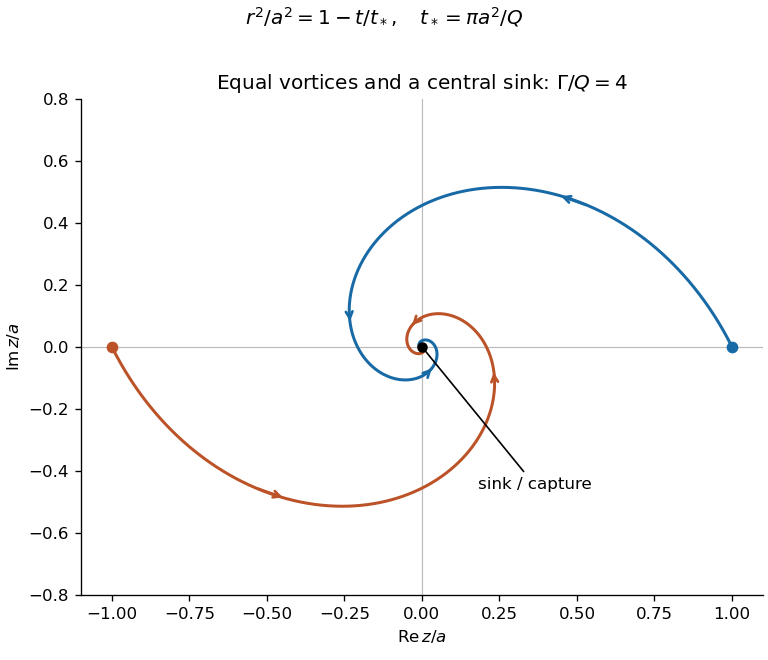
Use the complex potential of a two-dimensional potential flow convention , for which . A positive circulation is counterclockwise. The two point vortices and the two-dimensional point sink giveBranch choices change additive constants, not the local velocity field. A vortex is transported by the nonsingular velocity due to the other vortex and the sink; its own singular term is omitted. At this givesThe other vortex follows by symmetry. Put , with and . Multiplication by givesFor , integration yieldsEquivalently, with ,The curves obey , so they are logarithmic spirals. At , both vortices reach the sink at the origin. For nonzero circulation they make infinitely many turns in that finite time; for zero circulation they approach radially. The point-vortex evolution becomes singular at capture, so the formula does not define a regular continuation through the event.

Put and take the positive-frequency branch for . The phase velocity and group velocity areSince the square root is increasing, minimizing is equivalent to minimizing . Its derivative is , which changes sign from negative to positive atThe phase speed diverges at both positive endpoints and , so this stationary point is its global minimum. At , , givingThe relative speed is especially transparent:A narrow wave packet moves with , while its crests move with . For , : crests move forward through the packet, from its rear towards its front. For , : crests drift backwards relative to the packet, although both absolute velocities are positive. At the leading-order relative drift vanishes. This is the minimum phase speed of a gravity-capillary wave.
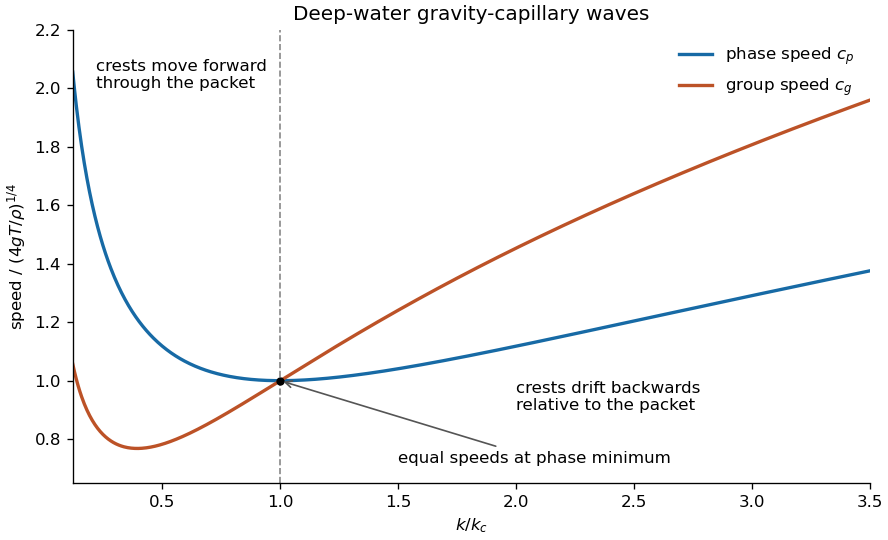
Phase and group speeds cross at the minimum phase speed; crest drift relative to the packet reverses there
. Details. 
A Poisson process has a Poisson distribution for the count in an interval of length , with mean equal to rate times length. Fifteen minutes is hour, so
The first arrival time , measured in hours after opening, has exponential distribution of rate twelve. ThereforeEquivalently, there must be no arrivals in the first quarter hour and at least one in the next; independent increments give .
Let and be the interarrival times adjacent to the second arrival. They are independent exponential random variables of rate twelve per hour. The second customer meets the first if hour, and meets a later customer if hour. If the third arrives too late, every subsequent customer does also. Thus the only way to meet nobody is for both gaps to be at least five minutes:Hence . Exact equality of arrival and departure times has probability zero. The calculation includes both customers already present and customers arriving during the visit; it is a two-sided interarrival test for overlap.
Independent marking with probability is Poisson thinning and gives a Poisson process of chip-buying arrivals, of rate per hour. Its first arrival time therefore satisfiesFor example, its survival probability is , which also derives the thinning conclusion directly.
Articles were limited to the first 100 out of 1118 total.
Articles by others on the same topic
There are currently no matching articles.