The Lagrange interpolation polynomialhas degree at most and takes the required value at each node, proving existence. If two such polynomials existed, their difference would have distinct roots despite degree at most , so it would vanish identically. This proves uniqueness.
Define . It has degree at most . At its value is , and at it is . At every interior node both and equal , giving . Uniqueness therefore givesIf the data come from with , uniqueness gives . If , that same polynomial has degree at most and satisfies each smaller interpolation problem, so .
For the final claim assume . Put . Its node values are , for , and . The linear spline joining these values has a ramp on the first interval, is zero on all middle intervals, and has a ramp on the last. ThusOn each node interval is constant and vanishes at both ends. Hence on that interval. Integrating the supplied identity and summing giveswhich proves the claimed inequality and the minimum Dirichlet energy of a linear interpolant.
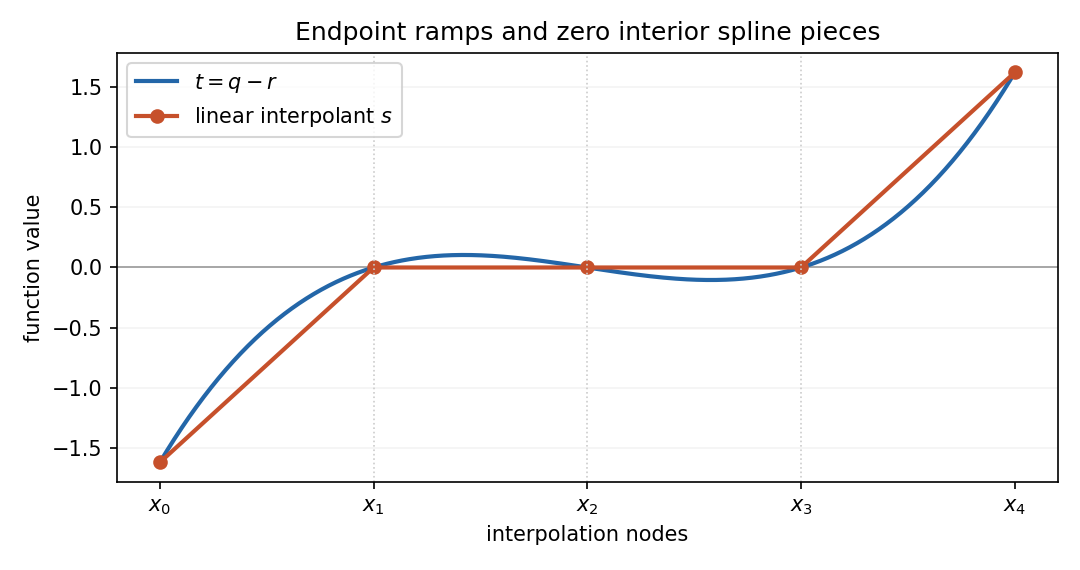

There is a source exception: with , and , so is constant and the left side of the asserted bound is zero. If , its right side is . Thus the final inequality requires , although the preceding interpolation statements remain valid for .
Articles by others on the same topic
There are currently no matching articles.