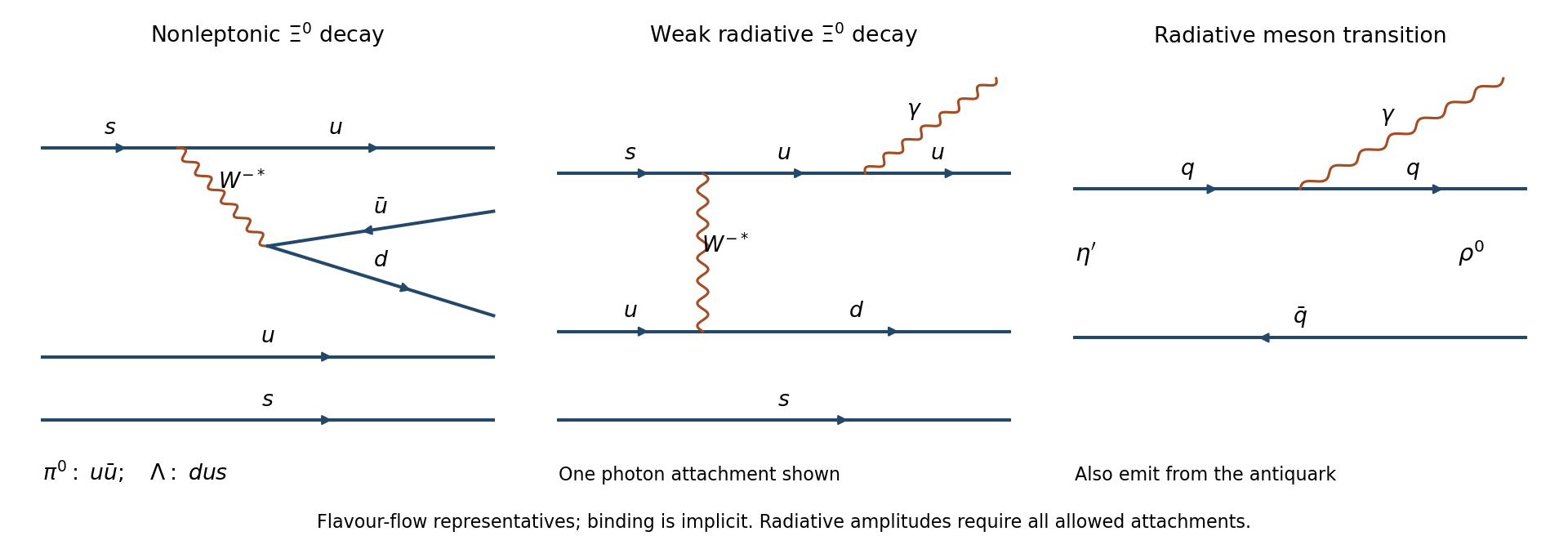
The initial strangeness is . The final state has strangeness , so its allowed nonleptonic amplitude is weak. One representative topology is followed by ; spectator combine with the produced into the , while contributes to the neutral pion. The available rest energy is .
The state would conserve strangeness and could have a strong vertex, but its threshold exceeds the parent mass by . It is kinematically forbidden. Coupling strength cannot rescue a closed decay channel.
The radiative channel also changes strangeness. It is a weak radiative hyperon decay, not an ordinary electromagnetic decay between states of the same flavour. A representative two-quark contribution is W exchange with a photon attached to a charged line; the other allowed attachments, hadronic intermediate states and short-distance loop contributions must be included for a complete amplitude. Its extra electromagnetic coupling and hadronic dynamics suppress it relative to the nonleptonic channel. ConsequentlyNA48 Collaboration measured a radiative branching fraction of about , corroborating the suppression rather than a purely electromagnetic interpretation.[ref]

Articles by others on the same topic
There are currently no matching articles.