Using the two-frequency approximation in a and in kilometres, the survival probability isThe slow coefficient is ; the fast one is . Since has period , the two individual oscillation periods areThe first broad trough is near km and the second near km; the slow component returns to its crest near km. Small, rapid ripples of depth about sit on the broad envelope. Averaging over unresolved fast oscillations replaces their squared sine by , giving .
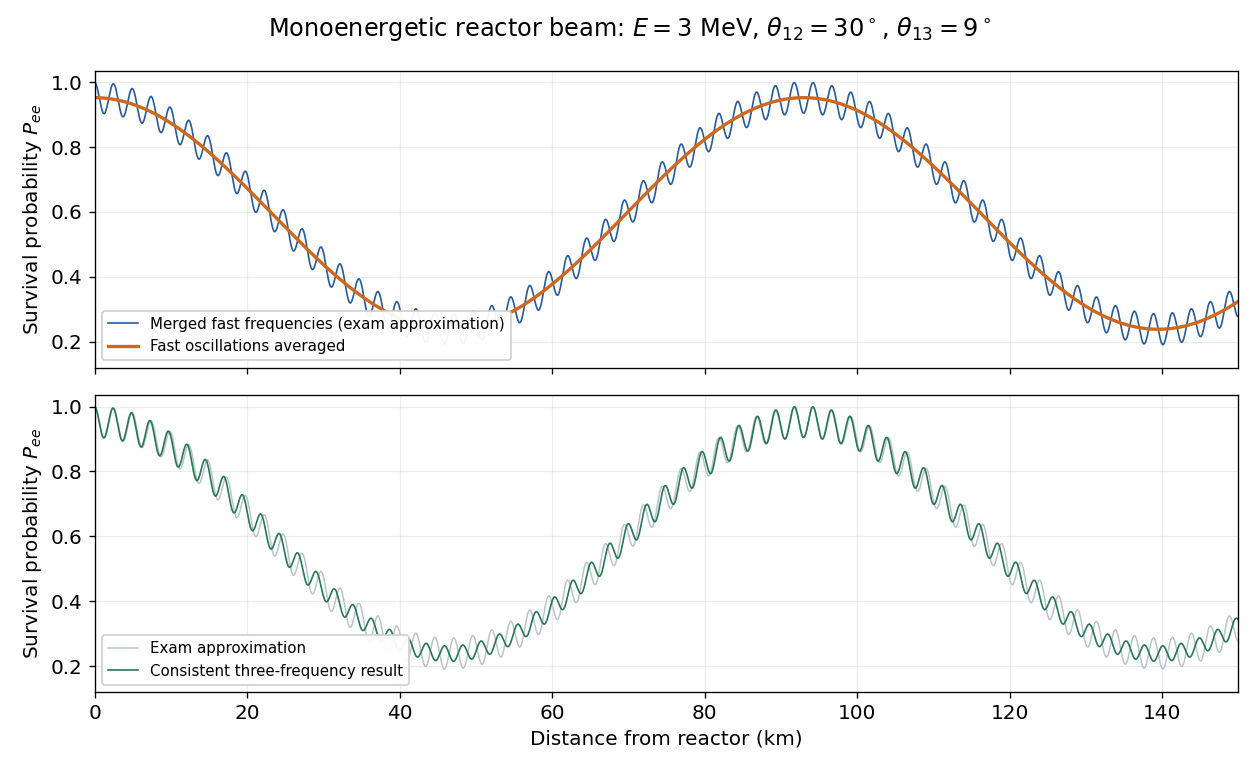
Reactor survival probability and the limits of merging the fast frequencies
. Details. 
There is no single short period for the combined curve. If the supplied ratio is taken as exact, its mathematical common period is km, outside the plotted range; the approximate physical data do not warrant interpreting that commensurability as exact.
The figure also shows the unmerged expressionFor that comparison take and enforce the identity , with a consistent sign convention. This illustrates the limitation identified in a: the simplified envelope is useful, but its individual fast ripples need not match the three-frequency result over 150 km. The supplied has no effect on vacuum electron-flavour disappearance.
Articles by others on the same topic
There are currently no matching articles.