The lepton mixing matrix is unitary, so each row has unit norm. Explicitly its electron row obeyswhere and . This is also the normalization needed for unit electron neutrino survival at .
Use and define in natural units. The exact vacuum neutrino oscillation result becomesThe given mass-squared differences satisfy , so the two fast oscillation frequencies are close: . Approximating their phases as equal combines their coefficients intowhile . HenceThe complex CP phase cancels from every . The phase-replacement approximation is uniformly reliable for , especially at short reactor baselines; closeness of the mass-squared differences alone does not guarantee close sine values at arbitrarily large . At medium baselines the distinct fast frequencies can beat, so the exact three-frequency expression is preferable if their detailed pattern matters.
Restoring units in the oscillation phase gives . With , one kilometre is . ThusHere denotes the coefficient in . The familiar applies when is in GeV, not MeV. Strictly, the dimensionless definition keeps once the already include the unit conversion. The intended numerical question concerns the practical coefficient multiplying the numerical values of .
Using the two-frequency approximation in a and in kilometres, the survival probability isThe slow coefficient is ; the fast one is . Since has period , the two individual oscillation periods areThe first broad trough is near km and the second near km; the slow component returns to its crest near km. Small, rapid ripples of depth about sit on the broad envelope. Averaging over unresolved fast oscillations replaces their squared sine by , giving .
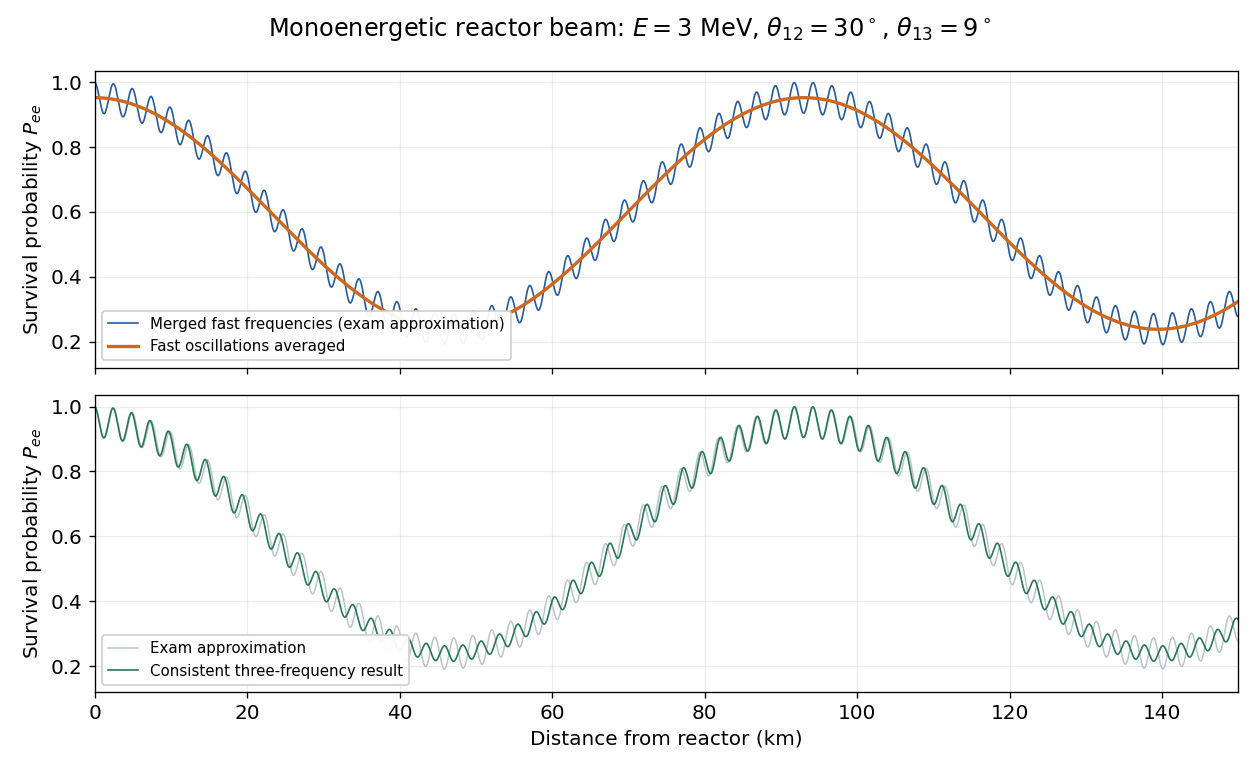
Reactor survival probability and the limits of merging the fast frequencies
. Details. 
There is no single short period for the combined curve. If the supplied ratio is taken as exact, its mathematical common period is km, outside the plotted range; the approximate physical data do not warrant interpreting that commensurability as exact.
The figure also shows the unmerged expressionFor that comparison take and enforce the identity , with a consistent sign convention. This illustrates the limitation identified in a: the simplified envelope is useful, but its individual fast ripples need not match the three-frequency result over 150 km. The supplied has no effect on vacuum electron-flavour disappearance.
For a rate measurement of the small mixing angle , choose the first fast disappearance maximum,A 47 km baseline instead lies near the slow oscillation maximum associated with . Its much lower flux, approximately falling as , and the many fast oscillations washed out by a reactor's broad energy spectrum make it a poor choice for this simple design. A medium-baseline spectral experiment can still constrain neutrino oscillation parameters if it has enough events and resolution; 47 km is not intrinsically useless, but it is not the optimal short-baseline rate experiment. In a, also affects the slow envelope through , so the sensitivity there is not identically zero.
Matched near and far particle detectors are a good design. A near particle detector, close enough that the fast oscillation phase is small, measures the unoscillated reactor spectrum and normalization. A far particle detector near the first fast maximum measures the disappearance. Their appropriately geometry-corrected ratio cancels much of the uncertain reactor flux and common cross section and detection efficiency. Relative calibration, different backgrounds, multiple reactor distances and any residual near-site oscillation still need treatment. The near site should retain enough shielding to suppress cosmic backgrounds.[ref]
Review of Particle Physics by Particle Data Group (2022). Section 14.6.4, Reactor Antineutrinos: relative near/far measurements of the reactor disappearance signal
A fission reactor supplies predominantly electron antineutrinos, with typical energies of a few MeV. Even if they oscillate to muon antineutrinos, producing a real muon through a charged current requires roughly the muon rest energy, over MeV for a free nucleon target. For example,Thus a muon spectrometer cannot observe this appearance channel from a reactor. Measure electron antineutrino disappearance instead, most commonly through inverse beta decay, , using the prompt Positron and delayed neutron signal.
The radiation length is the characteristic length for high-energy electron energy loss by bremsstrahlung; smaller means more radiative loss for the same traversed thickness. To limit that loss, minimize , choosing less material or a larger , rather than minimizing itself. At reactor Positron energies of a few MeV, ionization and subsequent annihilation matter more than high-energy bremsstrahlung. A sufficiently large scintillation counter measures the deposited energy, so containment of the Positron and annihilation photons, light yield and calibration are the relevant design issues.[ref]
Review of Particle Physics by Particle Data Group (2022). Sections 34.4.1–34.4.4: collision losses, radiation length, bremsstrahlung and critical energy
A Positron signal is correct for the reactor's antineutrinos, through inverse beta decay,A true electron neutrino charged current interaction instead produces an electron, for example . This corrects the source's loose use of “neutrino” for the reactor beam.
After slowing, the Positron annihilates with an electron, generally producing two keV photons. The prompt visible energy includes both the Positron kinetic energy and annihilation energy; neglecting the small neutron recoil,A delayed neutron capture supplies a powerful coincidence tag. Detecting only two annihilation photons discards useful prompt energy and does not uniquely identify the charged current event.
The relevant resolution condition is on the oscillation phase, not solely on which mixing angle is being measured. Since ,At the same medium baseline, the fast -dependent ripples have phases about times larger than the slow component. Resolving those ripples therefore requires a much better fractional energy resolution. At 47 km, ; avoiding substantial phase smearing requires a resolution appreciably better than .
However, a short-baseline experiment near 1.24 km and a experiment near 46.5 km each operate near their relevant first maximum, . Their intrinsic fractional phase-resolution requirements are then comparable. The smaller disappearance amplitude demands careful relative calibration and background control, but it does not by itself impose a universally finer energy resolution. The proposal is conditional on baseline and analysis, rather than a general requirement.
In vacuum the electron-flavour survival probability depends only on and the mass-squared differences. Complex conjugation of the lepton mixing matrix therefore leaves it unchanged:Thus a reactor disappearance measurement cannot search for the intrinsic CP violation phase in the standard three-neutrino model. Sensitivity to that phase calls for suitable appearance channels and, usually, comparison of neutrino and antineutrino beams. Matter can produce differences between propagation of neutrinos and antineutrinos; these are not by themselves intrinsic CP violation, and are small for the proposed short reactor baseline.
Articles by others on the same topic
There are currently no matching articles.