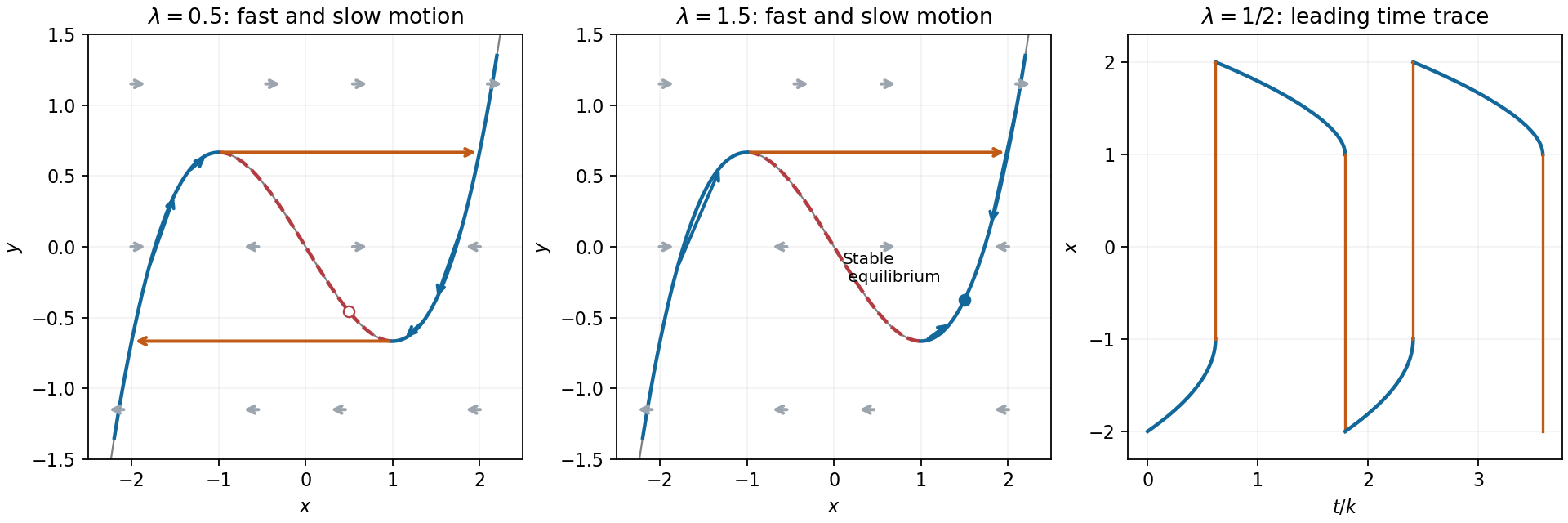
On the fast scale ,Fast trajectories are horizontal. Their equilibria lie on the cubic ; the transverse linearization is , so the outer branches attract and the middle branch repels. On a horizontal line, arrows point right when and left when .
The source prints the slow time as . The slow variable needed here is . With this correction,At leading order andThe reciprocal printed variable would give , rather than the autonomous slow equations used in the stated period formula.
For , the left attracting branch runs from to the fold , where . The horizontal fast jump at this height lands at . The right branch then runs from to the fold , where , followed by a fast jump to . The equilibrium at is on the repelling middle branch. The two slow segments dominate the period:The jump times are negligible on this scale. Substituting in the first integral also gives the compact valueFor , the negative slow segment takes , and the positive one takes . Thus rises slowly from to , jumps to , decreases more slowly to , then jumps back to ; the jumps are nearly vertical in the time trace.
For the fast horizontal field and attracting branches are unchanged. The right slow branch has arrows toward from both directions; the left branch still moves toward and jumps right. The equilibrium is stable, so the large relaxation cycle is replaced by approach to this equilibrium. If , a landing at moves right toward , rather than left. The sketches display the representative case .

Articles by others on the same topic
There are currently no matching articles.